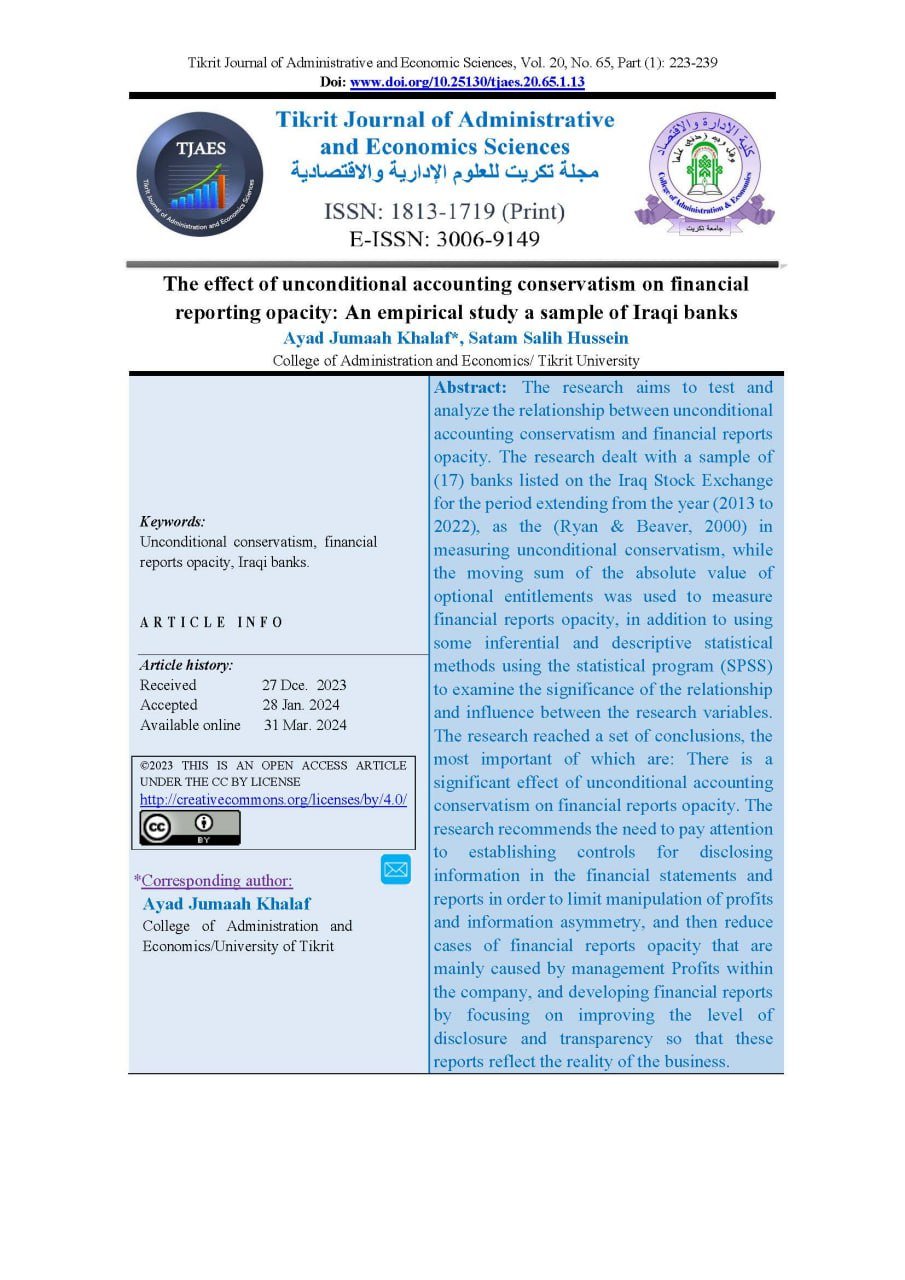
The effect of unconditional accounting conservatism on financial reporting opacity: An empirical study a sample of Iraqi banks
Article Sidebar
THIS IS AN OPEN ACCESS ARTICLE UNDER THE CC BY LICENSE
Main Article Content

Abstract
The research aims to test and analyze the relationship between unconditional accounting conservatism and financial reports opacity. The research dealt with a sample of (17) banks listed on the Iraq Stock Exchange for the period extending from the year (2013 to 2022), as the (Ryan & Beaver, 2000) in measuring unconditional conservatism, while the moving sum of the absolute value of optional entitlements was used to measure financial reports opacity, in addition to using some inferential and descriptive statistical methods using the statistical program (SPSS) to examine the significance of the relationship and influence between the research variables. The research reached a set of conclusions, the most important of which are: There is a significant effect of unconditional accounting conservatism on financial reports opacity. The research recommends the need to pay attention to establishing controls for disclosing information in the financial statements and reports in order to limit manipulation of profits and information asymmetry, and then reduce cases of financial reports opacity that are mainly caused by management Profits within the company, and developing financial reports by focusing on improving the level of disclosure and transparency so that these reports reflect the reality of the business.
Downloads
Article Details
References
اولاً. المصادر العربية:
احمد، نانسي محمد، (2022)، هل يؤثر التحفُّظ المحاسبي على العلاقة بين حوکمة الشرکات والقيمة السوقية للمنشأة. مجلة المحاسبة والمراجعة لاتحاد الجامعات العربية، 11(1)، 418-449.
جبار، ناظم شعلان، (2017)، قياس مستوى ممارسات التحفظ المحاسبي في الشركات المساهمة العراقية وأثارها على جودة الابلاغ المالي في التقارير المالية، مجلة المثنى للعلوم الإدارية والاقتصادية، (2) 7. 107-133.
حسين، احمد حسين علي، (2006)، كتاب القوائم المالية المحاسبية، المكتب الجامعي الحديث، جامعة الاسكندرية- مصر.
حماده، فرحان نحسن، (2018)، تأثير التحفظ المحاسبي في السلوك الاستثماري/ دراسة تحليلية في سوق العراق للأوراق المالية، رسالة ماجستير في المحاسبة غير منشورة، كلية الادارة والاقتصاد، جامعة بغداد- العراق.
السواح، تامر إبراهيم، (2022)، علاقة التحفظ المحاسبي وغموض القوائم المالية بالتجنب الضريبي في ظل الدور المعدل للمسئولية الاجتماعية- دراسة تطبيقية على الشرکات المصرية. المجلة العلمية للدراسات والبحوث المالية والتجارية، 3(2)، 193-306.
شهيد، رزان & عبس، فاطمة محمد شريف، (2018)، قياس التحفظ المحاسبي وبيان أثره في جودة الأرباح المحاسبية" دراسة تطبيقية على سوق دمشق للأوراق المالية". مجلة جامعة القدس للبحوث الاجتماعية. https://dspace.qou.edu/handle/194/1878.
صالح، رنا وليد خالد، (2022)، تأثير استراتيجية الاعمال في التحفظ المحاسبي وانعكاسه في قيمة الشركة/ دراسة تطبيقية على عينة من الشركات المدرجة في سوق العراق للأوراق المالية، رسالة ماجستير في المحاسبة غير منشورة، كلية الادارة والاقتصاد، جامعة تكريت- العراق.
الصاوي، عفت أبوبکر محمد، (2022)، دراسة واختبار تأثير غموض التقارير المالية والخصائص التشغيلية على مخاطر انهيار أسعار أسهم الشرکات المقيدة بالبورصة المصرية. المجلة العلمية للدراسات والبحوث المالية والتجارية، 3(1)، 263-328.
عبد الرحيم، محمد، ي، (2022)، دور التوسع في الإفصاح عن التقديرات المحاسبية في الحد من غموض التقارير المالية، مجلة الاسکندرية للبحوث المحاسبية، 6(3)، 349-396.
عبدالحليم، ناصر محمد.، أبو الخير، مدثر طه السيد، الميهي، عادل عبد الفتاح مصطفى، ... ومحمد، (2022)، قياس التحفظ المحاسبي لعناصر القوائم المالية وأثره على جودة التقارير المالية في ظل تطبيق معايير المحاسبة المصرية: مع دراسة تطبيقية. مجلة البحوث المحاسبية، 9(2)، 1-42.
عبدالخالق، احمد محمد، (2023)، أثر تحليل العلاقة بين التحفظ المحاسبي وإعادة صياغة القوائم المالية ومردودها على جودة اعداد التقارير المالية-دراسة ميدانية. المجلة العلمية للدراسات التجارية والبيئية، 14(1)، 34-76.
عبدالونيس، ايمان محمد، (2020)، قياس أثر تبني المعايير الدولية لإعداد التقارير المالية IFRS على العلاقة بين القدرة الإدارية وتعقد التقارير المالية في الشرکات المتداولة بالبورصة المصرية. الفکر المحاسبي، 24(4)، 1-25.
العبسي، احمد ساجت سالم، (2023)، تأثير التحفظ المحاسبي على وفق (IFRS9) في القدرة الإدارية/ دراسة في عينة من المصارف العراقية، رسالة ماجستير في المحاسبة غير منشورة، كلية الإدارة والاقتصاد- جامعة بغداد- العراق.
علي، سجى عبدالكريم، (2022)، تأثير التحفظ المحاسبي على القيمة الاقتصادية المضافة وانعكاسه على ادارة الارباح/ دراسة تطبيقية في عينة من المصارف العراقية، رسالة ماجستير في المحاسبة غير منشورة، كلية الادارة والاقتصاد، جامعة تكريت- العراق.
علي، سجى، حسين، سطم صالح، (2023) تأثير التحفظ المحاسبي على إدارة الأرباح دراسة في عينة من المصارف العراقية، مجلة تكريت للعلوم الإدارية الاقتصادية، 4(2).
علي، عزيزة رزق محمود، ع. (2019)، أثر التحفظ المحاسبي غير المشروط على ممارسة ادارة الارباح الحقيقية-دراسة تطبيقية على الشرکات المقيدة بسوق الاوراق المالية في مصر. المجلة العلمية للدراسات التجارية والبيئية، 10(العدد الثالث الجزء الثانی)، 290-342.
علي، نيفين صلاح، (2023)، أثر غموض التقارير المالية وجائحة فيروس كورونا على العلاقة بين ميول المستثمرين وخطر انهيار أسعار الأسهم: دراسة تطبيقية على الشركات المقيدة في البورصة المصرية. المجلة العلمية للبحوث التجارية. 51(4)، 717- 772.
غالي، أشرف أحمد محمد، (2018)، قياس أثر مدخل المراجعة المشترکة على العلاقة بين مستوى التحفظ المحاسبي وقيمة الشرکة: دليل تطبيقي من الشرکات المدرجة بالمؤشر المصري EGX 100. الفکر المحاسبى، 22(8)، 1231-1300.
ليلو، رائد محمد علي، (2014)، أثر مستوى التحفظ المحاسبي على جودة التقارير المالية/ دراسة تطبيقية على عينة من الشركات المدرجة في سوق العراق للأوراق المالية. اطروحة دكتوراه في المحاسبة/ غير منشورة، المعهد العالي للدراسات المحاسبية والمالية، جامعة بغداد، العراق.
محمد، دلال محمد إبراهيم، (2022)، التأثير المُعدل لحوکمة الشرکات في علاقة الثقة الإدارية المفرطة بالتحفظ المحاسبي عبر لزوجة التكاليف (دراسة اختبارية على الشرکات الصناعية المسجلة بالبورصة المصرية). المجلة العلمية للدراسات المحاسبية، 4(1)، 160-241.
محمد، س. س، (2022)، أثر التحفظ المحاسبي على الاستقرار المالي: دراسة تطبيقية على عينة من المصارف العراقية، مجلة تكريت للعلوم الإدارية والاقتصادية، 58(18). 1-14.
المشهداني وحميد، بشرى نجم الدين عبد الله، & انمار محسن. (2014). قياس ممارسة التحفظ المحاسبي في الشركات المساهمة المدرجة في سوق العراق للأوراق المالية. مجلة العلوم الادارية والاقتصادية 20(78) 359-359.
النجار، سامح محمد أمين وبسيوني، مروة محمد ماهر، (2023)، أثر العلاقة بين الثقة المفرطة للمديرين التنفيذيين وغموض التقارير المالية على خطر انهيار أسعار أسهم الشركات المقيدة بالبورصة المصرية: دليل تطبيقي. مجلة البحوث المحاسبية، 10(1)، 216-305.
ثانياً. المصادر الأجنبية:
Andreou, P. C., Lambertides, N., & Magidou, M., (2022), A critique of the agency theory viewpoint of stock price crash risk: The opacity and overinvestment channels. British Journal of Management. Vol. 34, 2158–2185.
Basu, S., (2005), Discussion of “Conditional and Unconditional Conservatism: Concepts and modeling”. Review of Accounting Studies, 10, 311-321.
Bushee, B. J., (2012), Discussion of “Financial reporting opacity and informed trading by international institutional investors”. Journal of Accounting and Economics, 54(2-3), 221-228.
Chen, Q., Hemmer, T., & Zhang, Y., (2007), On the relation between conservatism in accounting standards and incentives for earnings management. Journal of Accounting Research, 45(3), 541-565.
Dempsey, S. J., Harrison, D. M., Luchtenberg, K. F., & Seiler, M. J., (2012), Financial opacity and firm performance: the readability of REIT annual reports. The Journal of Real Estate Finance and Economics, 45, 450-470.
Fuad, F., Rohman, A., Yuyetta, E. N. A., & Zulaikha, Z., (2023), How risk and ambiguity affect accounting conservatism. Journal of Financial Reporting and Accounting.1985-2517.
Hejranijamil, M., Hejranijamil, A., & Shekarkhah, J., (2020), Accounting conservatism and uncertainty in business environments; using financial data of listed companies in the Tehran stock exchange. Asian Journal of Accounting Research, 5(2), 179-194.
Hille, J., (2011), Accounting Conservatism: The association Between Bondholder-Shareholder Conflicts Over Dividend Policy and Accounting Conservatism, The Effect on The Cost of Debt and The Influence of The Implementation of IFRS in 2005. Master Thesis in Accounting, Erasmus University Rotterdam.
Jin, J. Y., Kanagaretnam, K., Liu, Y., & Lobo, G. J., (2019), Economic policy uncertainty and bank earnings opacity. Journal of Accounting and Public Policy, 38(3), 199-218.
Kerr, J. N., (2012), The real effects of opacity: Evidence from tax avoidance. Columbia Business School Research Paper, (13-16).
Kothari, S.P., Leone, A.J. and Wasley, C.E., (2005), “Performance matched discretionary accrual measures”, Journal of Accounting and Economics, Vol. 39 No. 1, pp. 163-197.
Kordlouie,H., Mohammadi,F., Naghshineh, N., & Tozandejani, M., (2014), Role of accounting conservatism on the quality of financial statements. International Journal of Business and Management, 9(1), 129.
Lafond, R., & Roychowdhury, S., (2008), Managerial ownership and accounting conservatism. Journal Of Accounting Research, 46(1).
LaGore, W. D. (2008). Conditional and unconditional conservatism following a financial reporting failure: An empirical study. Doctoral dissertation, The Florida State University.
Leune, H., (2014), The impact of the financial crisis on accounting conservatism in the Netherlands. Master Thesis in Accounting, Erasmus School of Economics. Erasmus University Rotterdam.
Orthaus, S., Pelger, C., & Kuhner, C., (2023), The Eternal Debate over Conservatism and Prudence: A Historical Perspective on the Conceptualization of Asymmetry in Financial Accounting Theory. Contemporary Accounting Research, 40(1), 41-88.
Pajuste, A., Poriete, E., & Novickis, R., (2020), Management reporting complexity and earnings management: evidence from the Baltic markets. Baltic Journal of Management, 16(1),47-69.
Platikanova, P., & Soonawalla, K., (2020), Who monitors opaque borrowers? Debt specialisation, institutional ownership, and information opacity. Accounting & Finance, 60(2), 1867-1904.
Ruch, G. W., & Taylor, G., (2015), Accounting conservatism: A review of the literature. Journal of Accounting Literature, 34(1), 17-38.
Yu, Z. (2022). Financial Report Readability and Accounting Conservatism. Journal of Risk and Financial Management, 15(10).
Malau, M., Murwaningsari, E., & Mayangsari, S., (2020), Prudence Measurement Is Moderating Earning Opacity, information asymmetry, and earning informativeness on cost of capital three factors model. International Journal of Business, Economics and Law, 21(5), 37-46.
Yupeng, Lin., (2014), Zombie lending, financial reporting opacity and contagion. Master Thesis in Accounting, National University of Singa-pore.