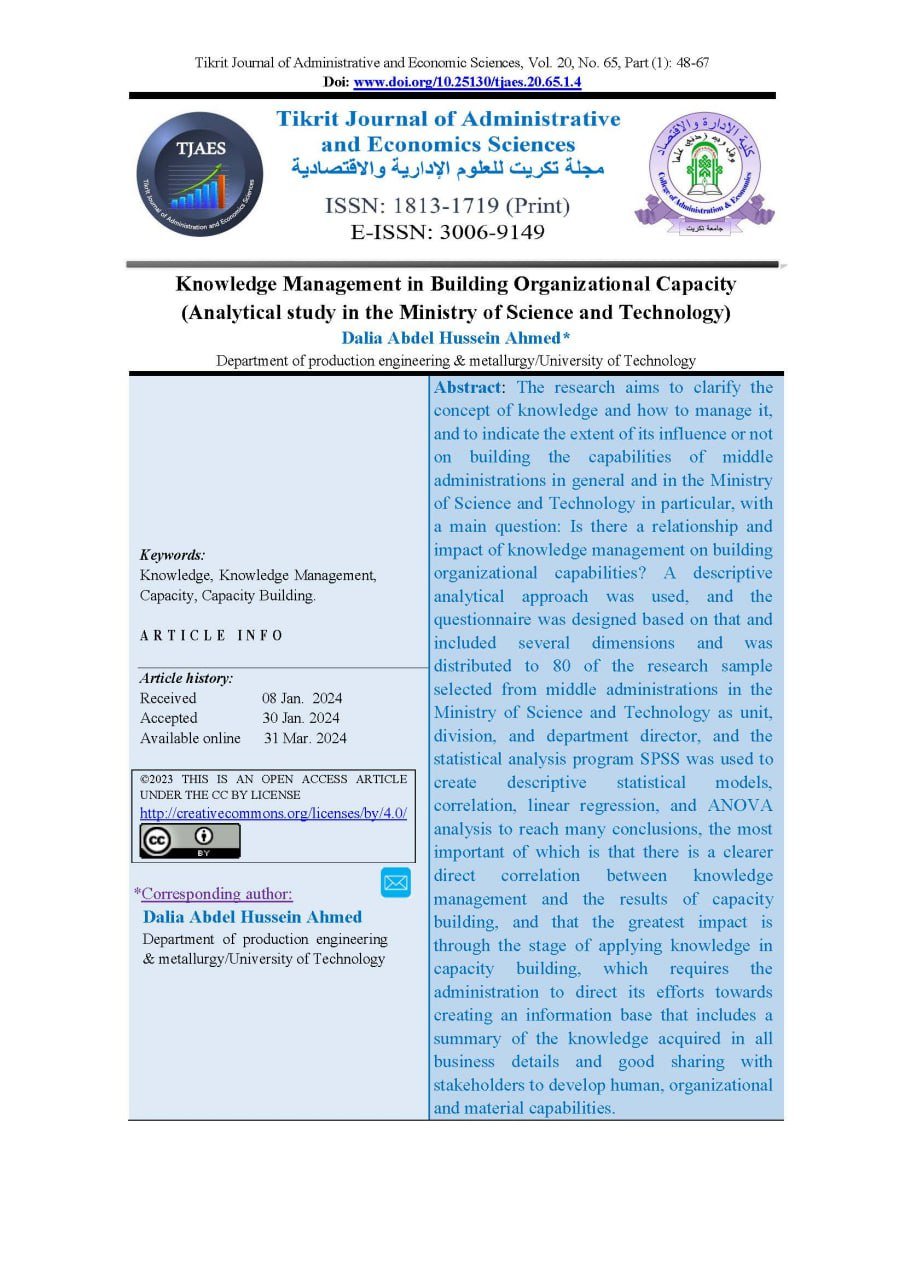
Knowledge Management in Building Organizational Capacity (Analytical study in the Ministry of Science and Technology)
Article Sidebar
THIS IS AN OPEN ACCESS ARTICLE UNDER THE CC BY LICENSE
Main Article Content

Abstract
The research aims to clarify the concept of knowledge and how to manage it, and to indicate the extent of its influence or not on building the capabilities of middle administrations in general and in the Ministry of Science and Technology in particular, with a main question: Is there a relationship and impact of knowledge management on building organizational capabilities? A descriptive analytical approach was used, and the questionnaire was designed based on that and included several dimensions and was distributed to 80 of the research sample selected from middle administrations in the Ministry of Science and Technology as unit, division, and department director, and the statistical analysis program SPSS was used to create descriptive statistical models, correlation, linear regression, and ANOVA analysis to reach many conclusions, the most important of which is that there is a clearer direct correlation between knowledge management and the results of capacity building, and that the greatest impact is through the stage of applying knowledge in capacity building, which requires the administration to direct its efforts towards creating an information base that includes a summary of the knowledge acquired in all business details and good sharing with stakeholders to develop human, organizational and material capabilities.
Downloads
Article Details
References
Ahmed, D. A. & Hussein, A. A.& Ibrahim, M. A., (2023), Capital structure and its impact on profitability and risk, Tikrit Journal of Administrative and Economic Sciences, Vol. 19, No. Special Issue, Part (4).
Aiken, Dennis, (2016), Best practices for the implementation of a knowledge management system in small and medium enterprises. Academic Extension 1277 University of Oregon Eugene, OR 97403-1277(800)824-2714
Al-Ameen, L.A.& Al-Hamadany, H. A., (2023), The reality of knowledge retention practices: An analytical study of the opinions of a sample of employees in the Iraqi Ministry of Planning, Tikrit Journal of Administrative and Economic Sciences, Vol. 19, Issue 63 Part 2.
Bala, Suman, (2015), Role of capacity building and knowledge management for improving efficiency of human resources in indirect tax administration MCTP phase IV.
Barrett, S. Kincaid, D. March, A., (2013) Building coaching capacity. Presented at the 2013 PBIS Leadership Forum.
Belavkin, Roman V. (2011) “The Knowledge Management Cycle” Lecture 2, BIS 4410.
Bencsik, A. (2021). The sixth generation of knowledge management – the headway of artificial intelligence. Journal of international studies, 14(2), 84-101. Doi:10.14254/2071-833.2021/14-2/6.
Bolo, Maurice Ochieng (2020). New knowledge management strategy for SGCS. IDRC Grant/ Subvention du CRDI: 109388-001.
Cap-Net (2004) “Applying Knowledge Management: A tool for capacity building Networks in Integrated Water Resources Management”, October.
Choo, Chun Wei, (2000) “Working with knowledge: how information professionals help organizations manage what they know”, Library Management, Volume 21, Number 8.
Courtney, James F .(2001) “Decision making and knowledge management in inquiring organizations: toward anew decision- making paradigm for DSS”, Decision support systems 31, 17-18.
Dalkir, K. (2011) “knowledge management in theory and practice”, the MTT press.
Drucker, Peter, (1999) “’The Post-Capitalist Society”, Oxford: butterworth-heinemann.
Eade, Deborah. (2007). Capacity building: An approach to people-centered development. Oxfam.
Fard, Hassan Danaee and Selseleh, Minoo (2010) “Measuring knowledge management cycle: Evidence from Iran”, European journal of scientific research, ISSN1450-216x, Vol.41, No,2, pp.297-309.
Hamid, S. M.& Kalaf, Q. F., (2019), Change in knowledge of administrative bodies of sports clubs in the two regions central and southern, Tikrit Journal of Administrative and Economic Sciences, Vol., Issue 58, P. 213-225.
Harsh, S. (2010). Gaining perspective on a complex task: A multidimensional approach to capacity building. Chapter 1.
Ibrahim, Mustafa Ali. (2023), The role of fiscal policy in achieving the economic and financial security of the state, Tikrit Journal of Administrative and Economic Sciences, Vol. 19, No. Special Issue, Part (3): 41-55
Jashapara, Ashok (2004) "Knowledge Management: An Integrated Approach " Halow, Essex Prentice Hall, New York, NY.
Lammert, J.D. Johnson, L. Flore, T.A., (2015), Conceptualizing capacity building. Rockville, MD, Westat.
Mclnerney, Claire R., (2005) “What Happens When Decisions Must be Made Quickly-Can KM Help?”, Rutgers University, USA.
Otto, William F., (2006) “Making Decisions Using Knowledge Management”, North East National Collegiate Honors Council Conference, Pittsburgh, April 6-9.