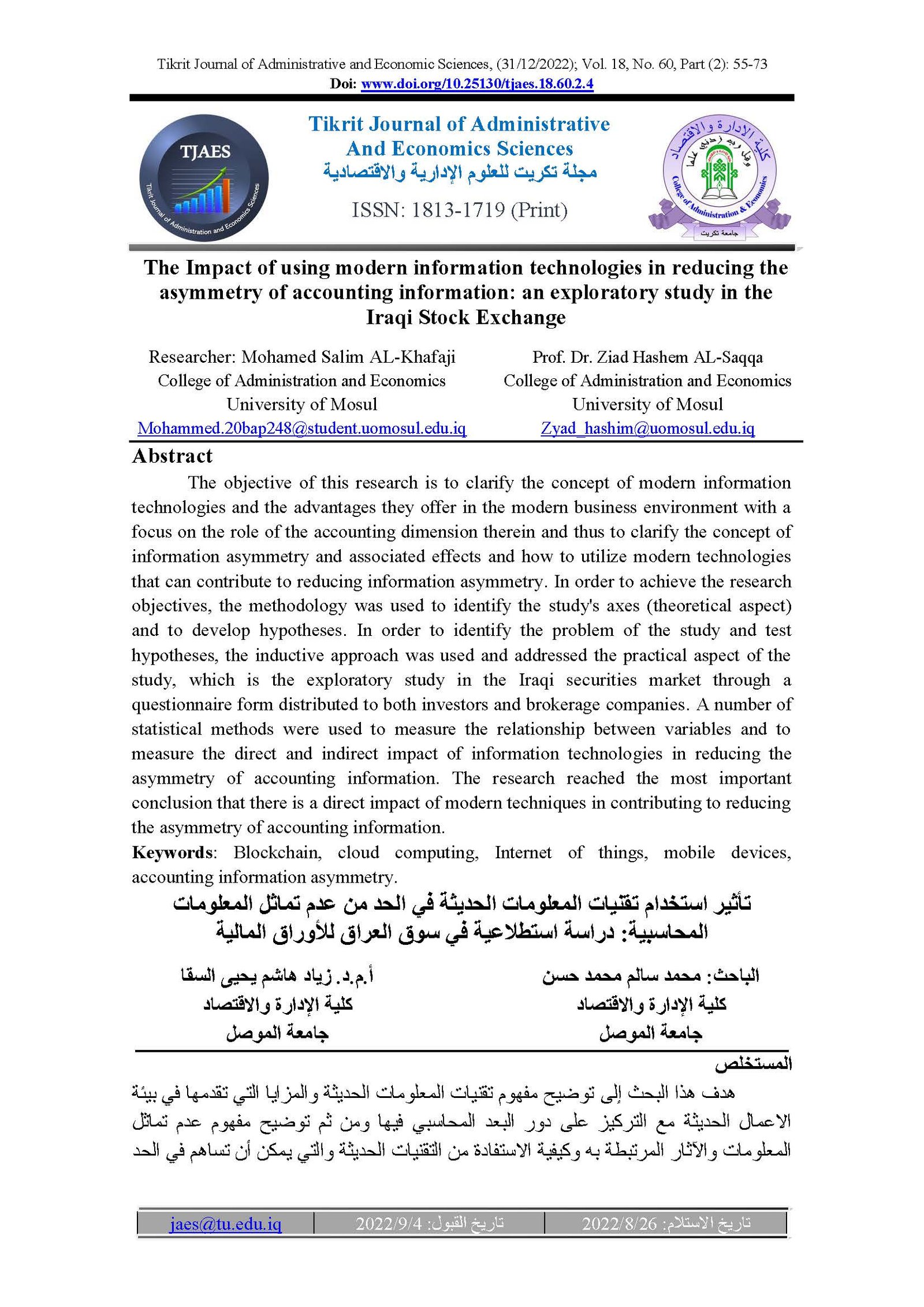
The Impact of using modern information technologies in reducing the asymmetry of accounting information: an exploratory study in the Iraqi Stock Exchange
Article Sidebar
THIS IS AN OPEN ACCESS ARTICLE UNDER THE CC BY LICENSE
Main Article Content

Abstract
The objective of this research is to clarify the concept of modern information technologies and the advantages they offer in the modern business environment with a focus on the role of the accounting dimension therein and thus to clarify the concept of information asymmetry and associated effects and how to utilize modern technologies that can contribute to reducing information asymmetry. In order to achieve the research objectives, the methodology was used to identify the study's axes (theoretical aspect) and to develop hypotheses. In order to identify the problem of the study and test hypotheses, the inductive approach was used and addressed the practical aspect of the study, which is the exploratory study in the Iraqi securities market through a questionnaire form distributed to both investors and brokerage companies. A number of statistical methods were used to measure the relationship between variables and to measure the direct and indirect impact of information technologies in reducing the asymmetry of accounting information. The research reached the most important conclusion that there is a direct impact of modern techniques in contributing to reducing the asymmetry of accounting information.
Downloads
Article Details
References
اولاً. المصادر العربية:
نصير، عبدالناصر عبداللطيف، (2021)، أثر التحول الرقمي على عدم تماثل المعلومات: دليل من الشركات المدرجة في سوق الاوراق المالية السعودية، مجلة الاسكندرية للبحوث المحاسبية، العدد 2، المجلد 5.
النعيمي، عبد الواحد غازي محمد، (2021)، استخدام التنقيب في البيانات في تحديد مخاطر التدقيق انموذج مقترح في البيئة العراقية، اطروحة دكتوراه غير منشورة، كلية الادارة والاقتصاد، جامعة الموصل، الموصل، العراق.
مشعل، & أحمد علي أحمد، (2021)، تحديات البحث والتطبيقات المستقبلية في إنترنت الأشياء. النشرة المعلوماتية في الحاسبات والمعلومات، المجلد 3، العدد 3.
فرهود، صبيحة برزان، (2016)، عدم تماثل المعلومات المحاسبية-الأسباب والمعالجات المقترحة، مجلة العلوم الاقتصادية والإدارية، المجلد 22، عدد 87.
العايب، ياسين، (2014)، مخاطر عدم تماثل المعلومات بين قصور صيغ التمويل التقليدية وحلول الصناعة المالية الإسلامية، مجلة الاقتصاد الإسلامي، العدد 25.
ريباز، محمد حسين محمد، (2017)، الافصاح الإلكتروني في القوائم المالية ودوره في الحد من عدم تماثل المعلومات المحاسبية/دراسة استطلاعية لآراء عينة من المستثمرين والمحللين الماليين في سوق العراق للأوراق المالية، مجلة تكريت للعلوم الاقتصادية والإدارية، مجلد 13، عدد 37.
السقا، زياد هاشم، (2011) نظام المعلومات المحاسبية، الطبعة الثانية، الموصل، العراق.
محسن، فؤاد محسن، وعبدالله، سلمان حسين، (2020)، علاقة اليات حوكمة الشركات بخاصية عدم تماثل المعلومات المحاسبية وانعكاسها على قرارات الاستثمار، مجلة تكريت للعلوم الادارية والاقتصادية، مجلد 16، العدد 52، الجزء 2.
إسماعيل، عصام عبد المنعم، (2016)، إطار مقترح لتطبيق لغة تقارير الاعمال الموسعة XBRL لتحقيق الشفافية والحد من عدم تماثل المعلومات: دراسة تطبيقية في البيئة المصرية، مجلة الفكر المحاسبي، جامعة عين شمس.
ثانياً. المصادر الأجنبية:
ALSaqa, Z. H., Hussein, A. I., & Mahmood, S. M., (2019), The impact of blockchain on accounting information systems. Journal of Information Technology Management, 11(3), 62-80.
Abad-Segura, E., Infante-Moro, A., González-Zamar, M. D., & López-Meneses, E., (2021), Blockchain technology for secure accounting management: research trends analysis. Mathematics, 9(14), 1631.
Ryan, P. J., & Watson, R. B., (2017), Research challenges for the internet of things: what role can or play? Systems, 5(1), 24.
Sharma, N., Shamkuwar, M., & Singh, I., (2019), The history, present and future with IoT. In Internet of Things and Big Data Analytics for Smart Generation (pp. 27-51). Springer, Cham.
Madakam, S., Ramaswamy, R., & Tripathi, S., (2015), Internet of things (IoT): A literature review. Journal of Computer and Communications, 3, 164–173. https://doi.org/ 10.4236/jcc.2015.35021.
Carmona, M. G., & Marin, J. A. M., (2013), ICT trends in education. European scientific journal, 9 (19.(
Huynh, T. L. D., Wu, J., & Duong, A. T., (2020), Information Asymmetry and firm value: Is Vietnam different? The Journal of Economic Asymmetries, 21, e00147.
Zavolokina, L., Schlegel, M., & Schwalbe, G., (2021), How can we reduce information asymmetries and enhance trust in ‘The Market for Lemons’? Information Systems and e-Business Management, 19(3), 883-908.
SEC (Securities and Exchange Commission), Release No. 69279 / April 2, (2013), Report of Investigation Pursuant to Section 21(a) of the Securities Exchange Act of 1934: Netflix, Inc., and Reed Hastings.
Al-Htaybat, K. and von Alberti-Alhtaybat, L., (2017), Big Data and Corporate Reporting: Impacts and Paradoxes, Accounting Auditing & Accountability Journal, 30(4): 850-873.
Jung, M. J., Naughton, J. P., Tahoun, A., & Wang, C., (2018), Do firms strategically disseminate? Evidence from corporate use of social media. The Accounting Review, 93(4), 225-252.
Valentinetti, D., & Flores Muñoz, F., (2021), Internet of things: Emerging impacts on digital reporting. Journal of Business Research, 131, 549–562.
Zhygalova, A., (2013), Perceived Value of Cloud Based Information Systems Case: Accounting Information Systems, Master's thesis, School of Business, Aalto University.
Singerova, J., (2018), Cloud in Accounting, European Financial and Accounting Journal, 13 (1): 61-76.
Boyanov, B., (2018), The Digital Transformations in the Accounting Systems of the Bulgarian Enterprises, 8TH International Conference on Application of Information and Communication Technology and Statistics in Economy and Education, Sofia, Bulgaria.