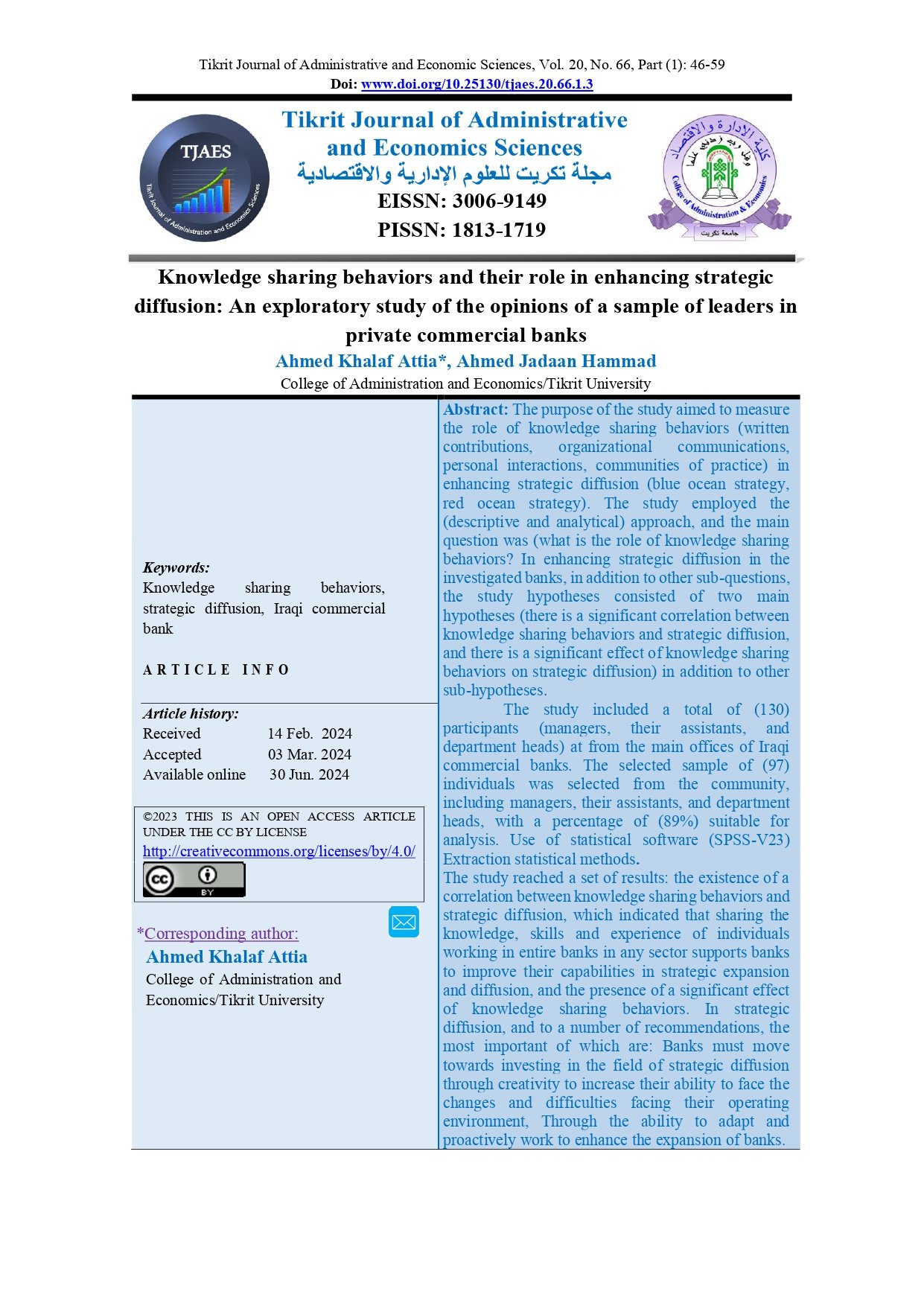
Knowledge sharing behaviors and their role in enhancing strategic diffusion: An exploratory study of the opinions of a sample of leaders in private commercial banks
Article Sidebar
THIS IS AN OPEN ACCESS ARTICLE UNDER THE CC BY LICENSE
Main Article Content

Abstract
The purpose of the study aimed to measure the role of knowledge sharing behaviors (written contributions, organizational communications, personal interactions, communities of practice) in enhancing strategic diffusion (blue ocean strategy, red ocean strategy). The study employed the (descriptive and analytical) approach, and the main question was (what is the role of knowledge sharing behaviors? In enhancing strategic diffusion in the investigated banks, in addition to other sub-questions, the study hypotheses consisted of two main hypotheses (there is a significant correlation between knowledge sharing behaviors and strategic diffusion, and there is a significant effect of knowledge sharing behaviors on strategic diffusion) in addition to other sub-hypotheses.
The study included a total of (130) participants (managers, their assistants, and department heads) at from the main offices of Iraqi commercial banks. The selected sample of (97) individuals was selected from the community, including managers, their assistants, and department heads, with a percentage of (89%) suitable for analysis. Use of statistical software (SPSS-V23) Extraction statistical methods.
The study reached a set of results: the existence of a correlation between knowledge sharing behaviors and strategic diffusion, which indicated that sharing the knowledge, skills and experience of individuals working in entire banks in any sector supports banks to improve their capabilities in strategic expansion and diffusion, and the presence of a significant effect of knowledge sharing behaviors. In strategic diffusion, and to a number of recommendations, the most important of which are: Banks must move towards investing in the field of strategic diffusion through creativity to increase their ability to face the changes and difficulties facing their operating environment, Through the ability to adapt and proactively work to enhance the expansion of banks.
Downloads
Article Details
References
أولاً. المصادر العربية:
حماد، أحمد جدعان، (2022)، ديناميكيات المعرفة ودورها في تحقيق التفوق التنافسي، دراسة استطلاعية لآراء عينة من القيادات الإدارية في الشركة العامة لصناعة الأدوية " مجلة اقتصاديات الأعمال، المجلد (3)، العدد (1)، ص 355-375.
حماد، أحمد جدعان، (2022)، دور التشارك المعرفي في الحد من مسببات الصمت التنظيمي بحث تطبيقي لعينة من الممرضين في مستشفى صلاح الدين العام " مجلة تكريت للعلوم الإدارية والاقتصادية، المجلد (18)، العدد (58)، الجزء (2): 32-51
محمد، عمار عواد، حماد، أحمد جدعان، محمد، عثمان عواد، (2021)، تقانة النانو كخيار استراتيجي في القرن الحادي والعشرين للنهوض بواقع التصنيع العراقي واللحاق بالدول الصناعية المتقدمة (دراسة حالة لواقع تقانة النانو في أفضل 20 الدول تقدما في هذا المجال)، مجلة الاقتصاد والعلوم الإدارية، المجلد (27)، العدد (126)، ص 289-303
بوراس، قدور، (2016)، أهمية الاتصال الشخصي في زيادة الثقة بين المدرب واللاعبين داخل الأندية الرياضية الجزائرية، دراسة ميدانية لفريق رائد رجاء المسيلة للكرة الطائرة، رسالة ماجستير، جامعة محمد بوضياف بالمسيلة، معهد علوم وتقنيات النشاطات البدنية والرياضية، قسم الإعلام والاتصال الرياضي.
شعراوي، محمد فتحي شلقامى، (2018)، استراتيجيات إدارة المعرفة وعلاقتها بالأداء الابتكاري في قطاع البنوك التجارية: دراسة ميدانية، المجلة العلمية للاقتصاد والتجارة، 48 (1) 117- 208.
الطراونة، نضال خليف، المجالي، محمد عبد الوهاب، الحواجرة، كامل محمد، (2022)، الثقافة الريادية ودورها في فاعلية التنفيذ الاستراتيجي في البنوك التجارية الأردنية، سلسلة العلوم الإنسانية والاجتماعية، العدد (1)، المجلد (36).
فائزة، رويم، (2005)، علاقة الاتصال الشخصي لدى العمال بتوافقهم المهني دراسة ميدانية بالشركة الوطنية للكهرباء والغاز بمدينة ورقلة، رسالة ماجستير، جامعة قاصدي مرباح ورقلة، كلية الآداب والعلوم الانسانية، قسم علم النفس وعلوم التربية.
ثانياً. المصادر الأجنبية:
Abdillah, M. R., Lin, C. T., Anita, R., & Suroto, B., (2018), Knowledge-sharing behavior among banking officers in Indonesia. Journal of International Studies, 11(2), 136-153.
Arhin, K., & Wiredu, G. O., (2018), An organizational communication approach to information security. The African Journal of Information Systems, 10(4), 1.
Bartol, K. M., & Srivastava, A., (2002), Encouraging knowledge sharing: The role of organizational reward systems. Journal of leadership & organizational studies, 9(1), 64-76.
Chennamaneni, A., (2006), Determinants of knowledge sharing behaviors: Developing and testing an integrated theoretical model. The University of Texas at Arlington.
Gupta, B., Joshi, S., & Agarwal, M., (2012), The effect of expected benefit and perceived cost on employees’ knowledge sharing behavior: A study of IT employees in India. Organizations and Markets in Emerging Economies, 3(1), 8-19.
Hsu, M. H., Ju, T. L., Yen, C. H., & Chang, C. M., (2007), Knowledge sharing behavior in virtual communities: The relationship between trust, self-efficacy, and outcome expectations. International journal of human-computer studies, 65(2), 153-169.
Hung, S. Y., Durcikova, A., Lai, H. M., & Lin, W. M., (2011), The influence of intrinsic and extrinsic motivation on individuals' knowledge sharing behavior. International journal of human-computer studies, 69(6), 415-427.
Ibrahim¹, S. B., Ahmed, U., & Abdullahi, M. S., (2021), Testing the Prediction of Knowledge Sharing Behavior through the Lens of Organizational Culture and Organizational Citizenship Behavior. Annals of Contemporary Developments in Management & hr (acdmhr), 3(2), 27-40.
Islam, T., Zahra, I., Rehman, S. U., & Jamil, S., (2022), How knowledge sharing encourages innovative work behavior through occupational self-efficacy? The moderating role of entrepreneurial leadership. Global Knowledge, Memory and Communication.
Jarrah, H. Y., & Alkhazaleh, M. S., (2020), Knowledge sharing behavior in the curricula of United Arab Emirates universities and educational organizations.
Kim WC, (2005), Blue Ocean strategy: from theory topractice. California Management Review 47(3): 105-121.
Kim, Yang, & Kim, J., (2008), A strategy for third-party logistics systems: A case analysis using the blue ocean strategy. Omega, 36(4), 522-534.
Koschmann, (2012). What is organizational communication. Retrieved April, 25, 2019.
Liang, T. P., Liu, C. C., & Wu, C. H., (2008), Can social exchange theory explain individual knowledge-sharing behavior? A meta-analysis.
Martin-Rios, C., & Erhardt, N., (2017), Small business activity and knowledge exchange in informal interfirm networks. International Small Business Journal, 35(3), 285-305.
Natu, S., & Aparicio, M., (2022), Analyzing knowledge sharing behaviors in virtual teams: Practical evidence from digitalized workplaces. Journal of Innovation & Knowledge, 7(4), 100248.
Nistor & Fischer, (2012), Communities of practice in academia: Testing a quantitative model. Learning, Culture and Social Interaction, 1(2), 114-126.
Omidvar, O., & Kislov, R., (2014), The evolution of the communities of practice approach: Toward knowledgeability in a landscape of practice—An interview with Etienne Wenger-Trayner. Journal of Management Inquiry, 23(3), 266-275.
Ozbebek, A., & Topu, E. K., (2011), Empowereg employees’ knowledge sharing behavior. International Journal of Business and Management Studies, 3(2), 69-76.
Ramayah, T., Yeap, J. A., & Ignatius, J., (2014), Assessing knowledge sharing among academics: A validation of the knowledge sharing behavior scale. Evaluation review, 38(2), 160-187.
Rashid, A. M., (2020), Knowledge Sharing Behavior among postgraduate students using Facebook: An Empirical Study of Iraq. Journal of Basrah Researches (Sciences), 46(2).
Rezeki, S., Sentanu, I. G. E. P. S., Sanawiri, B., Shankar, K., & Thanh, P., (2019), Blue Ocean Strategy for creating Value of the Organization: Examination of Differentiation with Red Ocean Strategy. International Journal of Recent Technology and Engineering, 8, 2277-3878.
Rrezaie, K., Ostadi, B., Samadi, H., Mohammadi, M., & Nazari-Shirkouhi, S., (2013), Learning organisations, strategic deployment and change management strategy for enhancing successful implementation of projects. International Journal of Business Innovation and Research, 7(1), 61-83.
Saadah, N., & Rijanti, T., (2022), The Role of Knowledge Sharing, Leader-Member Exchange on Organizational Citizenship Behavior and Employee Performance: An Empirical Study on Public Health Center of Pati 1, Pati 2 and Trangkil in Central Java. International Journal of Social and Management Studies, 3(1), 112-131.
Samrin, Irawan, & Se, M., (2019), Analisis Blue Ocean Strategy Bagi Industri Kerajinan Di Kota Tanjung Balai. Jurnal Manajemen, 11(1), 93-100.
Saunders, A. M., (2005), Performance excellence and strategy deployment: a framework for implementing strategic initiatives: a thesis presented in partial fulfillment of the requirements for the degree of Doctor of Philosophy in Production Technology at Massey University, Palmerston North, New Zealand (Doctoral dissertation, Massey University).
Saunders, M., Mann, R., & Smith, R., (2007), Benchmarking strategy deployment practices. Benchmarking: An International Journal, 14(5), 609-623.
Strategy, B. O., (2015), Blue Ocean Strategy. Marketing, 1009, 4C.
Wang & Noe, (2010), Knowledge sharing: A review and directions for future research. Human resource management review, 20(2), 115-131.
Yunus, M., & Sijabat, F. N., (2021), A review on Blue Ocean Strategy effect on competitive advantage and firm performance. Academy of Strategic Management Journal, 20(1), 1-10.