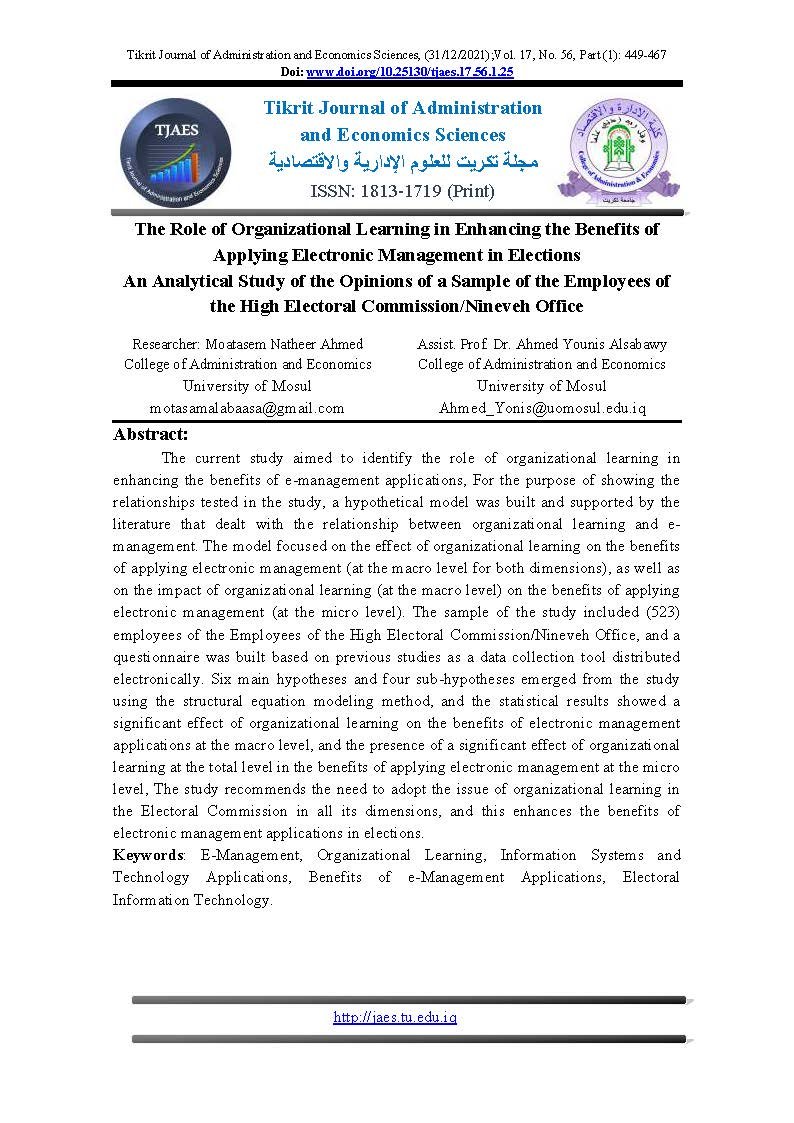
The Role of Organizational Learn ing in Enhancing the Benefits of Applying Electronic Management in Elections An Analytical Study of the Opinions of a Sample of the Employees of the High Electoral Commission/Nineveh Office
Article Sidebar
THIS IS AN OPEN ACCESS ARTICLE UNDER THE CC BY LICENSE
Main Article Content

Abstract
The current study aimed to identify the role of organizational learning in enhancing the benefits of e-management applications, For the purpose of showing the relationships tested in the study, a hypothetical model was built and supported by the literature that dealt with the relationship between organizational learning and e- management. The model focused on the effect of organizational learning on the benefits of applying electronic management (at the macro level for both dimensions), as well as on the impact of organizational learning (at the macro level) on the benefits of applying electronic management (at the micro level). The sample of the study included (523) employees of the Employees of the High Electoral Commission/Nineveh Office, and a questionnaire was built based on previous studies as a data collection tool distributed electronically. Six main hypotheses and four sub-hypotheses emerged from the study using the structural equation modeling method, and the statistical results showed a significant effect of organizational learning on the benefits of electronic management applications at the macro level, and the presence of a significant effect of organizational learning at the total level in the benefits of applying electronic management at the micro level, The study recommends the need to adopt the issue of organizational learning in the Electoral Commission in all its dimensions, and this enhances the benefits of electronic management applications in elections.
Downloads
Article Details
References
اولاً. المصادر العربية:
عامر، عبد الناصر السيد، (2018)، نمذجة المعادلة البنائية للعلوم النفسية والاجتماعية، الجزء الأول، دار جامعة نايف للنشر، الرياض، المملكة العربية السعودية.
ثانياً. المصادر الأجنبية:
Abiodun, A. J., Ibidunni, A. S., & Kehinde, O. J., (2015), Demographic determinants of communication and information technology appreciation and usage among health care professionals. The International Journal of Health Economics, (5), 5-19, 2069-5748.
Ahakwa, I., Yang, J., Agba Tackie, E., Afotey Odai, L., & Dartey, S., (2021), The Effects of Job Autonomy, Organizational Learning, and Work Environment on Organizational Commitment of Public Sector Employees in the Ashanti Region of Ghana. International Journal of Scientific Research and Management, 9 (1), 2099-2110.
Ashworth, M., Mukhopadhyay, T., & Argote, L., (2004), Information technology and organizational learning: An empirical analysis. ICIS 2004 Proceedings, 38, 481-492.
Badeleh, A., Khakpour, M., & Khatibi, M. B., (2020), Presentation of Information Technology (IT) Communication Model with Knowledge Management and Organizational Learning in the Staff of Farhangian University. Journal of Academic librarianship and Information Research, 54 (2).321-341.
Bahra, N., (2001), Competitive Knowledge Management. Palgrave Publisher, New York.
Beekman, G., & Quinn J. M., (2006), Computer Confluence Tomorrows Technology and You, Prentice. Hall New Jersey, USA.
Beisse, F., (2014), A guide to computer user support for help desk and support specialists. Nelson Education. Toronto, Canada.
Bell, S. J., Mengüç, B., & Widing, R. E., (2010), Salesperson learning, organizational learning, and retail store performance. Journal of the Academy of Marketing Science, 38 (2), 187-201.
Beneke, J., Blampied, S., Dewar, N., & Soriano, L., (2016), The impact of market orientation and learning orientation on organisational performance. Journal of Research in Marketing and Entrepreneurship, 18(1), 90-108.
Carroll, T., & Hunter, S. D., (2005), Organizational Design, Organizational Learning, and the Market Value of the Firm, 2, 1-38.
Cho, V., (2007), A study of the impact of organizational learning on information system effectiveness. International Journal of Business and Information, 2 (1), 127-158.
Daghfous, A., (2004), Organizational learning, knowledge and technology transfer: a case study. The Learning Organization, 11(1), 67-83.
Denscombe, M., (2014), The good research guide: for small-scale social research projects. McGraw-Hill Education (UK).
Falconer, L., (2006), Organizational learning, tacit information, and e‐learning: a review. The Learning Organization, 13(2), 140-151.
Gregor, S., Martin, M., Fernandez, W., Stern, S., & Vitale, M., (2006), The transformational dimension in the realization of business value from information technology. The Journal of Strategic Information Systems, 15 (3), 249-270.
Hassan, N. H. B., Arshad, N. I. B., Mustapha, E. E. B., & Jaafar, J. B., (2014, June), Understanding the ways organizational learning drives information technology (IT) infrastructure. In 2014 International Conference on Computer and Information Sciences (ICCOINS) (pp. 1-5), IEEE.
Hindasah, L., & Nuryakin, N., (2020), The relationship between organizational capability, organizational learning and financial performance. The Journal of Asian Finance, Economics, and Business, 7(8), 625-633.
Jiang, X., & Li, Y., (2008), The relationship between organizational learning and firms’ financial performance in strategic alliances: A contingency approach. Journal of world business, 43(3), 365-379.
Kane, G. C., & Alavi, M., (2007), Information technology and organizational learning: An investigation of exploration and exploitation processes. Organization Science, 18(5), 796-812.
Lengnick-Hall, C. A., & Inocencio-Gray, J. L., (2013), Institutionalized organizational learning and strategic renewal: The benefits and liabilities of prevailing wisdom. Journal of Leadership & Organizational Studies, 20(4), 420-435.
Lin, H. F., & Lee, G. G., (2005), Impact of organizational learning and knowledge management factors on e‐business adoption. Management Decision, 43 (2), 171-188.
Malik, S., Chetty, M., & Chadhar, M., (2018), Information Technology and Organizational Learning Interplay: A Survey. Australasian Conference on Information Systems (pp. 1-11). Australasian.
Robey, D., Boudreau, M. C., & Rose, G. M., (2000), Information technology and organizational learning: a review and assessment of research. Accounting, Management and Information Technologies, 10 (2), 125-155.
Saadat, V., & Saadat, Z., (2016), Organizational learning as a key role of organizational success. Procedia-Social and Behavioral Sciences, 230, 219-225.
Soomro, B. A., Mangi, S., & Shah, N., (2020), Strategic factors and significance of organizational innovation and organizational learning in organizational performance. European Journal of Innovation Management, 1-26.
Templeton, G. F., Lewis, B. R., & Snyder, C. A., (2002), Development of a measure for the organizational learning construct. Journal of management information systems, 19 (2), 175-218.
Tippins, M. J., & Sohi, R. S., (2003), it competency and firm performance: is organizational learning a missing link? Strategic management journal, 24(8), 745-761.
Tippins, M. J., & Sohi, R. S., (2003), it competency and firm performance: is organizational learning a missing link? Strategic management journal, 24 (8), 745-761.
Wang, W., Sedera, D., & Tan, F., (2009), Measuring CRM and SCM benefits: a preliminary measurement model. In Proceedings of the 13th Pacific Asia Conference on Information Systems (PACIS) (pp. 1-11). AIS Electronic Library (AISeL). Queensiand University of Technology, Brisbane Australia.
Wang, X., & Zhi, F., (2010, April), A perspective on information technology based organizational learning. In 2010 2nd IEEE International Conference on Information Management and Engineering (pp. 319-322). IEEE. Union University Beijing, China.
Wu, F., & Cavusgil, S. T., (2006), Organizational learning, commitment, and joint value creation in interfirm relationships. Journal of Business Research, 59 (1), 81-89.