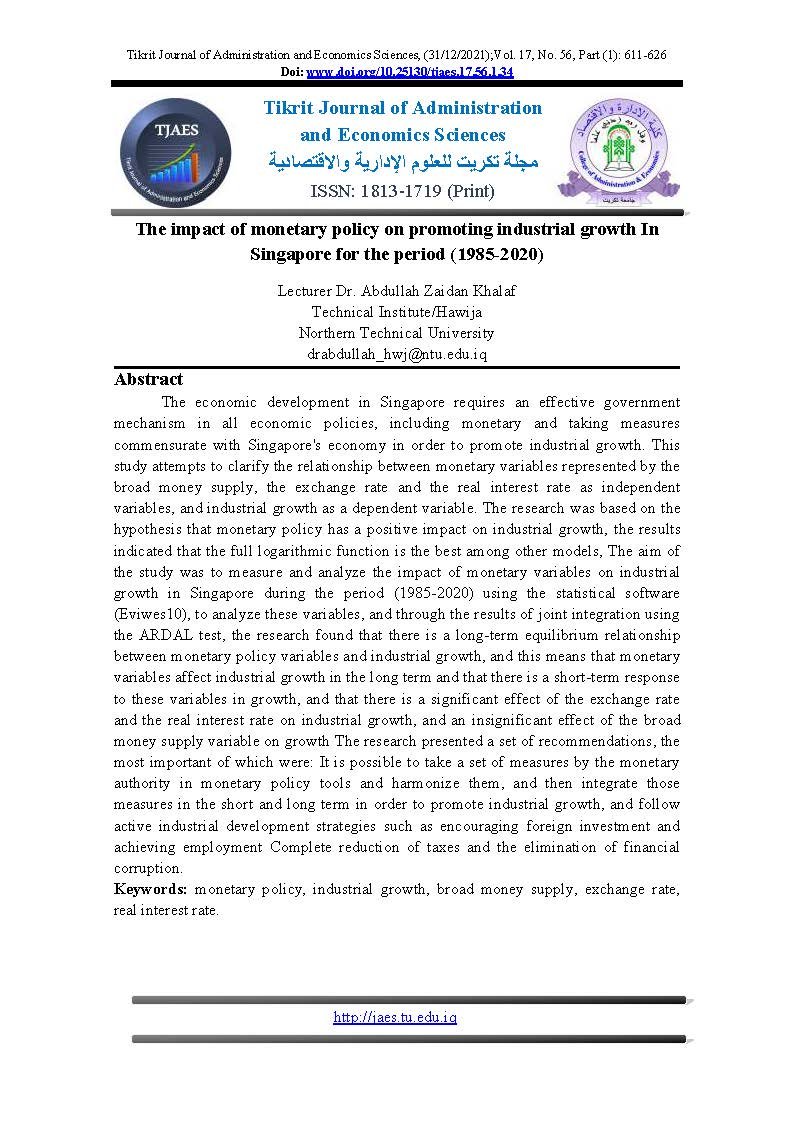
The impact of monetary policy on promoting industrial growth In Singapore for the period (1985-2020)
Article Sidebar
THIS IS AN OPEN ACCESS ARTICLE UNDER THE CC BY LICENSE
Main Article Content

Abstract
The economic development in Singapore requires an effective government mechanism in all economic policies, including monetary and taking measures commensurate with Singapore's economy in order to promote industrial growth. This study attempts to clarify the relationship between monetary variables represented by the broad money supply, the exchange rate and the real interest rate as independent variables, and industrial growth as a dependent variable. The research was based on the hypothesis that monetary policy has a positive impact on industrial growth, the results indicated that the full logarithmic function is the best among other models, The aim of the study was to measure and analyze the impact of monetary variables on industrial growth in Singapore during the period (1985-2020) using the statistical software (Eviwes10), to analyze these variables, and through the results of joint integration using the ARDAL test, the research found that there is a long-term equilibrium relationship between monetary policy variables and industrial growth, and this means that monetary variables affect industrial growth in the long term and that there is a short-term response to these variables in growth, and that there is a significant effect of the exchange rate and the real interest rate on industrial growth, and an insignificant effect of the broad money supply variable on growth The research presented a set of recommendations, the most important of which were: It is possible to take a set of measures by the monetary authority in monetary policy tools and harmonize them, and then integrate those measures in the short and long term in order to promote industrial growth, and follow active industrial development strategies such as encouraging foreign investment and achieving employment Complete reduction of taxes and the elimination of financial corruption.
Downloads
Article Details
References
اولاً. المصادر العربية:
عمر علواني، 2016، أثر السياسة النقدية على النمو الاقتصادي حالة الجزائر (1990-2014)، رسالة ماجستير غير منشورة، جامعة ابي بكر، تلمسان، كلية العلوم التجارية، الجزائر.
الجبوري، عبدالله زيدان خلف، 2018، اثر النمو الصناعي في انبعاث الغازات المسببة للاحتباس الحراري في دول مختارة للمدة (1990-2015)، اطروحة دكتوراه غير منشوره، كلية الادارة والاقتصاد، جامعة الموصل.
عامري رضوان، 2017، العلاقة بين النمو وسعر الصرف، اطروحة دكتوراه غير منشوره، جامعة الجيلالي ليابس، كلية العلوم الاقتصادية والتجارية وعلوم التسيير، الجزائر.
بوخاري فضيلة، وعمالي امال، 2018، أثر سعر الفائدة على النمو الاقتصادي، رسالة ماجستير غير منشوره، جامعة محمد بوضياف، كلية العلوم الاقتصادية والتجارية وعلوم التسيير، الجزائر.
الحمداني، احمد شهاب، والحمداني، رفاه شهاب، ونايف، عبد القادر، 2018، أثر التغيرات في عرض النقد على الناتج المحلي الاجمالي العراقي للمدة (20115-2015)، مجلة المنصور، العدد (30).
بيانات البنك الدولـي لعـام (2020)، مؤشـرات النمـو الاقتصـادي، الموقـع علـى الانتـرنت: http://www.albankaldawli.org
ثانياً. المصادر الأجنبية:
Parrado, Eric, 2014, Singapore`s Unique Monetary Policy: How Does It Work? International Monetary Fund WP.
Thing, Chai & Mohamed, Azali, 2020, Monetary Policy Rules in Malaysia, Singapore, Economic and Management, University Putra Malaysia.
Lim, Hank, 2010, Introduction: Historical Background, Singapore Institute of International Affairs.
Siddiqi, Kalim, 2015, The Political Economy of Development in Singapore, Vol. 2: Issue 4, University of Huddlers Field, UK.
Barthes, Run Roland, 2009, Le Development Economic iue, Paris Codex 12.
Winston T. H. Koh, 2006, Singapore's Transition to Innovation-based Economic Growth: Infrastructure, Institutions and Governments Role, School of Economic and Social Sciences Singapore Management University, qo Stamford Road.
Oon Jin, Yeoh & Sam, Kok Weng, Raymund Chao, Christopher Kelkar, David Wijeratne, 2020, Time to Act Singapore.
Khuong M. Vu, 2011, Sources of Singapore's Economic Growth Trends, Patterns and Policy Implications, lee Kuna Yew School of Public Policy, National University of Singapore.
Dingela, Syasang & Khobai, 2017, Dynamic Impact of Money Supply on Economic Growth in South Africa, Nelson Mandela University.
Dimitijevic Dojan & Lover Ivan, 2013, Essay on Monetary Policy and Economic Growth, Journal of Control Bank Theory and Practice.
Chaitipa Prasert, Chokethaworna Kanchana, Chukiat Chaiboonsrib, 2015, Money Supply Influencing on Economic Growth-Wide, International Conference on Applied Economics Kazan, Russia.
Narayan Roy, Suvcndu, 2021, Concept of For Forcing Change Rate.
Rousseau, Petrel & Sylla, Richard, 2003, Financial, Economic Growth and Globalization, National Bureau of Economic Research, University of Chicago Press, URL, 1.
Harswari, Muhammad Hariz Afiq Bin Nor, 2017, The Impact of Interest Rate of Economic and Development, International Journal of Accounting & Business Management, VOL:5 (No.1), Anglia Ruskin University, UK.
Hillary Chijindu, Imo Godwin I be, Uch Boniface, Ugwuani, and Emmanduel Kalu Agbaeze, 2018, Monetary Policy Transmission and Industrial Sector Growth.
Mushtaq, Saba & Siddiqui, Ahmed, 2016, Effect of Interest Rate on Economic Performance: Evidence from Islamic and Non-University Business School, University of Karachi, Pakistan.