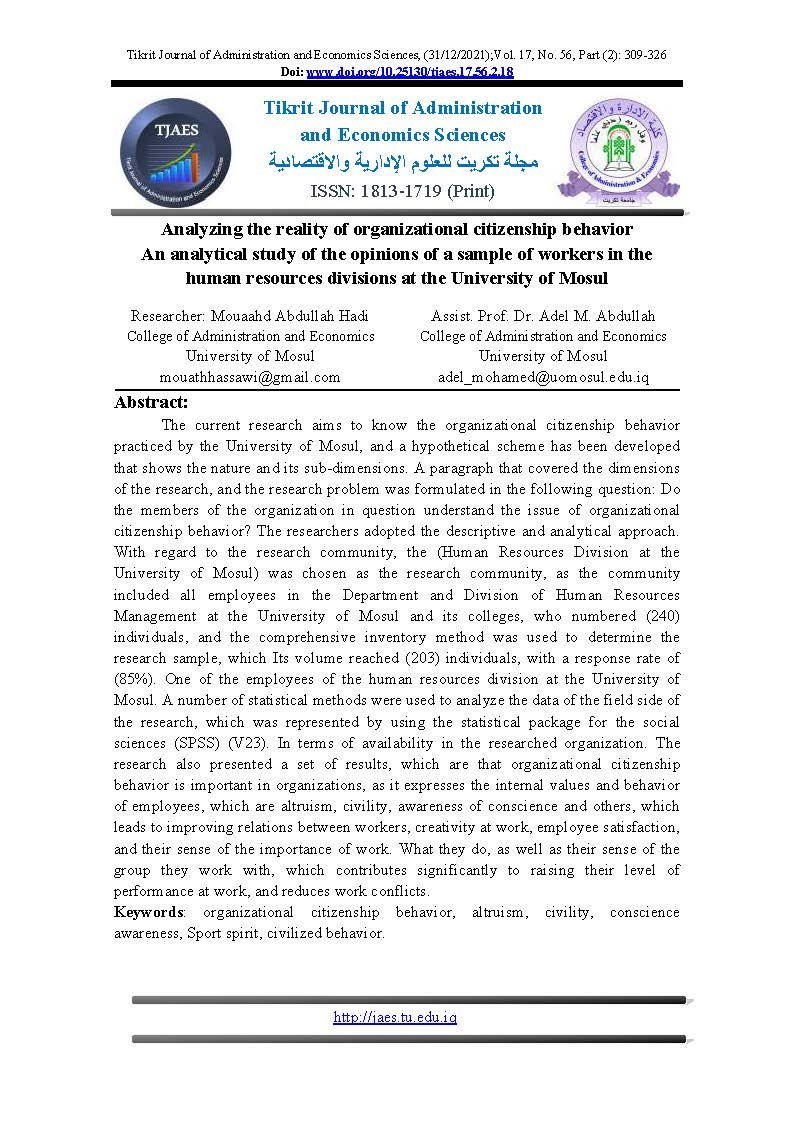
Analyzing the reality of organizational citizenship behavior An analytical study of the opinions of a sample of workers in the human resources divisions at the University of Mosul
Article Sidebar
THIS IS AN OPEN ACCESS ARTICLE UNDER THE CC BY LICENSE
Main Article Content

Abstract
The current research aims to know the organizational citizenship behavior practiced by the University of Mosul, and a hypothetical scheme has been developed that shows the nature and its sub-dimensions. A paragraph that covered the dimensions of the research, and the research problem was formulated in the following question: Do the members of the organization in question understand the issue of organizational citizenship behavior? The researchers adopted the descriptive and analytical approach. With regard to the research community, the (Human Resources Division at the University of Mosul) was chosen as the research community, as the community included all employees in the Department and Division of Human Resources Management at the University of Mosul and its colleges, who numbered (240) individuals, and the comprehensive inventory method was used to determine the research sample, which Its volume reached (203) individuals, with a response rate of (85%). One of the employees of the human resources division at the University of Mosul. A number of statistical methods were used to analyze the data of the field side of the research, which was represented by using the statistical package for the social sciences (SPSS) (V23). In terms of availability in the researched organization. The research also presented a set of results, which are that organizational citizenship behavior is important in organizations, as it expresses the internal values and behavior of employees, which are altruism, civility, awareness of conscience and others, which leads to improving relations between workers, creativity at work, employee satisfaction, and their sense of the importance of work. What they do, as well as their sense of the group they work with, which contributes significantly to raising their level of performance at work, and reduces work conflicts.
Downloads
Article Details
References
اولاً. المصادر العربية:
الحراحشة، محمد عبود والخريشا، ملوح باجي، (2012)، درجة ممارسة سلوك المواطنة التنظيمية وعلاقتها بالولاء التنظيمي لدى العاملين في مديريات التربية والتعليم في محافظة المفرق، مجلة جامعة مؤتة للبحوث والدراسات، سلسلة العلوم الإنسانية والاجتماعية، المجلد (27)، العدد (2)، 57-69.
الحوامدة، نضال، وأبو شتال، معتصم، (2011) مدى توافر أبعاد الصحة المنظمية وأثرها في الحد من مصادر ضغوط العمل دراسة ميدانية على أطباء القطاع الحكومي في الأردن مجلة أبحاث اليرموك، 27 (2)، 1809-1829.
الربيعة، صالح بن محمد، (2015)، الشفافية الإدارية والمواطنة التنظيمية في الجامعات السعودية رؤية تطويرية مقترحة، أطروحة دكتوراه، جامعة الملك سعود، كلية التربية، السعودية.
الرواشدة، أسامة محمد والصيادي، عثمان محمد والزغبي، محمد سيد احمد وإبراهيم، سعيد سلامة، (2020)، أثر القيادة الر وحية في تعزيز سلوك المواطنة التنظيمية دراسة تطبيقية على بعض الفنادق الأردنية، مجلة اتحاد الجامعات العربية للسياحة والضيافة، المجلد (19)، العدد (1)، 247-260.
الزهراني، محمد بن عبد الله بن سعيد، (2007)، سلوك المواطنة التنظيمية لدى معلمي مدارس التعليم العام الحكومي للبنين بمدينة جدة من وجهة نظر مديري ومعلمي تلك المدارس، أطروحة دكتوراه، جامعة ام القرى، كلية التربية، السعودية.
السلايمة، لبنى علي، (2020)، دور التواصل الاجتماعي في تعزيز سلوك المواطنة التنظيمية لدى المعلمين في المدراس الأساسية الخاصة في العاصمة عمان من وجهة نظر المديرين، رسالة ماجستير، جامعة الشرق الأوسط، كلية الاعمال، عمان، الأردن.
حسون، محمد، (2016)، دور القيادة التحويلية في سلوك المواطنة التنظيمية دراسة ميدانية على العاملين في فروع المصرف التجاري السوري بدمشق، مجلة جامعة تشرين للبحوث والدراسات العلمية، سلسلة العلوم الاقتصادية والقانونية، المجلد (38)، العدد (4)، 395-414.
شهري، مينه سليمان، (2019)، سلوك المواطنة التنظيمية لدى أعضاء هيئة التدريس في الجامعات الحكومية الجزائرية من وجهة نظر القادة الأكاديميين، المجلة الأردنية في إدارة الاعمال، المجلد (15)، العدد (3)، 373-403.
عبدالمجيد، أشرف عبد الثواب والعوفي، زهور سمران مرزوق، (2016)، العلاقة بين العدالة التنظيمية وسلوك المواطنة التنظيمية لدى المشرفات التربويات بمدينة تبوك، دراسات عربية في التربية وعلم النفس، العدد (80)، 329-382.
فيروز، زروخي وغالب، فاتح وميمون، الطاهر، (2019)، دور ممارسات إدارة الموارد البشرية في تفعيل سلوكيات المواطنة التنظيمية دراسة حالة مديرية التجهيزات العمومية لولاية الشلف، مجلة دراسات اقتصادية، المجلد (6)، العدد (2)، 155-175.
كبير، عمر وعلي، عبد الرزاق، (2019)، أثر المناخ التنظيمي على سلوك المواطنة التنظيمية لدى موظفي مؤسسة صيدال-عنابة الجزائر، مجلة رؤى اقتصادية، المجلد (9)، العدد (2)، 225-242.
نوح، علياء حسين علاء الدين، (2013)، أثر الدعم التنظيمي في إدارة المنظمات وسلوك المواطنة التنظيمية دراسة تطبيقية في المنظمات الصناعية في مدينة سحاب، رسالة ماجستير، جامعة الشرق الأوسط، كلية الاعمال، عمان، الأردن.
ثانياً. المصادر الأجنبية:
Agustina, G., Permanar, T. E., Nurhayati, S. E., Ahman, E., & Febrian, F., (2020), Happiness at Work and Organizational Citizenship Behavior in Krakatau Steel. Dinasti International Journal of Digital Business Management, 1(6), 911-920.
Al-Dhuwaihia, A., & ALqahtainib, B. H., (2020), The Relationship Between Organizational Citizenship Behavior and Job Performance for Public Kindergarten Teachers in Dammam And Khobar. International Journal of Innovation, Creativity and Change, (14), pp.155-180.
Alkahtani, A., (2015), Organizational citizenship behavior (OCB) and rewards. International Business Research, 8(4), pp. 210-222.
Anggita, N. M. A., & Ardana, I. K., (2020), The Role of Job Satisfaction Medium Perceived Organizational Support to Behavior Organizational Citizenship Among Employees in Bali Zoo. American Journal of Humanities and Social Sciences Research, 4(3), pp. 79-87.
Berber, A., & Rofcanin, Y., (2012), Investigation of organization citizenship behavior construct a framework for antecedents and consequences. International Journal of Business and Social Research (IJBSR), 2(4), pp. 195-210.
Chepkemoi, J., (2021), Employee retention strategies, career development practices and organizational citizenship behavior in environmental agencies within north rift region, Kenya (Doctoral dissertation, Moi University).
Claudia, M., (2018), The influence of perceived organizational support, job satisfaction and organizational commitment toward organizational citizenship behavior (a study of the permanent lecturers at University of Lambung Mangkurat, Banjarmasin). Journal of Indonesian Economy and Business, 33(1), pp. 23-45.
Deery, S., Rayton, B., Walsh, J., & Kinnie, N., (2017), The costs of exhibiting organizational citizenship behavior. Human Resource Management, 56(6), pp. 1039-1049.
Dehnad, M., (2015), The Organizational Citizenship Behavior and Intellectual Capital Growth of Employees` Empowerment, International Journal of Business and Technopreneurship, 5(2), pp. 225-238.
Ebrahimpour, H., Zahed, A., Khaleghkhah, A., & Sepehri, M. B., (2011), A survey relation between organizational culture and organizational citizenship behavior. Procedia-Social and Behavioral Sciences, (30), pp. 1920-1925.
Feldt L. S. & Brennan R. L., (1989), Reliability in R. L. Linn (Ed.) Educational measurement (3rd ed، pp. 105-146), New York Macmillan.
Grego-Planer, D., (2019), The relationship between organizational commitment and organizational citizenship behaviors in the public and private sectors. Sustainability, 11(22), 6395.1-20.
Guinot, J., Chiva, R., & Mallén, F., (2016), Linking altruism and organizational learning capability: A study from excellent human resources management organizations in Spain. Journal of Business Ethics, 138(2), pp. 349-364.
Kaya, A., (2015), The relationship between spiritual leadership and organizational citizenship behaviors: A research on school principals’ behaviors. Educational Sciences: Theory & Practice, 15(3), pp. 597-606.
Lee, U. H., Kim, H. K., & Kim, Y. H., (2013), Determinants of Organizational Citizenship Behavior and Its Outcomes. Global Business & Management Research, 5(1), pp. 54-65.
Noruzy, A., Shatery, K., Rezazadeh, A., & Hatami-Shirkouhi, L., (2011), Investigation the relationship between organizational justice, and organizational citizenship behavior: The mediating role of perceived organizational support. Indian Journal of science and Technology, 4(7), pp. 842-847.
Ocampo, L., Acedillo, V., Bacunador, A. M., Balo, C. C., Lagdameo, Y. J., & Tupa, N. S., (2018), A historical review of the development of organizational citizenship behavior (OCB) and its implications for the twenty-first century. Personnel Review, 4(47), pp. 821-862.
Podsakoff, N. P., Whiting, S. W., Podsakoff, P. M., & Blume, B. D., (2009), Individual-and organizational-level consequences of organizational citizenship behaviors: A meta-analysis. Journal of applied Psychology, 94(1), pp. 122-141.
Polat, S., (2009), Organizational citizenship behavior (OCB) display levels of the teachers at secondary schools according to the perceptions of the school administrators. Procedia-Social and Behavioral Sciences, 1(1), pp. 1591-1596.
Purba, D. E., Oostrom, J. K., Van Der Molen, H. T., & Born, M. P., (2015), Personality and organizational citizenship behavior in Indonesia: The mediating effect of affective commitment. Asian Business & Management, 14(2), pp. 147-170.
Rita, M., Payangan, O. R., Rante, Y., Tuhumena, R., & Erari, A., (2018), Moderating effect of organizational citizenship behavior on the effect of organizational commitment, transformational leadership and work motivation on employee performance. International Journal of Law and Management, 4(60), pp. 953-964.
Shim, D. C., & Faerman, S., (2017), Government employees’ organizational citizenship behavior: The impacts of public service motivation, organizational identification, and subjective OCB norms. International Public Management Journal, 20 (4), pp. 531-559.
Tran, T. B. H., & Choi, S. B., (2019), Effects of inclusive leadership on organizational citizenship behavior: the mediating roles of organizational justice and learning culture. Journal of Pacific Rim Psychology, 13, pp.1-11.
Yaghoubi, N. M., Salarzehi, H., & Moloudi, J., (2013), the relationship between human resource productivity (HRP) and organizational citizenship behavior (OCB). African Journal of Business Management, 7(32), pp. 3168-3176.