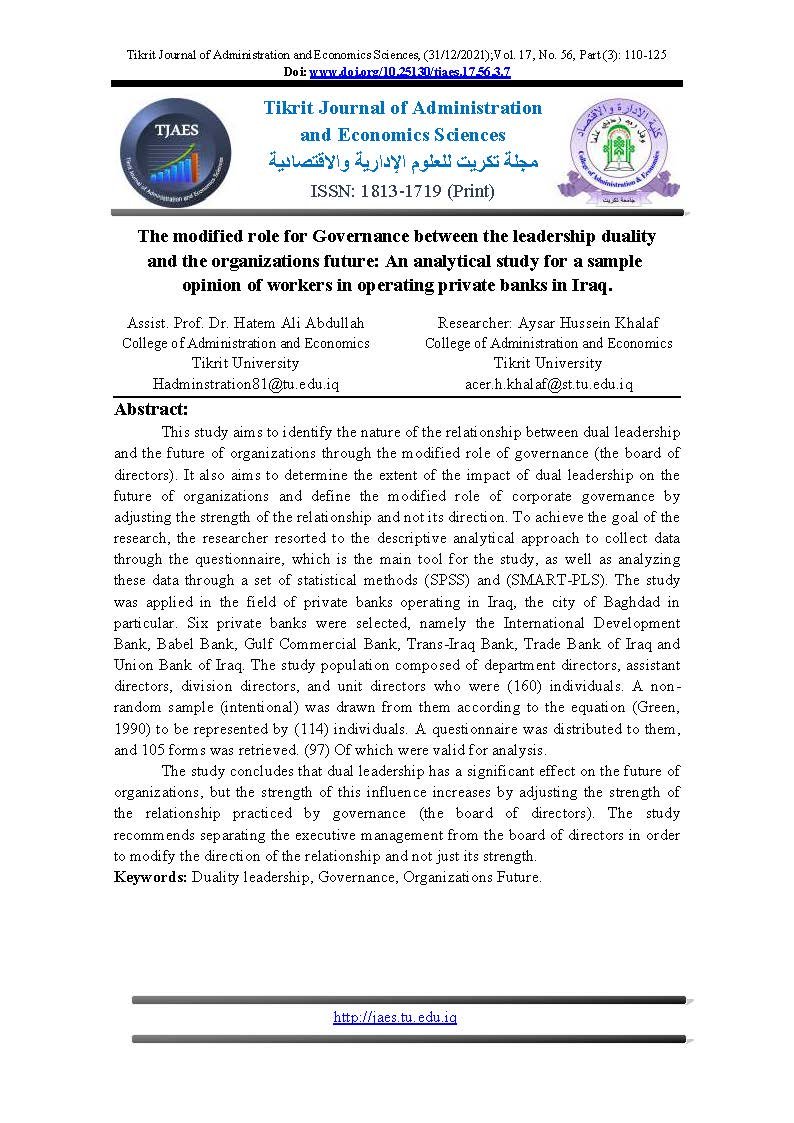
The modified role for Governance between the leadership duality and the organizations future: An analytical study for a sample opinion of workers in operating private banks in Iraq.
Article Sidebar
THIS IS AN OPEN ACCESS ARTICLE UNDER THE CC BY LICENSE
Main Article Content

Abstract
This study aims to identify the nature of the relationship between dual leadership and the future of organizations through the modified role of governance (the board of directors). It also aims to determine the extent of the impact of dual leadership on the future of organizations and define the modified role of corporate governance by adjusting the strength of the relationship and not its direction. To achieve the goal of the research, the researcher resorted to the descriptive analytical approach to collect data through the questionnaire, which is the main tool for the study, as well as analyzing these data through a set of statistical methods (SPSS) and (SMART-PLS). The study was applied in the field of private banks operating in Iraq, the city of Baghdad in particular. Six private banks were selected, namely the International Development Bank, Babel Bank, Gulf Commercial Bank, Trans-Iraq Bank, Trade Bank of Iraq and Union Bank of Iraq. The study population composed of department directors, assistant directors, division directors, and unit directors who were (160) individuals. A non-random sample (intentional) was drawn from them according to the equation (Green, 1990) to be represented by (114) individuals. A questionnaire was distributed to them, and 105 forms was retrieved. (97) Of which were valid for analysis.
The study concludes that dual leadership has a significant effect on the future of organizations, but the strength of this influence increases by adjusting the strength of the relationship practiced by governance (the board of directors). The study recommends separating the executive management from the board of directors in order to modify the direction of the relationship and not just its strength.
Downloads
Article Details
References
اولاً. المصادر العربية:
غادر، محمد ياسين، 2012، محددات الحوكمة ومعاييرها، جامعة الجنان، طرابلس، لبنان.
ثانياً. المصادر الأجنبية:
Beheshtifar, M., & Korouki, A., (2013), Reputation: An Important Component of Corporations' Value, International Journal of Academic Research in Business and Social Sciences, 3(7), 2222-6990.
Bennett, A., Nikolaos, L., Lisa, C., Joel, A., Fad, W., & Hee, N., (2018), Examining Follower Responses to Transformational Leadership from a Dynamic, Person-Environment Fit Perspective, Academy of Management Journal, 1-18.
Boadu, M., (2013), Ethical Dimensions of Corporate Governance Practice in Ghana: Building a Theoretical Perspective.
Bravo, F., Abad, C., & Briones, J. L., (2015), the board of directors and corporate reputation: an empirical analysis, Academia Revista Latinoamericana de Administración, Emerald.
Brown, J. R., Dev, C. S., & Lee, D. J., (2000), Managing marketing channel opportunism: the efficacy of alternative governance mechanisms, Journal of Marketing, 64(2), 51-65.
Broye, G., François, A., & Moulin, Y., (2017), the cost of CEO duality: Evidence from French leadership compensation, European Management Journal, 35(3), 336-350, Elsevier.
Burak, E., Erdil, O., & Altindag, E., (2017), Effect of corporate governance principles on business performance, Australian Journal of Business and Management Research, 5(7), 8-21.
Caniels, M. C., & Gelderman, C. J., (2010), the safeguarding effect of governance mechanisms in inter‐firm exchange: the decisive role of mutual opportunism. British Journal of Management, 21(1), 239-254.
Corbetta, G., & Salvato, C., (2004), Self-serving or self-actualizing? Models of man and agency costs in different types of family firms: A commentary on comparing the agency costs of family and non–family firms: Conceptual issues and exploratory evidence, Entrepreneurship Theory and Practice, 28(4), 355-362.
De Clercq, D., Fatima, T., & Jahanzeb, S., (2020), Gossiping About an Arrogant Leader: Sparked by Inconsistent Leadership, Mitigated by Employee Resilience, the Journal of Applied Behavioral Science, 0021886320917520.
Dimitrova, Y. P., (2016), Communication strategies for reputation management of the company, Romanian Journal of Economics, 43(2 (52)), 5-13.
Dragomir, V. D., (2019), Accountability in the Name of Global Corporate Governance. A Historical Perspective, The Bucharest Academy of Economic Studies, Romania) www. asecu. Gr/files/Romania Proceedings/20. Pdf, accessed, 7.
Feldman, P. M., Bahamonde, R. A., & Velasquez Bellido, I., (2014), A new approach for measuring corporate reputation, Revista de Administração de Empresas, 54(1), 53-66.
Ghasemian, S. H. R., Azad, N., & Seyedaliakbar, H., (2014), a structural equation model of effective variables on service quality in capital industrial goods sector, International Journal of Quality and Service Sciences. Emerald.
Hair JR, Joseph F., Hult, G. Tomas M. Ringle, Christian M. Sarstedt, Marko., (2014), A Primer on Partial Least Structural Equation modeling (PLS-SEM), SAGE Publications, Inc, USA. Emeraled.
Hormiga, E., & García-Almeida, D. J., (2016), Accumulated knowledge and innovation as antecedents of reputation in new ventures. Journal of Small Business and Enterprise Development emerald.
Kim, K. H., Al-Shammari, H. A., Kim, B., & Lee, S. H., (2009), CEO duality leadership and corporate diversification behavior, Journal of Business Research, 62(11), 1173-1180. Elsevier.
Lejárraga, I., Shepherd, B., & van Tongeren, F., (2013), 4 Transparency in Nontariff Measures: Effects on Agricultural Trade, In Nontariff Measures with Market Imperfections: Trade and Welfare Implications, Emerald Group Publishing Limited. Emeraled.
Lin, R., Li, F., & Olawoyin, A., (2020), CEO overconfidence and firm internationalization: the moderating role of experience and managerial discretion, Nankai Business Review International. Emerald.
Lowe, E. A., & Soo, W. F., (1980), Organisational Effectiveness-A Critique and Proposal, Managerial Finance. Emeraled.
Salhi, B., Riguen, R., Kachouri, M., & Jarboui, A., (2019), the mediating role of corporate social responsibility on the relationship between governance and tax avoidance: UK common law versus French civil law, Social Responsibility Journal. Emeraled.
Schultz, H. B., & Werner, A., (2005), Reputation management, Retrieved June 13, 2005. oxford.
Spitzeck, H., (2009), the development of governance structures for corporate responsibility. Corporate Governance: International Journal of Business in Society, 9(4), 495-505. Emeraled.
Stoker, G., (2006), Public value management: a new narrative for networked governance? The American review of public administration, 36(1), 41-57.
Toscano, R., Price, G., & Scheepers, C., (2018), the impact of CEO arrogance on top management team attitudes. European Business Review. Emerald.
Vintila, G., & Duca, F., (2013), Study on CEO duality and corporate governance of companies listed in Bucharest Stock Exchange. Romanian Statistical Review Supplement, 61(2), 88-93.
Wijethilake, C., & Ekanayake, A., (2019), CEO duality and firm performance: the moderating roles of CEO informal power and board involvements. Social Responsibility Journal. Emerald.
Yaşlıoğlu, M., Çalışkan, B. Ö. Ö., & Şap, Ö., (2013), the role of innovation and perceived service quality in creating customer value: A study on employees of a call center establishment. Procedia-Social and Behavioral Sciences, 99, 629-635. Elsevier.
Zidane, Y. J. T., & Olsson, N. O., (2017), Defining project efficiency, effectiveness and efficacy, International Journal of Managing Projects in Business. Emeraled.