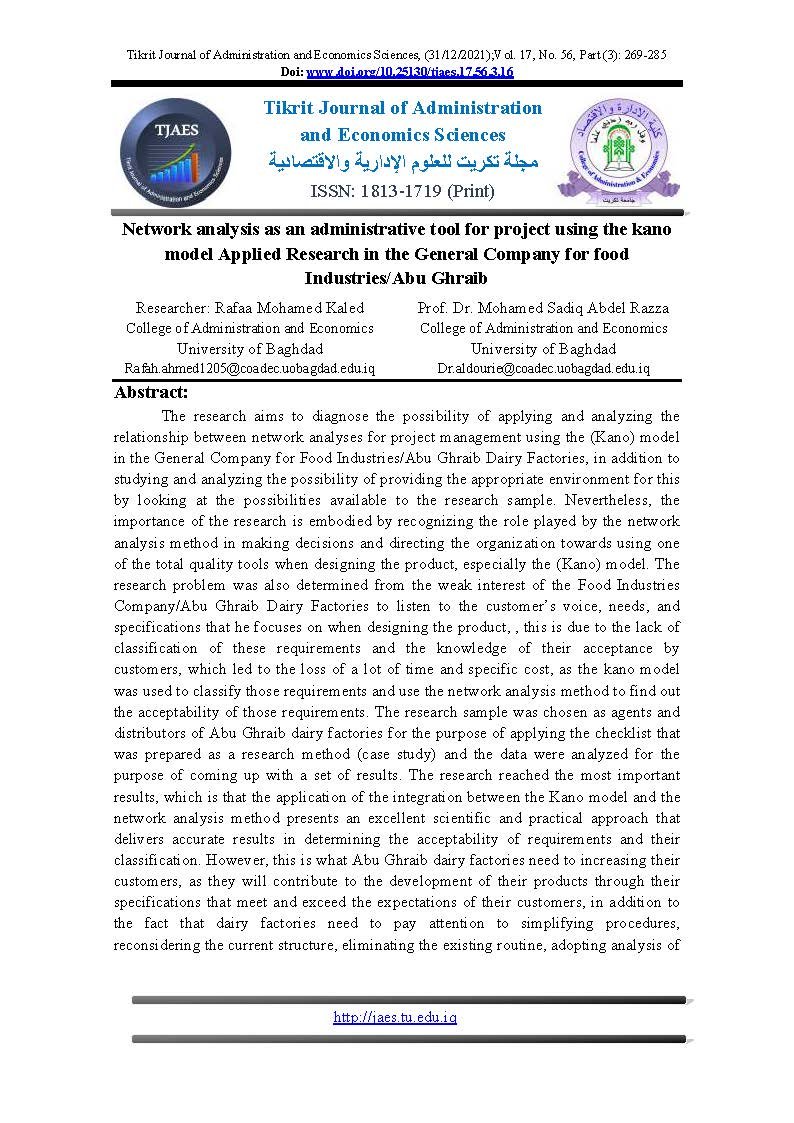
Network analysis as an administrative tool for project using the kano model Applied Research in the General Company for food Industries/Abu Ghraib
Article Sidebar
THIS IS AN OPEN ACCESS ARTICLE UNDER THE CC BY LICENSE
Main Article Content

Abstract
The research aims to diagnose the possibility of applying and analyzing the relationship between network analyses for project management using the (Kano) model in the General Company for Food Industries/Abu Ghraib Dairy Factories, in addition to studying and analyzing the possibility of providing the appropriate environment for this by looking at the possibilities available to the research sample. Nevertheless, the importance of the research is embodied by recognizing the role played by the network analysis method in making decisions and directing the organization towards using one of the total quality tools when designing the product, especially the (Kano) model. The research problem was also determined from the weak interest of the Food Industries Company/Abu Ghraib Dairy Factories to listen to the customer’s voice, needs, and specifications that he focuses on when designing the product, , this is due to the lack of classification of these requirements and the knowledge of their acceptance by customers, which led to the loss of a lot of time and specific cost, as the kano model was used to classify those requirements and use the network analysis method to find out the acceptability of those requirements. The research sample was chosen as agents and distributors of Abu Ghraib dairy factories for the purpose of applying the checklist that was prepared as a research method (case study) and the data were analyzed for the purpose of coming up with a set of results. The research reached the most important results, which is that the application of the integration between the Kano model and the network analysis method presents an excellent scientific and practical approach that delivers accurate results in determining the acceptability of requirements and their classification. However, this is what Abu Ghraib dairy factories need to increasing their customers, as they will contribute to the development of their products through their specifications that meet and exceed the expectations of their customers, in addition to the fact that dairy factories need to pay attention to simplifying procedures, reconsidering the current structure, eliminating the existing routine, adopting analysis of operations and making a greater effort to develop strategic plans which are objective and appropriate to the economic reality of Iraq.
Downloads
Article Details
References
أولاً. المصادر العربية:
أكرام، بن علي وفاطمة، تينيلان، (2020)، استخدام نماذج شبكات الاعمال الحديثة في تخطيط ومراقبة المشاريع: دراسة حالة: مشروع الانارة العمومية المنجز من طرف المؤسسة "ايباش" بولاية أدرار، رسالة مقدمة للحصول على درجة الماجستير في علوم التسيير، كلية العلوم الاقتصادية والتجارية وعلوم التسيير، جامعة احمد دراية-أدرار.
الحكيم، علاء عبد الحسين نوري، (2020)، تقييم المجهزين عب وفق تكامل أداة وظيفة نشر الجودة وعملية التحليل الهرمي الضبابي، بحث تطبيقي، رسالة مقدمة للحصول على درجة الماجستير في علوم إدارة الصناعية، كلية إدارة والاقتصاد-جامعة بغداد.
خنفاس، احمد حسين، (2020)، تأثير اليقظة التسويقية في التسويق الداخلي على وفق نموذج kano))، بحث تطبيقي، رسالة مقدمة للحصول على درجة الماجستير في علوم الإدارة الصناعية، كلية الإدارة والاقتصاد، جامعة بغداد.
الربيعي، أمير راهي عبد، (2018)، تصميم الخدمة باستعمال نموذجي kano وBlueprint، دراسة حالة، رسالة مقدمة للحصول على درجة الماجستير في تقنيات إدارة العمليات، الكلية التقنية الإدارية، الجامعة التقنية الوسطى.
زميت، فواد، (2012)، تقنيات إدارة المشاريع باستعمال التحليل الشبكي، بحث تطبيقي رسالة مقدمة للحصول على درجة الماجستير في علوم تجارية قسم تقنيات كمية، كلية العلوم الاقتصادية والتجارية وعلوم التسيير، جامعة المسيلة.
عبد العال، منى عبد الحي وعبد المحسن، نها عبد الله، (2020)، دور تكنولوجيا التعبئة والتغليف في الحد من الفقد خلال دورة حياة المنتج الغذائي، دراسة حالة، مجلة العمارة والفنون والعلوم الإنسانية، المجلد الخامس، العدد 21، الصفحات (650-664).
عبود، مصطفى قصي، (2018)، تكامل انموذج kano)) واداه QFD)) لتحسين جودة المشروع/دراسة حالة: مجمع الايادي السكني، رسالة مقدمة للحصول على درجة الماجستير في علوم الإدارة الصناعية، كلية الإدارة والاقتصاد، جامعة بغداد.
ثانياً. المصادر الأجنبية:
Alessio Ishizaka, Philippe Nemery, (2013), Multi-Criteria Decision Analysis Methods and Software, Wiley, United Kingdom.
Al-Khasawneh, Yahya, (2016), Impact of Application of the Internal Marketing on Job Satisfaction for the Employees in the Islamic Banks a Case Study of Jordan‖, International Journal of Managerial Studies and Research (IJMSR), Vol. (4), No. (6), PP 33-45.
Chen, Liang-Hsuan & Ko, Wen-Chang & Yeh, Feng-Ting, (2016), Approach based on fuzzy goal programming and quality function deployment for new product planning" European Journal of Operational Research.
Chun-Fang Lin, Chen-Su Fu & Chia-Chun Li, (2019), Integrating meansend chains and the Kano model to understand tourists, cognitive structure toward leisure and recreational resources of suburban-mountains, Asia Pacific Journal of Tourism Research
Dace, Elina, Agnis Stibe, Lelde, Timma, (2019), A holistic approach to manage environmental quality by using the Kano model and social cognitive theory, Corporate Social Responsibility and Environmental Management Vol.2, No 27, pp (1-14).
Djekic, Ilija, Jovan Ilic, Raquel P. F. Guiné, gor Tomasevic, can we understand food oral processing using Kano model? Case study with confectionery products, Journal Texture Studies wiley, Vol.10, No 25, pp (1-9).
Enofe, Obamwonyi, (2010), Maintenance impact on Production Profitability", Acasestudy, Limnaeus University, Schoolof Engineering, Department of Terotechnology Hill International, U.S.
Gailevičiūtė, Ieva, (2011), Kano model: how to satisfy customers? Global Academic Society Journal: Social Science Insight, Vol. (4), No. (12), pp 14-25.
GORENER, Ali, (2012), Comparing AHP and ANP An Application of Strategic Decisions Making in a Manufacturing Company, International Journal of Business and Social Science, Beykent University, Istanbul, Turkey, vol. 3, no. 11.
He, Lina & Ming, Xinguo & Li, Miao & Zheng, Maokuan & Xu, Zhitao, (2015), Understanding customer requirements through quantitative analysis of an improved fuzzy Kano’s model, Journal of Engineering Manufacture, pp (1-14).
Khan, M., et al., (2014), multi-criteria supplier selection using Fuzzy AHP approach: A case study of manufacturing company, International Journal of research In Mechanical engineering & technology. Vol. 5, Issue 1, pp 73-79.
Koo, L. C., (2012), Service Attributes of Casinos in Macau, The First Asia Pacific Conference on Gambling and Commercial Gaming Research (APGC).
Krajewski, L.J., Ritzman, L.P., & Malhotra, M.K., (2010), Operations Management- Processes and Supply Chains-Global Edition, Pearson Prentice Hall, New Jersey, Ninth Edition.
Madzík, Peter & Budaj, Pavol & Mikuláš, Dalibor & Zimon, Dominik, (2019), Application of the Kano Model for a Better Understanding of Customer Requirements in Higher Education A Pilot Study‖, Administrative Sciences, Vol. (9), No. (11).
Mohammed, Ahmed Husham, (2020), The Use of Analytical Hierarchy Process (AHP) Technology in the Selection of an Appropriate Punishment for the Electronic Crime, Management and Economics Journal, University of Basrah, Iraq, No. 24, June, pp (201-216).
Ozcan Kilincci and Suzan Aslı Onal, (2011), Fuzzy AHP Approach for Supplier Washing Machine Company, Expert Selection in A system with Applications, Vol. 38, No. 8, pp. 965-966.
Peter Madzík, (2019), Increasing accuracy of the Kano model, a case study, Total Quality Management & Business Excellence, Department of Management, Faculty of Education, Catholic university in Ruzomberok, Nabrezie Jana Pavla II., c. 15, 058 01 Poprad, Slovakia
Peter Madzík, Věra Pelantová, (2018), Validation of product quality through graphical interpretation of the Kano model-an explorative study, International Journal of Quality & Reliability Management.
Piryono, Anjar & Yulita, Andina, (2017), Integrating Kano Model and Quality Function Deployment for designing service in hospital front office, vol. 13, mum (5) pp. 923-945.
Saaty, T., (1982), the Analytical Hierarchy Process, Mc Gra Hill International, U.S.
Salomon, A. P. & B. Montevechi, (2001), A Compilation of Compar1isons on The Analytic Hierarchy Process and Other Multiple Criteria Decision Making, Methods: Some Cases Developed in Brazil.
Shahin, Arash & Pourhamidi, Masoud & Antony, Jiju, (2015), Typology of Kano models: a critical review of literature and proposition of a revised mode‖, International Journal of Quality & Reliability Management, Vol. (30), No. (3), pp 341-358.
Taylor, Bernard, (2002), Introduction to Management Science, 7thed, Prentice Hall, Inc, USA
Yah, Tsu-Ming, (2010), Determining medical service improvement priority by integrating the refined Kano model, Quality function deployment and Fuzzy integrals, African Journal of Business Management, Vol. 4 (12), PP: 2534-2545.
Zobnina, Margarita, Rozhkov, Aleksandr, (2018), Listening to the voice of the customer in the hospitality industry: Kano model application, Worldwide Hospitality and Tourism Themes, https://doi.org/10.1108/WHATT-03-2018-0020.