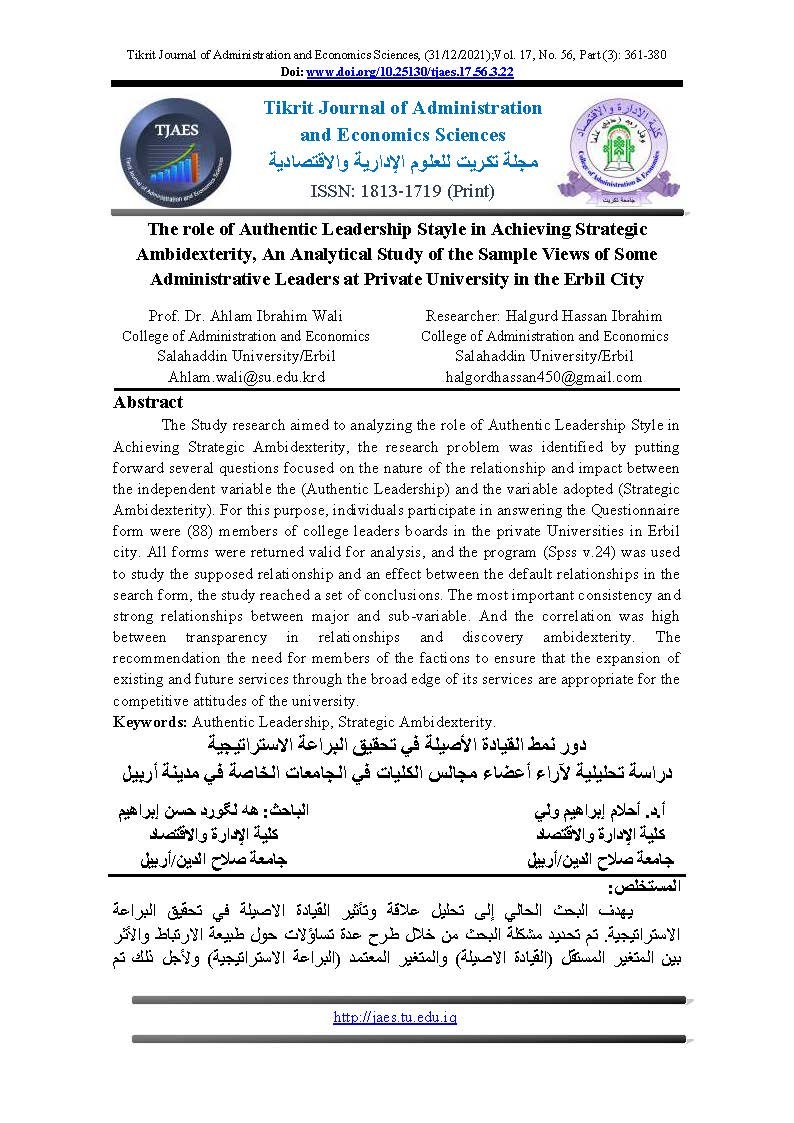
The role of Authentic Leadership Stayle in Achieving Strategic Ambidexterity, An Analytical Study of the Sample Views of Some Administrative Leaders at Private University in the Erbil City
Article Sidebar
THIS IS AN OPEN ACCESS ARTICLE UNDER THE CC BY LICENSE
Main Article Content

Abstract
The Study research aimed to analyzing the role of Authentic Leadership Style in Achieving Strategic Ambidexterity, the research problem was identified by putting forward several questions focused on the nature of the relationship and impact between the independent variable the (Authentic Leadership) and the variable adopted (Strategic Ambidexterity). For this purpose, individuals participate in answering the Questionnaire form were (88) members of college leaders boards in the private Universities in Erbil city. All forms were returned valid for analysis, and the program (Spss v.24) was used to study the supposed relationship and an effect between the default relationships in the search form, the study reached a set of conclusions. The most important consistency and strong relationships between major and sub-variable. And the correlation was high between transparency in relationships and discovery ambidexterity. The recommendation the need for members of the factions to ensure that the expansion of existing and future services through the broad edge of its services are appropriate for the competitive attitudes of the university.
Downloads
Article Details
References
اولاً. المصادر العربية:
البغدادي، عادل، الجبوري، حيدر، (2015)، إثر البراعة التنظيمية في تحقيق المرونة الاستراتيجية: دراسة ميدانية مقارنة بين شركتي الاتصالات (زين واسيا تل في العراق)، مجلة القادسية للعلوم الإدارية والاقتصادية، المجلد (17)، العدد (1)، العراق، ص17-32.
علي، آري، دلمان، شرفاني، (2017)، تأثير البراعة الاستراتيجية في تحسين أبعاد جودة الخدمة الفندقية دراسة استطلاعية لآراء المديرين لعينة من فنادق الأربعة والخمسة نجوم في محافظتي دهوك وأربيل، مجلة الابتكار والتسويق، المجلد (4)، العدد (1)، ص11-29.
عويس، ممدوح، (2015)، دور ممارسات إدارة الموارد البشرية في بناء البراعة التنظيمية وأثرها على الأداء التنظيمي دراسة تطبيقية على الشركات الصناعية الصغيرة والمتوسطة في المملكة العربية السعودية، مجلة الإدارة العامة، معهد الإدارة العامة، العامة، المجلد (55)، العدد (2).
ثانياً. المصادر الاجنبية:
Anderson, L., (2018), The Influence of Authentic Leadership on Fourth Year Nursing Students Experience of Workplace Bllying and Withdrawal Intentions, Ph.D. Dissertation, Western University.
Boanta Catalin & Csiszar Akos, (2017), optimal design of a parallel structure used as a haptic Interface, Mechanism and Machine Theory Journal homepage: www.elsevier.com/locate/mechmachtheory.
Bodwell, W., & Chermack, T., T., (2010), Organizational ambidexterity: Integrating deliberate and emergent strategy with scenario planning. Technological Forecasting and Social Change Journal, 77 (2), pp.193-202.
Bordei, Irina, (2015), The Influence of Authentic Leadership on Employees Analyzed Through Self Determination Theory. Dissertation submitted to gain the degree of Master in Human Resource management, university of Algarve.
Burgers H., & Jansen J., (2008), Organizational ambidexterity and corporate entrepreneurship: the differential effects on venturing, innovation. Fortier's of Entrepreneurship Research, 28 (19), pp. 1-16.
Clapp-smith, R., Vogelesang, G., and avey, J., (2009), authentic leadership and positive psychological capital: the mediating role of trust at the group level of analysis, Organizational studies 15:3, pp.227-240
Davidson, E.S., (2017), Presence of Authentic Leadership and Bullying in the nursing Workplace: A Corrrelational Study, Ph.D. Dissertation, University of Arkansas for Medical Sciences.
Dhliwayo, S., & Van Vuuren, J., (2007), the strategic entrepreneurial thinking imperative, Acta Commercii, 7(3), 123-134.
Duignan. P & Bhindi. N., (1997), Authenticity in leadership: an emerging perspective Journal of Education Administration, Vol.35 No. 3, pp.
Emuwa, A., (2015), Examining the Endorsement of Authentic Leadership, Organizational Commitment and Perceived Leader Effectiveness Among Nigerian Employees, Unpublished Doctoral Dissertation, School of Business & Leadership, Regent University.
George, B., (2003), authentic leadership: Rediscovering the secrets to creating lasting value, San Francisco: Jossey-Bass.
Gibson, B & Birkinshaw, J., (2004), the Antecedents, Consequences, and Mediating Role of Organizational Ambidexterity, Academy of Management Journal, 47 (2), 209-226.
Henderson. J. & Hoy. W., (1983), Leader authenticity: The development and test of an operational measure educational and psychological Research, 3 (2), 63-75.
Kermis, M. H., (2003), toward a conceptualization of optimal self-esteem, Psychological Inquiry, 14(1), pp.1-26.
Lavikka, R., Smeds, R. & Jaatinen, M., (2015), A process for building inter-organizational contextual ambidexterity', Business Process Management Jounal, Vol. 21, Iss.5, Pp. 1140-1161.
May, D.R., Chan, A. Y., Hodges, T. D., & Avolio, B. J., (2003), Development the Moral Component of Authentic Leadership, Organizational Dynamics, 32(3), pp. 60-247.
Morgan. H, Harkins. P. & Goldsmith. M., (2005), The Art and Practice of Leadership Coaching Jon Wiley & Sons, Inc., Hoboken, New Jersey, pp.91.
Northouse. P.G., (2013), Leadership: Theory and practice (6th ed.), thousand Oaks, CA: SAGE: www.Amazon.com.
Ortega, Eva, Azorin, Jose, (2018), A Joint Analysis of Determinants and Performance Consequence of ambidexterity, BRQ Business Research Quarterly, 21, pp. 84-98.
Pai, Ashwin, (2007), overcoming the Innovator's Dilemma through Organizatioal Ambidexterity within the Indian pharmaceutical Industry, University of Nottingham.
Palm, K., & Lilja, J., (2017), Key enabling factors for organizational ambidexterity in the public sector, International Journal of Quality and Service Sciences, 9 (1), pp. 2-20.
Probst, G., & Raisch, S., (2005), Organizational crisis: The logic of failure, Academy of Management Perspectives, 19 (1), pp. 90-105.
Rego, Armenio, Sousa. Filipa, Marques, Carla. Cunha, Miguel Pina, (2014), Hope and positive affect mediating the authentic leadership and creativity relationship; Journal of Business Research 67, pp. 22-210.
Rego, A, Sousa, F, Marrques, C, & Cunha. M., (2012), Authentic leadership promoting employee's psychological capital and creativity Journal of business Research 65, pp.429-437.
Ramukumba Ndivhuwa, (2017), Building an Organizational self-disruption capability for a competitive advantage: an investigation for the organizational antecedents.
Rothwell. A. & Charleston. B., (2013), International volunteering: employability leadership and more Education + Training, Vol. 55 No. 2, pp.159-173.
Schulze, Patrick, (2009). Balancing Exploitation and Exploration, Germany, Heidelberg: Gabler.
Silvia, P. J., & Duval, T. S., (2001), Objective self-awareness theory: Recent progress and enduring problems, Personality and Social Psychology Review, 5, pp. 230-241.
Simsek, Zeki, Heavey, Ciaran, Veiga, Johan & Souder, David, (2009), A typology for Aligning Organizational Ambidexterity's Conceptualizations, Antecedents, and Outcomes, Journal of Management Studies, 46 (5), pp. 864-984.
Tuan L., Trong, (2016), Organizational Ambidexterity, Enter Preneuial Organization, and Deals: the moderating Role of CSR, Journal of Business Ethics, Vol.6, and No.35.
Walumbwa, Fred O., Christensen, Amanda L., Hailey, Fernanda, (2011), Authentic leadership and the knowledge economy: Sustatining motivation and trust among knowledge Workers; Organizational dynamics 40, pp. 110-118.
Zamahani, M., Ghorbani, V. and rezaie, F., (2011), Impact of Authentic Leadership and Psychological Capital on Follower’s Trust and Performance, Australian Journal of Basic and Applied Science, 5 (12), pp. 658-667.