Economic measurement of the impact of foreign trade on environmental development in selected developed countries for the period (1990-2019)
Article Sidebar
THIS IS AN OPEN ACCESS ARTICLE UNDER THE CC BY LICENSE
Main Article Content

Abstract
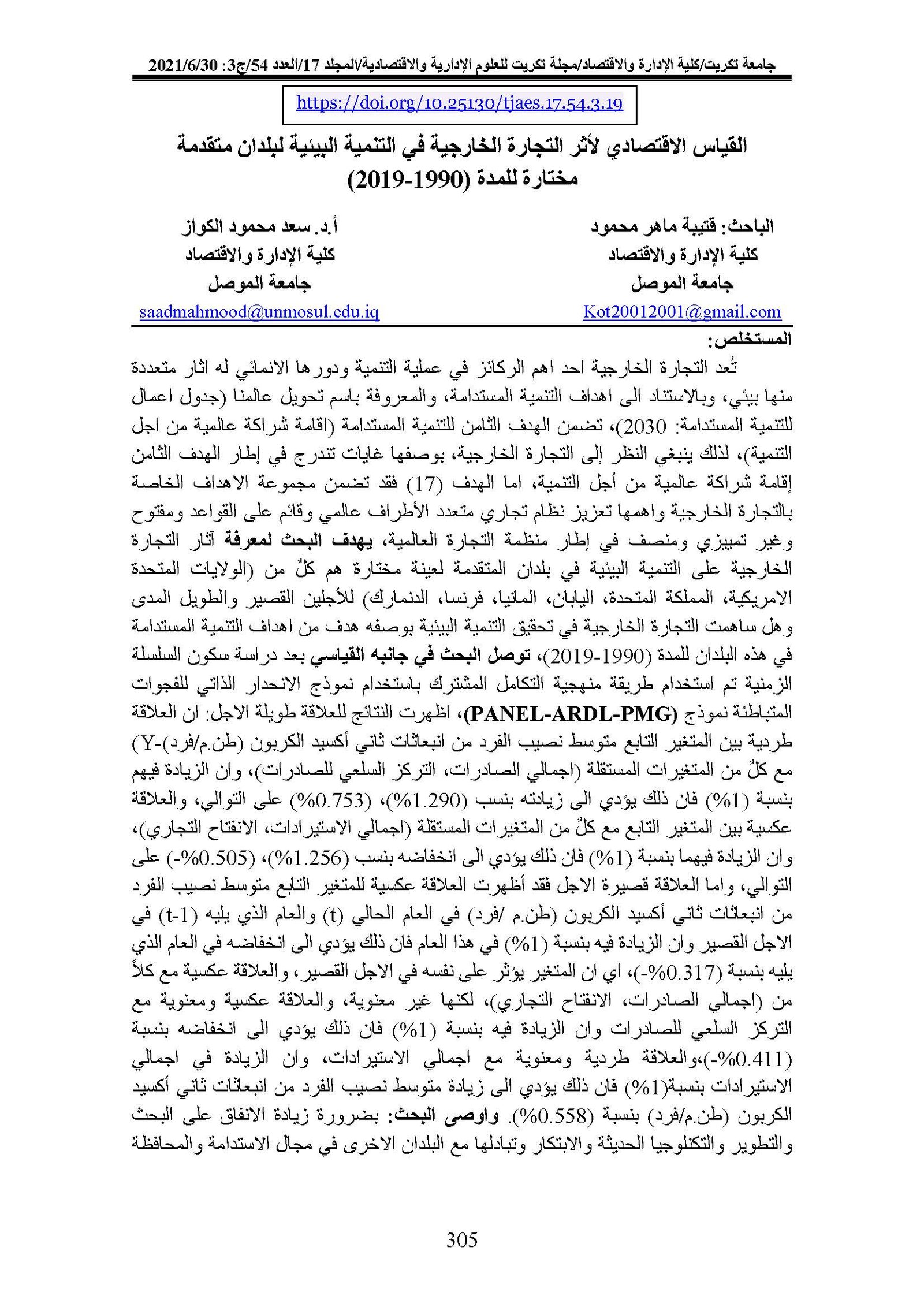
Foreign trade is one of the most important pillars in the development process and its development role has multiple implications, including environmental. Based on the sustainable development goals, known as transforming our world (Sustainable Development Agenda: 2030), it includes the eighth goal of sustainable development (establishing a global partnership for development), Therefore, foreign trade should be viewed as goals within the eighth goal, to establish a global partnership for development. As for Goal (17), the set of objectives for foreign trade include the promotion of a global, rules-based, open, non-discriminatory and equitable multilateral trading system within the framework of an organization. Global trade, the research aims to find out the effects of foreign trade on environmental development in developed countries for a selected sample (the United States of America, the United Kingdom, Japan, Germany, France, and Denmark) for the short and long term. Did foreign trade contribute to achieving environmental development as a goal from the sustainable development goals in these countries for the period (1990-2019). The research reached its standard aspect after studying the dormancy of the time series. Cointegration methodology using the self-regression model of lagging gaps (PANEL-ARDL-PMG) model. The results showed for the long-term relationship: that the relationship is positive between the dependent variable average per capita emissions of carbon dioxide (tons per capita) - Y) with each of the independent variables (total exports, commodity concentration of exports), and an increase in them by (1%), this leads to an increase of (1.290%) and (0.753%) respectively. The inverse relationship between the dependent variable with each of the independent variables (Total imports, trade openness), and an increase in them by (1%), this leads to a decrease in rates (-1.256%) and (-0.505%) respectively. As for the short-term relationship, the inverse relationship to the dependent variable showed the average per capita share of carbon dioxide emissions (tons per capita) in the current year (t) and the following year (t-1) in the short term. An increase in it by (1%) in this year, this leads to a decrease in the following year by (t) (-0.317%), meaning that the variable affects itself in the short term, and the relationship is inversely related to (total exports, trade openness). Re), but it is not moral, and the opposite and significant relationship with the commodity concentration of exports, and an increase in it by (1%), this leads to a decrease by (-0.411%), and the positive and moral relationship with the total imports, and the increase in total imports by (1%) This leads to an increase in the average per capita carbon emissions (tons per capita) by (0.558%). The research recommended: development, modern technology and innovation and exchange them with other countries in the field of sustainability and resource conservation, work to spread environmental awareness, exchange experiences and information among developing countries, monitor and follow up activities polluting the environment, and the need to work in developing countries to pursue an economic and trade policy that works on observing environmental conditions and monitoring increases in pollution rates.
Downloads
Article Details
References
أولاً. المصادر العربية:
ابو النصر ومحمد، مدحت، ياسين مدحت، (2017)، التنمية المستدامة مفهومها ابعادها مؤشراتها، المجموعة العربية للتدريب والنشر، الطبعة الاولى، القاهرة، مصر.
باداوة تي، سردار عثمان خدر، (2009)، تحليل العلاقة الدالية بين درجة الحرية الاقتصادية والتجارة الخارجية وانعكاساتها على المؤشرات الاقتصادية الكلية لبلدان نامية مختارة للمدة 1990-2005، اطروحة دكتوراه، كلية الادارة والاقتصاد، جامعة بغداد.
العزاوي، فلاح جمال معروف، (2016)، التنمية المستدامة والتخطيط المكاني، الطبعة الاولى، دار دجلة ناشرون موزعون، عمان، الاردن.
غنية، د. حركو، (2019)، نظريات التجارة الدولية، مطبوعة موجهة لطلبة السنة الثالثة اقتصاد دولي، جامعة عبدالحميد مهري قسطنطينية 2، كلية العلوم الاقتصادية وعلوم التيسير، قسم العلوم الاقتصادية.
محمود وتفاحة، د. حبيب، أيهم، (2010)، الآثار المتبادلة بين التجارة والبيئة دراسة تحليلية حول المعايير البيئية والنفاذ إلى الأسواق العالمية في سوري، مجلة جامعة تشرين للبحوث والدراسات العلمية، سلسلة العلوم الاقتصادية والقانونية المجلد 23، العدد 2.
البنك الدولي: (https://www.albankaldawli.org/)
ثانياً. المصادر الأجنبية:
Giles Atkinson, Simon Dietz and Eric Neumayer, (2007), Hand book sustainable Develombpmen, Cheltenham, UK, Northampton, MA, USA, 418-419.
Blaed, Sean King, (2014), Three Essays on Environmental Economics and International Trade, 22.
Yutong Tian, Shulian Xue, Chunhui Li, Hongli Liang and Jiansu Mao, (2019), Sustainable Developmental Evaluation of Foreign Trade Based on Emergy Analysis Method in Shenzhen City, Beijing Normal University, Beijing,China.