
The Contributions of Quality Function Deployment Technology in Green Product Design A survey study of a group of dairy factories in Mosul City
Article Sidebar
THIS IS AN OPEN ACCESS ARTICLE UNDER THE CC BY LICENSE
Main Article Content

Abstract
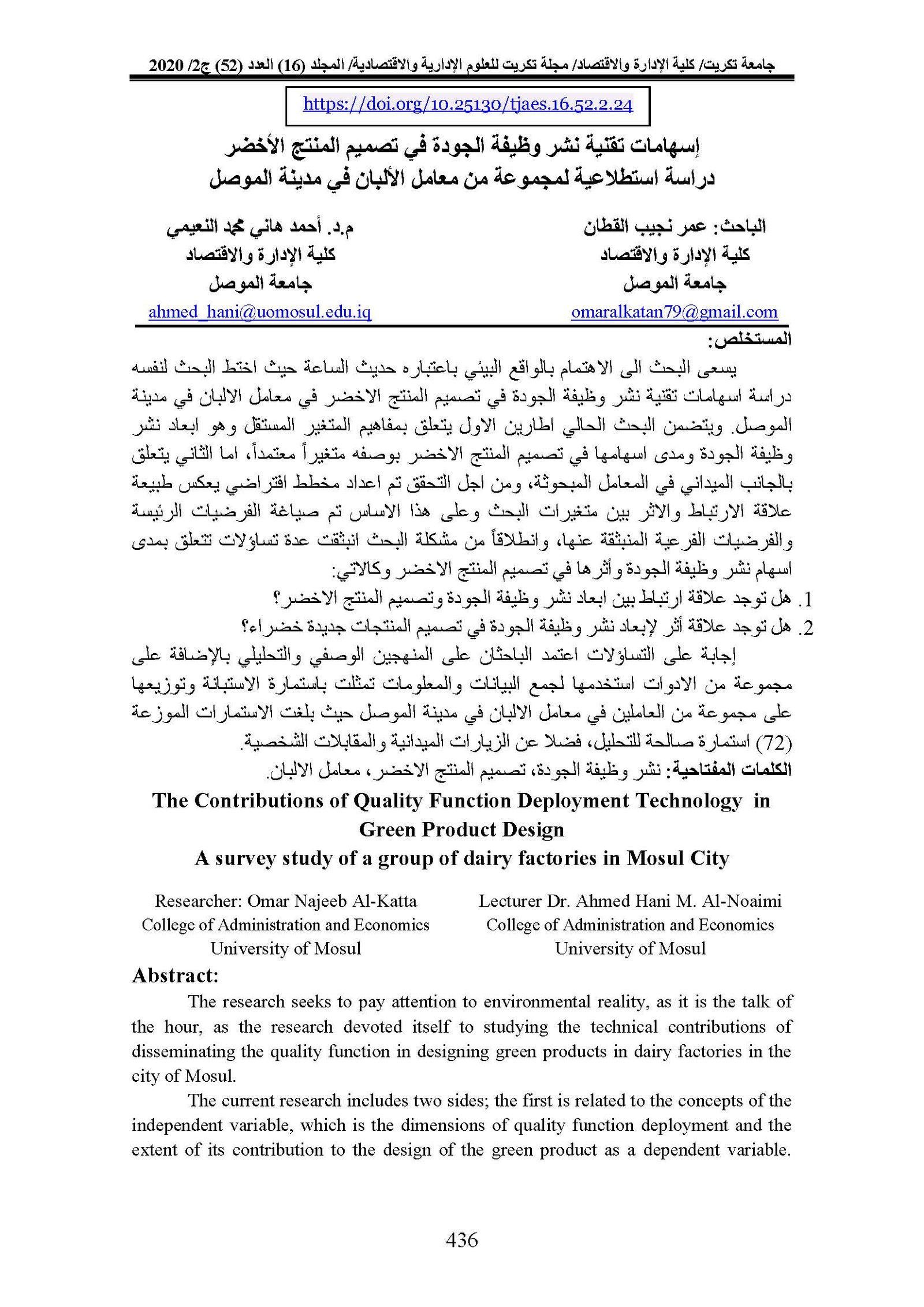
The research seeks to pay attention to environmental reality, as it is the talk of the hour, as the research devoted itself to studying the technical contributions of disseminating the quality function in designing green products in dairy factories in the city of Mosul.
The current research includes two sides; the first is related to the concepts of the independent variable, which is the dimensions of quality function deployment and the extent of its contribution to the design of the green product as a dependent variable. Basically, the main hypotheses and the sub-hypotheses emanating from them were formulated, and on the basis of the research problem, several questions arose regarding the extent of the contribution of quality function deployment and its impact on the green product design as follows:
- Is there a correlation between the dimensions of quality function deployment and green product design?
- Is there an impact relationship to banish the deployment of the quality function in designing new green products?
In answer to the questions, the two researchers relied on the descriptive and analytical approaches, in addition to a set of tools that they used to collect data and information, represented by the questionnaire form and its distribution to a group of workers in dairy factories in the Mosul city, where the distributed forms reached (72) forms suitable for analysis, as well as field visits and personal interviews.
Downloads
Article Details
References
اولاُ. المصادر العربية:
ابو شحاتة، ثناء معوض علي، (2019)، دور الابتكار الاخضر في تصميم المنتجات صديقة البيئة، دراسة ميدانية بالتطبيق على قطاع الصناعات الكهربائية في مدينة العاشر من رمضان، المجلة العلمية للاقتصاد والتجارة.
الخطيب، سمير كاظم ولودير، تالين كايزاك، (2011)، تطبيق أداة نشر وظيفة الجودة دراسة تطبيقية في الشركة العامة للصناعات الجلدية، مجلة كمية الإدارة والاقتصاد-جامعة بغداد، العدد 64، بغداد.
ليليا، وهاب، (2013)، تأثير إعادة التدوير في الرفع من القدرة التنافسية في ظل فلسفة التسويق الأخضر-دراسة حالة مؤسسة أنابيب ببرج بوعريريج-، ماجستير في علوم التسيير كلية العلوم الاقتصادية والعلوم التجارية، جامعة المسيلة.
ثانياً. المصادر الاجنبية:
Al-Bashir, Adnan, (2016), Applying Total Quality Management Tools Using QFD at Higher Education Institutions in Gulf Area (Case Study: ALHOSN University). International Journal of Production Management and Engineering. Int. J. Prod. Manag. Eng. (2016) 4 (2), 87-98.
Alrabghi, Leenah O., (2013), QFD in Software Engineering, Master of Science Kent State University.p24.
Baumann, H., Boons, F. and A. Bragdm, (2002), mapping the green product development field: engineering, policy and business perspectives. Journal of Cleaner Production 10 (2002) 409-425.
Büyüközkan, G. & Çifçi, G., (2012), Evaluation of the green supply chain management practices: a fuzzy ANP approach, Production Planning & Control, 23:6, 405-418.
Chien, M., and L. Shih. (2007), an Empirical Study of the Implementation of Green Supply Chain Management Practices in the Electrical and Electronic Industry and Their Relation to Organizational Performances. International Journal of Engineering Scienc. pp.383-394.
Chiou, T., H. Chan, and C. Wen. (2011), the Influence of Greening the Suppliers and Green Innovation on Environmental Performance and Competitive Advantage in Taiwan. Transportation Research Part E47: 822-836.
Fitzgerald, D. P., Herrmann, J. W., Sandborn, P. A., Schmidt, L. C. and T. H. Gogoll (2007), Design for Environment (DfE): Strategies, Practices, Guidelines, Methods, and Tools, Environmentally Conscious Mechanical Design.
H. Farsijani, M. Shafiei Nikabadi, S. Keshavarz Dastak, (2017), The Role of Integration QFDVA in New Product Design to Achieve WorldClass Manufacturing, International Journal of Research in Industrial Engineering, Vol. 6, No. 1 (2017) 17–38.
Hubner, R., (2012), Eco-design: Reach, Limits and Challenges 20 years of Eco-design-Time for a Critical Reflection. Forum Ware International 1: 25-38.
Karlsson, R. and Luttropp, C., (2006), EcoDesign: what is happening? An overview of the subject area of EcoDesign and of the papers in this special issue, Journal of Cleaner Production 14 (2006) 1291-1298.
Khor, K. S. & Udinb, Z. M., (2013), Reverse logistics in Malaysia: Investigating the effect of green product design and resource commitment Resources, Conservation and Recycling 81 (2013) 71-80.
Kumar, S., S. Teichman, and T. Timpernagel, (2012), A Green Supply Chain is a Requirement for Profitability. International Journal of Production Research 50 (5): 1278-1296.
Kunecka, Danuta, (2016), Quality Function Deployment as a Method Used In the Development of the Quality of Education for the Nursing Practice. General and Professional Education 1/2016 pp. 42-45.
Large, R.O. and Thomsen, C.G., (2011), Drivers of green supply management performance: Evidence from Germany, Journal of Purchasing & Supply Management, Vol. 17, No. 3, pp. 176-184.
Large, R.O. and Thomsen, C.G., (2011), Drivers of green supply management performance: Evidence from Germany, Journal of Purchasing & Supply Management, Vol. 17, No. 3, pp. 176-184.
Lindahl, M. & Tingström, J., (2001), A little textbook on Environmental Effect Analysis, Department of Technology, University of Kalmar,ISBN 91-973906-4-X.
Mazur, G., (2003), ‘Voice of the customer (define): QFD to define value.’ ASQ’s 57th Annual Quality Congress Proceedings, pp. 151-157.
Mujalda, S., Verma, D. S., (2015), Quality Function Deployment For Row House Construction In Real Estate International Journal Of Scientific & Technology Research Volume 4, Issue 06, June 2015 .p161-167.
Nei.lEldin, M. &Verda .Hikle, (2003), Pilot Study of Quality Function Deploymentin Construction Projects, Journal of Construction Engineering and Management © ASCE / MAY/JUNE 2003.pp 314-329.
Okonta, Okechukwu Emmanuel, Ojugo, Adimabua Arnold, Wemembu Uchenna Raphael, Ajani Dele, (2013), Embedding Quality Function Deployment In Software Development: A Novel Approach. West African Journal of Industrial & Academic Research Vol.6 No.1 March 2013.PP.50-64.
Özgener, z., (2003), Quality function deployment: A teamwork approach. Total Quality Management and Business Excellence, VOL. 14, NO. 9, NOVEMBER, 2003, 969–979.
P. Thamsatitdej, S. Boon-itt, P. Samaranayake, M. Wannakarn &T.Laosirihongthong (2017): Eco-design practices towards sustainable supply chain management:interpretive structural modelling (ISM) approach, International Journal of Sustainable Engineering.pp.1-12.
Poulikidou, Sofia, (2012), Methods and tools for environmentally friendly product design and development Identification of their relevance to the vehicle design context. P.34.
Prasad, K., Chakraborty, S., (2013), A quality function deployment-based model for materials selection. Materials and Design 49 (2013) 525-535.
Ritzen S., (2000), Integrating Environmental Aspects into Product Development-Proactive Measures. PhD Thesis. Stockholm: Royal Institute of Technology-KTH.p.10.
Savaş, H.,and Ay, M., (2005), Üniversite kütüphanesi tasarımında Kalite Fonksiyon Göçerimi uygulaması, Dokuz Eylül Üniversitesi Sosyal Bilimler Enstitüsü Dergisi, 7, 3, 80-98.
Shi, J., Lia, Q., Lia, H., Li, S., Zhang, J. and Shi, Y., (2017), Eco-design for recycled products: Rejuvenating mullite from coal fly ash. Resources,Conservation and Recycling Volume 124, September 2017, Pages 67-73.
Singhal, Puja, (2013), Green Supply Chain and Eco-Design in Electronic Industry, Delhi Business Review X Vol. 14, No. 1 (January - June 2013). PP57-78.
Suliyev, T., (2007), Müşteri beklentilerinin Kalite Fonksiyon Yayılımı ile analiz edilmesi ve gıda ambalajı sanayinde örnek bir uygulama, Master thesis, Gazi University, Institute of SocialSciences, 127p.
Tseng, M., R. Wang, Y. Geng, and Y. Lin., (2012), Improving Performance and Green Innovation Practices Under Uncertainty. Journal of Cleaner Production 40 (1): 71–82.
Wakulele, S. R., Odock, S., Nyile, B. C., & E. Kiswili, (2016), Effect of Eco-design Practices on the Performance of Manufacturing Firms in Mombasa County, Kenya. International Journal of Business and Social Science Vol. 7, No. 8; August 2016.pp.108-132.
Winco K.C. Yung, H.K. Chan, Danny W.C. Wong, Joey H.T. So Albert C. K. Choi & T.M. Yue, (2012), Eco-redesign of a personal electronic product subject to the energyusing product directive, International Journal of Production Research, 50:5, 1411-1423.
Wu, K-J., Tseng, M-L, and Vy, T., (2011), Evaluation the drivers of green supply chain management practices in uncertainty, Procedia-Social and Behavioral Sciences, Vol. 25, pp. 384-397.
Yang, Jirong, (2013), the green design and manufacturing technology based on the recycling theory. Applied Mechanics and Materials Online: 2013-08-16 ISSN: 1662-7482, Vols. 365-366, pp 541-544.
Yarwood, J. and Eagan, P. D., (2001), Design for the Environment (DfE) Toolkit, Minnesota Office of Environmental Assistance, Minnesota Technical Assistance Program (MnTAP), available: http://www.pca.state.mn.us/index.php/view-document.html?gid=4683, accessed October 29, 2012.pp.17-27.
Zaim, S.,and Şevkli, M., (2002), The methodology of Quality Function Deployment with crisp and fuzzy approaches and an application in the Turkish shampoo industry, Journal of Economic and Social Research, 4, 1, 27-53.
Zsidisin, G. A, Siferd, S.P., (2001), Environmental purchasing: a framework for theory development. European Journal of Purchasing and Supply Management. 7 (1): 61-73.