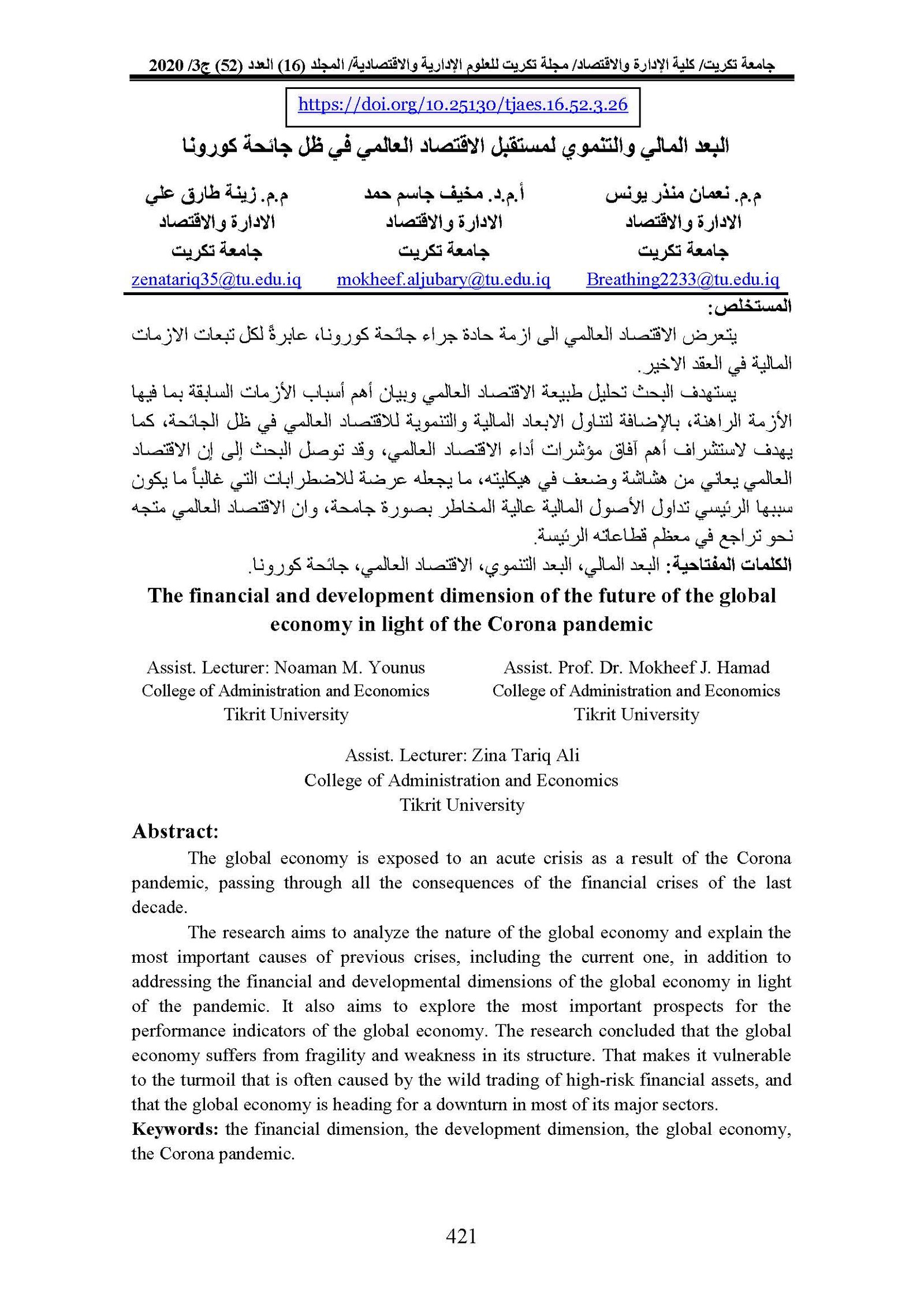
The financial and development dimension of the future of the global economy in light of the Corona pandemic
Article Sidebar
THIS IS AN OPEN ACCESS ARTICLE UNDER THE CC BY LICENSE
Main Article Content

Abstract
The global economy is exposed to an acute crisis as a result of the Corona pandemic, passing through all the consequences of the financial crises of the last decade.
The research aims to analyze the nature of the global economy and explain the most important causes of previous crises, including the current one, in addition to addressing the financial and developmental dimensions of the global economy in light of the pandemic. It also aims to explore the most important prospects for the performance indicators of the global economy. The research concluded that the global economy suffers from fragility and weakness in its structure. That makes it vulnerable to the turmoil that is often caused by the wild trading of high-risk financial assets, and that the global economy is heading for a downturn in most of its major sectors.
Downloads
Article Details
References
أولاً. المصادر العربية:
الخزرجي، ثريا، (2009)، الأزمة المالية العالمية الراهنة وأثرها في الاقتصاديات العربية: التحديات وسبل المواجهة، ورقة عمل مقدمة في المؤتمر العلمي الثالث لكلية العلوم الادارية والمالية المنعقد في 28-29 أبريل، جامعة الاسراء، الأردن.
الموسوي، حيدر يونس، (2011)، انعكاسات الأزمة المالية العالمية على أسواق المال العربية-دراسة تحليلية في بلدان عربية مختارة للمدة 2003-2009، العدد السادس والثمانون، مجلة الادارة والاقتصاد، كلية الادارة والاقتصاد، الجامعة المستنصرية.
صلاح، علي، (2020)، ملامح جديدة للاقتصاد العالمي في مرحلة ما بعد كورونا، دراسة صادرة عن المستقبل للأبحاث والدراسات المتقدمة، الإمارات، العدد 4.
تقرير مستجدات آفاق الاقتصاد العالمي، (2020(، الصادر عن صندوق النقد الدولي:
https://www.imf.org/ar/Publications/WEO
تقرير الراصد المالي عدد أبريل (2020)، الصادر عن صندوق النقد الدولي:
https://www.imf.org/ar/Publications/FM/Issues/2020/04/06/fiscal-monitor-april-2020
ثانياً. المصادر الأجنبية:
FDI, (2020), Investment trends monitor, impact of the coronavirus outbreak on global. United Nations, UNCTAD.
OECD, (2020, 03 26), New OECD outlook on the global economy, https://www.oecd.org/coronavirus/en/
Gourinchas, P.-O., & Rey, H., (2007), from world banker to world venture capitalist: US external adjustment and the exorbitant privilege. In G7 current account imbalances: sustainability and adjustment , University of Chicago Press
Gemici, K., (2013), Moral economy redux: social protests in Turkey after the 2001 economic crisis. (P. D. Hank Johnston, Ed.) Mobilization: An International Quarterly, 8 (18)
Kindleberger, C., & Aliber, R., (2011), Manias, panics and crashes: a history of financial crises. Palgrave Macmillan.
Lyonnet, V., & Werner, R., (2012), Lessons from the Bank of England on ‘quantitative easing and other ‘unconventional monetary policies. (Elsevier, Ed.) International Review of Financial Analysis.
Longstaff, F., (2010), the subprime credit crisis and contagion in financial markets. (Elsevier, Ed.) Journal of financial economics, 97 (3).
McCauley, R., McGuire, P., & von Peter, G., (2012), after the global financial crisis: From international to multinational banking? Journal of Economics and Business, 64(1).
Ramelli, S., & Wagner, A., (2020), 7 What the stock market tells us about the consequences of COVID-19. Mitigating the COVID Economic Crisis: Act Fast and Do Whatever.
Shin, K.-Y., (2013), Economic crisis, neoliberal reforms, and the rise of precarious work in South Korea. (C. Sage Publications Sage CA: Los Angeles, Ed.) American Behavioral Scientist, 57(3).
Unctad, (2020, March), Investment trends monitor, Impact of the Coronavirus Outbreak on Global FDI. United Nations.