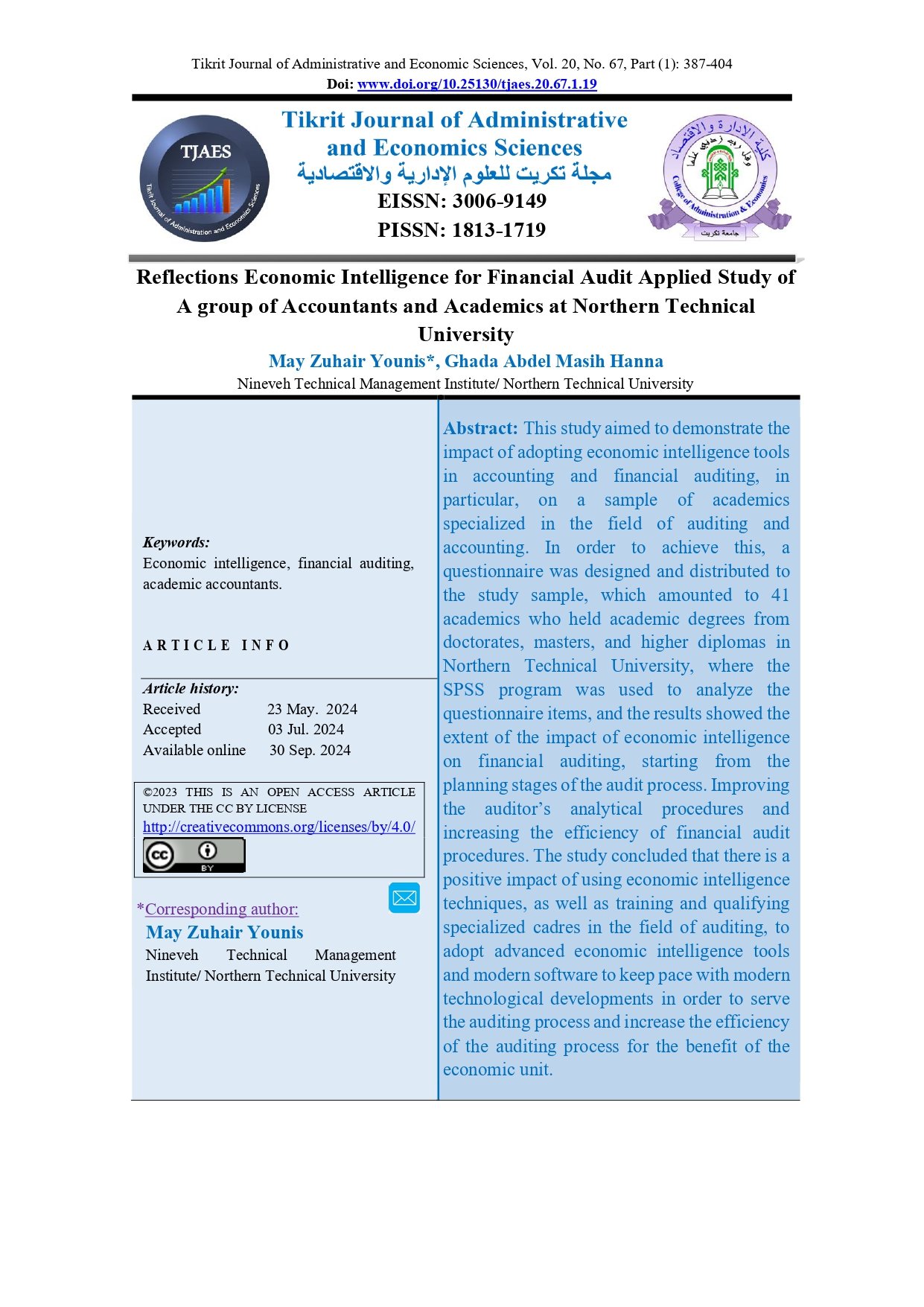
Reflections Economic Intelligence for Financial Audit Applied Study of A group of Accountants and Academics at Northern Technical University
Article Sidebar
THIS IS AN OPEN ACCESS ARTICLE UNDER THE CC BY LICENSE
Main Article Content

Abstract
This study aimed to demonstrate the impact of adopting economic intelligence tools in accounting and financial auditing, in particular, on a sample of academics specialized in the field of auditing and accounting. In order to achieve this, a questionnaire was designed and distributed to the study sample, which amounted to 41 academics who held academic degrees from doctorates, masters, and higher diplomas in Northern Technical University, where the SPSS program was used to analyze the questionnaire items, and the results showed the extent of the impact of economic intelligence on financial auditing, starting from the planning stages of the audit process. Improving the auditor’s analytical procedures and increasing the efficiency of financial audit procedures. The study concluded that there is a positive impact of using economic intelligence techniques, as well as training and qualifying specialized cadres in the field of auditing, to adopt advanced economic intelligence tools and modern software to keep pace with modern technological developments in order to serve the auditing process and increase the efficiency of the auditing process for the benefit of the economic unit.
Downloads
Article Details
References
أولاً. المصادر العربية:
البارودي، شیرین بدري توفیق، 2014، أثر الذكاء الاقتصادي في تحقیق متطلبات تنمیة المشاریع الصغیرة دراسة قیاسیة لعینة من المشاریع الصناعیة الصغیرة في محافظة بغداد، مجلة كلیة بغداد للعلوم الاقتصادية الجامعة، العدد (39).
الجنابي والزبيدي، نبيل مهدي، محمد نعمة محمد، 2019، الذكاء الاقتصادي المدخل الحديث للاقتصاد المعرفي، جامعة القادسية، الطبعة الاولى، دار غيداء للنشر والتوزيع، عمان.
ابو بكر وخير الدين، خوالد، بو زرب، 2017، الذكاء الاقتصادي ودوره في تعزيز تنافسية الاقتصاديات والدول: قراءة في التجربة اليابانية، مجلة البشائر الاقتصادية، المجلد (3)، العدد (3).
لطيفة واخرون، قرين، عبار، شهيد، 2018، الذكاء الاقتصادي بين المفاهيم الأساسية وآلية التطبيق، مجلة المؤشر للدراسات الاقتصادية، المجلد (2)، العدد (3).
بن الحبيب محسن، نجاع فاتح (2022) مساهمة الذكاء الاقتصادي في الرفع من جودة الخدمة التامينية حالية الشركة الوطنية للتأمينات ورقلة، مجلة افاق للبحوث والدراسات المجلد 5 العدد 2
حسين وآخرون عثماني. (2017) السبل الكفيلة في تحسين فعالية رقابة جودة أعمال التدقيق في ظل تطبيق المعيار الدولي للتدقيق رقم 220 – عرض تجارب دولية وعربية وآفاق مستقبلية واعدة.- مقدمة ضمن الملتقى العلمي الوطني حول: المحاسبة والتدقيق كدعامة لتحسين االستثمار بالمؤسسات الجزائرية ، المدية: جامعة يحي فارس.
خالد أمين عبد الله، (2012)، علم تدقيق الحسابات، دار وائل، الطبعة السادسة، عمان، األاردن.
زهرة وعائشة، براهيم، عبان، 2018، واقع الذكاء الاقتصادي ودوره في تحقيق القدرة التنافسية في المؤسسة الاقتصادية دراسة حالة مؤسسة جازي "وكالة أدرار "، رسالة ماجستير غير منشورة مقدمة الى كلية العلوم الاقتصادية والتجارية وعلوم االتسيير، جامعة أحمد دراية أدرار، الجزائر.
سعيدي فارس وبصري ريمة (2022)، انعكاسات استخدام تطبيقات الذكاء الاقتصادي على مهنة الندقيق، مجلة الاقتصاد الجديد، المجلد 13، العدد 2، الجزائر.
سجى ناجح كريم (2022)، أثر أدوات ذكاء الاعمال على التدقيق المالي، مجلة كلية الإدارة والاقتصاد للدراسات الاقتصادية والإدارية والمالية، المجلد 14، العدد1.
عبد الحق زياني، (2023)، دور التدقيق المالي في تحسين جودة التقارير المالية دراسة حالة عينة من محافظي الحسابات على مستوى الجزائر، مجلة الاقتصاد والمالية، المجلد 9 العدد1.
عبد الرحمن تمام همام خليفة (2023)، أثر استخدام تقنيات الذكاء الاصطناعي على جودة عملية المراجعة في بيئة الاعمال المصرية مع دراسة ميدانية، المجلة العلمية للدراسات والبحوث المالية والإدارية، المجلد الخامس عشر، (عدد خاص).
فريدة أمزال، عبد الكريم شناي (2022) التدقيق الداخلي كأداة لتحسين أداء المؤسسة االقتصادية مجلة الاقتصاد الصناعي، المجلد،12 العدد،01.
مها سمهدان وتمارا سلمو (2021)، أثر الذكاء الاصطناعي على مجال التدقيق، سلسلة كتيبات تعريفية، العدد 15، صندوق النقد العربي، أبو ظبي.
نور الدين أحمد قايد، (2017)، التدقيق المحاسبي. عمان، دار االعصار للنشر والتوزيع.
ثانياً. المصادر الأجنبية:
Karlsen, A. C., & Wallberg, M., (2017), The effects of digitalization on auditors’ tools and working methods: A study of the audit profession.
Kamordzhanova, N., & Selezneva, A., (2019, May), The impact of the digital economy on accounting, reporting and audit. In International Science and Technology Conference" FarEastСon"(ISCFEC 2019) (pp. 228-230). Atlantis Press.
Thottoli, M. M., Ahmed, E. R., & Thomas, K. V., (2022), Emerging technology and auditing practice: analysis for future directions. European Journal of Management Studies, 27(1), 99-119.
Moeller, R. R., (2005), Brink's modern internal auditing. John Wiley & Sons. Incorporated.
Binanti, A., (2019), Economic intelligence and industrial espionage.
Porter, B., Simon, J., & Hatherly, D., (2014), Principles of External Auditing (Vol. Fourth Edition). United Kingdom: John Wiley & sons.
Faradiba, H., Ningsih, S. A., Andrew, L., & Muda, I., (2020), The Ideal Financial Audit Models for Private Sector Assistance against 173 COVID-19 Pandemic. International Journal of Research and Review, 7(4), 248-255.
Sánchez, G., (2006), Auditoría de Estados Financieros. (2nd Ed.). México: Pearson Education.
Mircheska, K., Karadjova, V., Blazheva, S., Malakovska, M., & Nikolovski, P., (2020), The Importance of Forensic Audit and Differences in Relation to Financial Audit. International Journal of Sciences: Basic and Applied Research (IJSBAR), 54(2).
Issa, H., Sun, T., & Vasarhelyi, M. A., (2016), Research ideas for artificial intelligence in auditing: The formalization of audit and workforce supplementation. Journal of Emerging Technologies in Accounting, 13(2).
Neskorodieva, T., & Fedorov, E., (2021), Automatic Analysis Method of Audit Data Based on Neural Network Mapping. In CEUR Workshop Proceedings, Vol. 2833