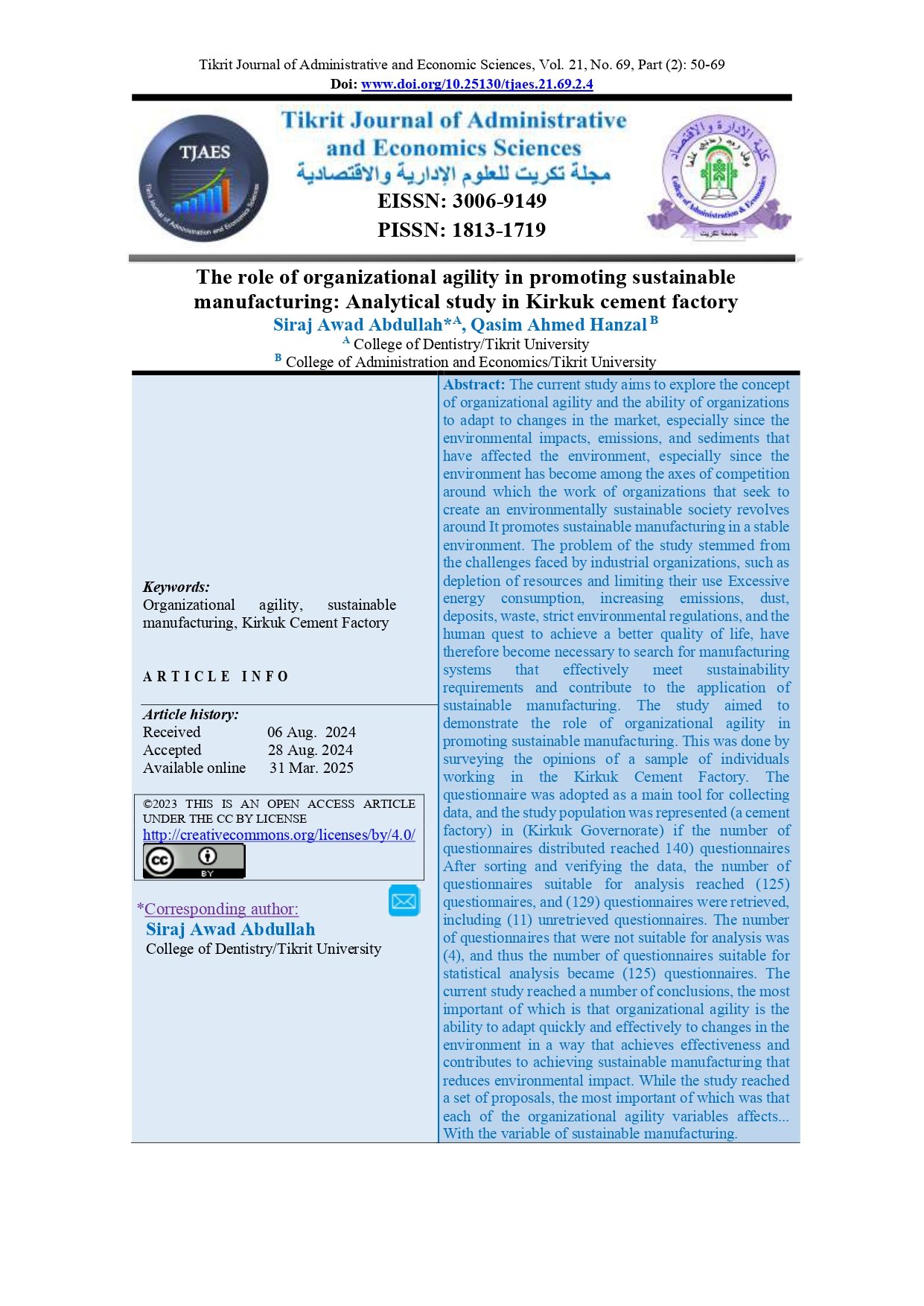
The role of organizational agility in promoting sustainable manufacturing: Analytical study in Kirkuk cement factory
Article Sidebar
THIS IS AN OPEN ACCESS ARTICLE UNDER THE CC BY LICENSE
Main Article Content

Abstract
The current study aims to explore the concept of organizational agility and the ability of organizations to adapt to changes in the market, especially since the environmental impacts, emissions, and sediments that have affected the environment, especially since the environment has become among the axes of competition around which the work of organizations that seek to create an environmentally sustainable society revolves around It promotes sustainable manufacturing in a stable environment. The problem of the study stemmed from the challenges faced by industrial organizations, such as depletion of resources and limiting their use Excessive energy consumption, increasing emissions, dust, deposits, waste, strict environmental regulations, and the human quest to achieve a better quality of life, have therefore become necessary to search for manufacturing systems that effectively meet sustainability requirements and contribute to the application of sustainable manufacturing. The study aimed to demonstrate the role of organizational agility in promoting sustainable manufacturing. This was done by surveying the opinions of a sample of individuals working in the Kirkuk Cement Factory. The questionnaire was adopted as a main tool for collecting data, and the study population was represented (a cement factory) in (Kirkuk Governorate) if the number of questionnaires distributed reached 140) questionnaires After sorting and verifying the data, the number of questionnaires suitable for analysis reached (125) questionnaires, and (129) questionnaires were retrieved, including (11) unretrieved questionnaires. The number of questionnaires that were not suitable for analysis was (4), and thus the number of questionnaires suitable for statistical analysis became (125) questionnaires. The current study reached a number of conclusions, the most important of which is that organizational agility is the ability to adapt quickly and effectively to changes in the environment in a way that achieves effectiveness and contributes to achieving sustainable manufacturing that reduces environmental impact. While the study reached a set of proposals, the most important of which was that each of the organizational agility variables affects... With the variable of sustainable manufacturing.
Downloads
Article Details
References
Jäger, C. (2019). To recycle, or not to recycle?: an analysis of consumption and recycling awareness of consumers in contemporary Japan, with a focus on Uniqlo’s All-Product Recycling Initiative.
2. Chalmers, I., Bracken, M. B., Djulbegovic, B., Garattini, S., Grant, J., Gülmezoglu, A. M.,... & Oliver, S. (2014). How to increase value and reduce waste when research priorities are set. The Lancet, 383(9912), 156-165
3. Jayal, A. D., Badurdeen, F., Dillon Jr, O. W., & Jawahir, I. S. (2010). Sustainable manufacturing: Modeling and optimization challenges at the product, process and system levels. CIRP Journal of Manufacturing Science and Technology, 2(3), 144-152.
4. Saunders et al Singh, S., Olugu, E. U., & Fallahpour, A. (2014). Fuzzy-based sustainable manufacturing assessment model for SMEs. Clean Technologies and Environmental Policy, 16, 847-860.
5. Jermias, J., & Gani, L. (2004). Integrating business strategy, organizational configurations and management accounting systems with business unit effectiveness: a fitness landscape approach. Management accounting research, 15(2), 179-200
6. Boylan, S. A., & Turner, K. A. (2017). Developing organizational adaptability for complex environment. Journal of Leadership Education, 16(2), 183-198
7.Nafei, W. A. (2016). Organizational agility: The key to organizational success. International Journal of Business and Management, 11(5), 296-309.
8. Houghton, R., El Sawy, O. A., Gray, P., Donegan, C., & Joshi, A. (2004). Vigilant Information Systems for Managing Enterprises in Dynamic Supply Chains: Real-Time Dashboards at Western Digital. MIS Quarterly Executive, 3(1), 19-35
9.Ahsan, K., & Rahman, S. (2022). A systematic review of e-tail product returns and an agenda for future research. Industrial Management & Data Systems, 122(1), 137-166.
Ciampi, F., Faraoni, M., Ballerini, J., & Meli, F. (2022). The co-evolutionary relationship between digitalization and organizational agility: Ongoing debates, theoretical developments and future research perspectives. Technological Forecasting and Social Change, 176, 121383.
Dubey, R., Gunasekaran, A., Childe, S. J., Wamba, S. F., & Papadopoulos, T. (2016). The impact of big data on world-class sustainable manufacturing. The International Journal of Advanced Manufacturing Technology, 84, 631-645.
Hankinson, B. J. (2022). The agility ecosystem: Can application of agility theory transform contemporary emergency management? (Doctoral dissertation, Queensland University of Technology
Jayal, A. D., Badurdeen, F., Dillon Jr, O. W., & Jawahir, I. S. (2010). Sustainable manufacturing: Modeling and optimization challenges at the product, process and system levels. CIRP Journal of Manufacturing Science and Technology, 2(3), 144-152.
Koçyiğit, Y., & Akkaya, B. (2020). The role of organizational flexibility in organizational agility: Research on SMEs. Business Management and Strategy, 11(1), 110-123.
Lee, N. C. A., & Liu, G. H. W. (2023). Organizational Mindfulness Perspective on Driving Enterprise System Adaptation and Organizational Agility. IEEE Transactions on Engineering Management.
Leng, J., Ruan, G., Jiang, P., Xu, K., Liu, Q., Zhou, X., & Liu, C. (2020). Blockchain-empowered sustainable manufacturing and product lifecycle management in industry 4.0: A survey. Renewable and sustainable energy reviews, 132, 110112.
Machado, C. G., Winroth, M. P., & Ribeiro da Silva, E. H. D. (2020). Sustainable manufacturing in Industry 4.0: an emerging research agenda. International Journal of Production Research, 58(5), 1462-1484.
Park, Young, Ki., (2011), "The Dynamics of Opportunity and Threat Management in Turbulent Environments the Role of Information Technologies", A Dissertation Ching, N. T., Ghobakhloo, M., Iranmanesh, M., Maroufkhani, P., & Asadi, S. (2022). Industry 4.0 applications for sustainable manufacturing: A systematic literature review and a roadmap to sustainable development. Journal of Cleaner Production, 334, 130133.