The role of discretionary budgets as a tool in making administrative decisions in government institutions in Tikrit
Article Sidebar
THIS IS AN OPEN ACCESS ARTICLE UNDER THE CC BY LICENSE
Main Article Content

Abstract
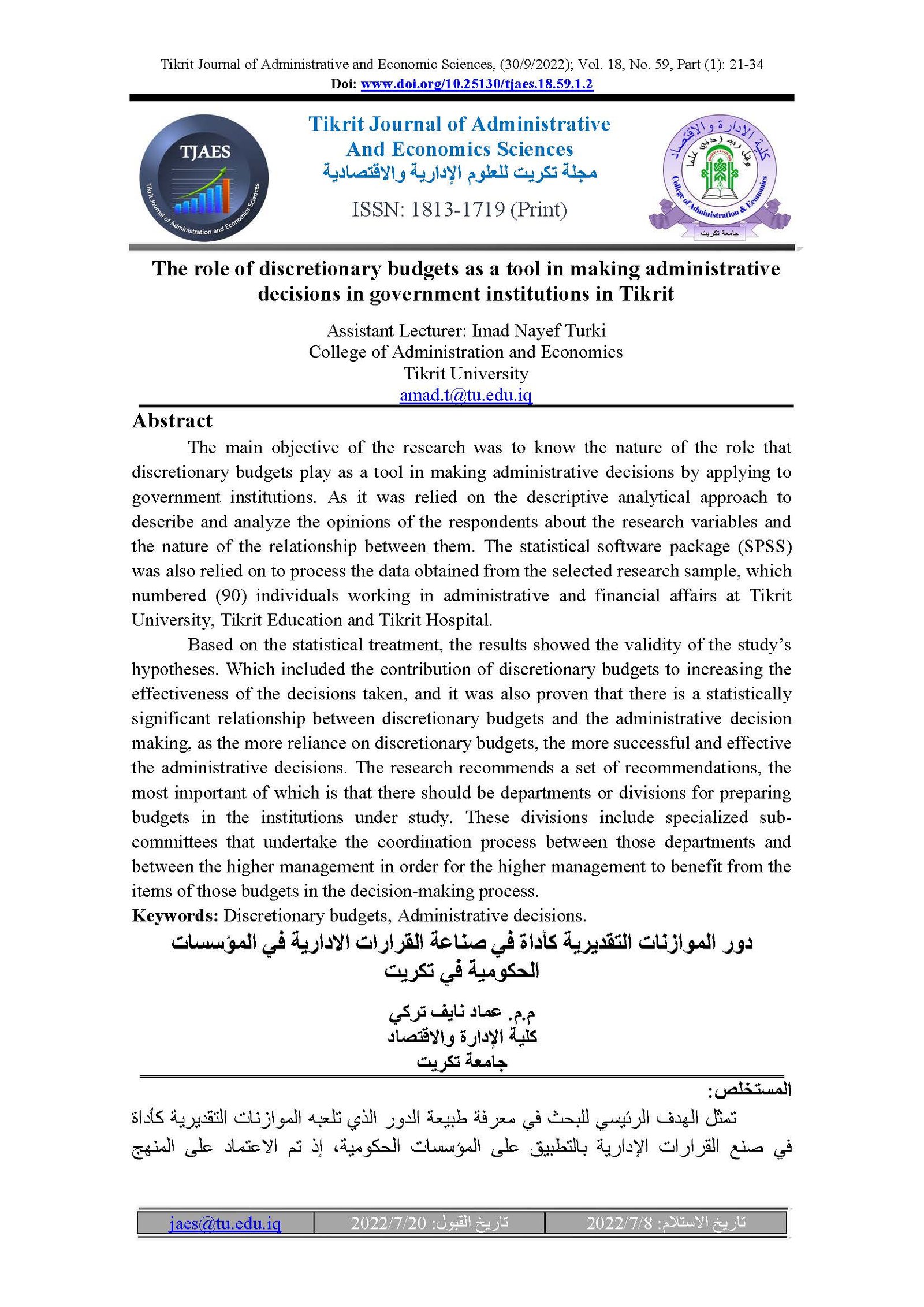
The main objective of the research was to know the nature of the role that discretionary budgets play as a tool in making administrative decisions by applying to government institutions. As it was relied on the descriptive analytical approach to describe and analyze the opinions of the respondents about the research variables and the nature of the relationship between them. The statistical software package (SPSS) was also relied on to process the data obtained from the selected research sample, which numbered (90) individuals working in administrative and financial affairs at Tikrit University, Tikrit Education and Tikrit Hospital.
Based on the statistical treatment, the results showed the validity of the study’s hypotheses. Which included the contribution of discretionary budgets to increasing the effectiveness of the decisions taken, and it was also proven that there is a statistically significant relationship between discretionary budgets and the administrative decision making, as the more reliance on discretionary budgets, the more successful and effective the administrative decisions. The research recommends a set of recommendations, the most important of which is that there should be departments or divisions for preparing budgets in the institutions under study. These divisions include specialized sub-committees that undertake the coordination process between those departments and between the higher management in order for the higher management to benefit from the items of those budgets in the decision-making process.
Downloads
Article Details
References
اولاً. المصادر العربية:
ابراهيم مجدي مرسي واخرون، (2016)، مدى استخدام الموازنات التقديرية في التخطيط والرقابة وتقييم الاداء المالي في الشركات الصناعية دراسة حالة في منع سور للملبوسات العسكرية، قسم المحاسبة قسم التمويل جامعة السودان.
بلعرابي عبدالكريم، (2011)، اثر تكنولوجيا المعلومات على اتخاذ القرارات الادارية دراسة حالة، اطروحة دكتوراه، جامعة وهران كلية الحقوق.
حنان بو خشبة وليندة مريشة، (2018)، دور الموازنات التقديرية في تحسين الاداء المالي في المؤسسة الاقتصادية، رسالة ماجستير، جامعة اولحاج البويرة، كلية العلوم الاقتصادية.
حنان عبدالله علي، (2017)، معوقات صنع القرار واتخاذه لدى مديري مدارس التعليم الاساسي بجمهورية مصر العربية: دراسة ميدانية، مجلة جامعة الفيوم للعلوم التربوية والنفسية، العدد الحادي عشر، الجزء الخامس.
فاطمة ال مفتاح وسعد عبدالله الخريف، (2022)، اساليب اتخاذ القرارات اثناء الازمات: دراسة ميدانية على عينة من القيادات الادارية بجامعة الملك سعود في السعودية، المجلة العربية للإدارة، العدد الثاني، مجلد 44.
لبنى صديق اجي المعداني، (2013)، مدى توفر مقومات الاساس الصفري لإعداد الميزانيات التقديرية، دراسة استكشافية على الشركات الخدمية العامة في بنغازي، رسالة ماجستير، جامعة بنغازي، كلية الاقتصاد.
نضال محمود الرمحي، (2017)، استخدام الموازنات التخطيطية في تحسين التخطيط والرقابة وتقييم الاداء في الشركات الصناعية الاردنية المساهمة العامة، قسم نظم المعلومات المحاسبية، جامعة الزرقاء.
نواف طلال فهيد العازمي، (2012)، اثار القرار الاداري على العمل الاداري، دراسة مقارنة بين القانونيين والاداريين في الاردن والكويت، رسالة ماجستير، كلية الحقوق جامعة الشرق الاوسط.
الوكالة الامريكية للتنمية الدولية (2011)، دليل اعداد الموازنات التقديرية لشركات مياه الشرب والصرف الصحي في جمهورية مصر العربية.
ثانياً. المصادر الأجنبية:
Iqbal, H. S., Akhtar, M. M. S., & Saleem, M., (2020), A Study of Decision-Making Styles of Academic Managers in Public Sector Universities of the Punjab. Bulletin of Education and Research, 42(2), 181-196.
de Andreis, F., (2020), A Theoretical Approach to the Effective Decision-Making Process. Open Journal of Applied Sciences, 10(6), 287-304.