
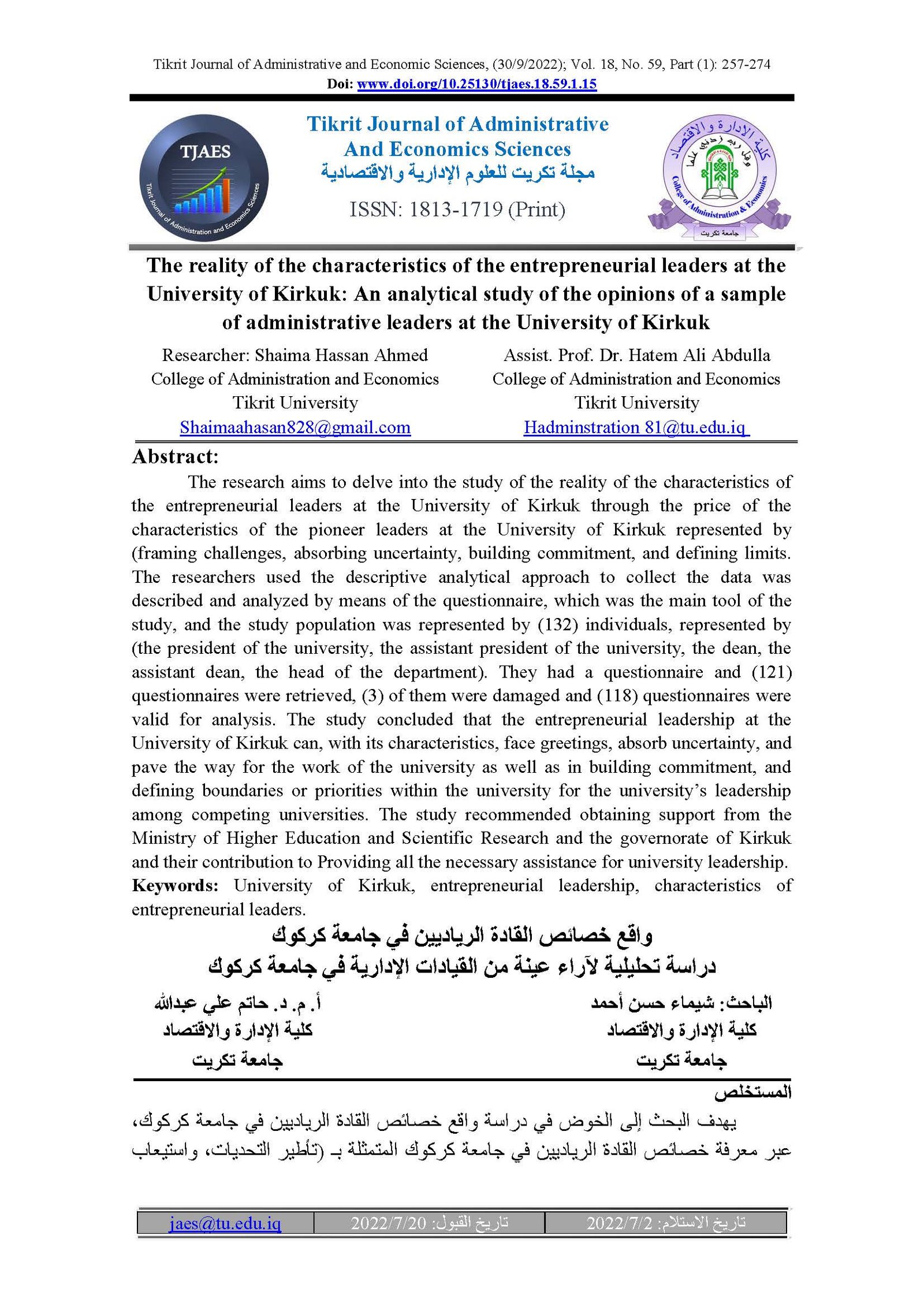
The reality of the characteristics of the entrepreneurial leaders at the University of Kirkuk: An analytical study of the opinions of a sample of administrative leaders at the University of Kirkuk
Article Sidebar
THIS IS AN OPEN ACCESS ARTICLE UNDER THE CC BY LICENSE
Main Article Content

Abstract
The research aims to delve into the study of the reality of the characteristics of the entrepreneurial leaders at the University of Kirkuk through the price of the characteristics of the pioneer leaders at the University of Kirkuk represented by (framing challenges, absorbing uncertainty, building commitment, and defining limits. The researchers used the descriptive analytical approach to collect the data was described and analyzed by means of the questionnaire, which was the main tool of the study, and the study population was represented by (132) individuals, represented by (the president of the university, the assistant president of the university, the dean, the assistant dean, the head of the department). They had a questionnaire and (121) questionnaires were retrieved, (3) of them were damaged and (118) questionnaires were valid for analysis. The study concluded that the entrepreneurial leadership at the University of Kirkuk can, with its characteristics, face greetings, absorb uncertainty, and pave the way for the work of the university as well as in building commitment, and defining boundaries or priorities within the university for the university’s leadership among competing universities. The study recommended obtaining support from the Ministry of Higher Education and Scientific Research and the governorate of Kirkuk and their contribution to Providing all the necessary assistance for university leadership.
Downloads
Article Details
References
Azizah, S. N., Nurhayati, S., & Anggraeni, A. I., (2020), How path goal theory enhances village administrator productivity in Indonesia collective culture. I core, 5(1).
Bagheri, A., & Harrison, C., (2020), Entrepreneurial leadership measurement: a multi-dimensional construct. Journal of Small Business and Enterprise Development. Emerald
Bakir, S. M. A., (2017), The influence of strategic leadership on building employees’ entrepreneurial orientation: A field study at the Jordanian Public Sector. International Business Research, 10 (6), 62-74.
Chandranathan, P., (2020), The activity of entrepreneurial leadership. Lancaster University (United Kingdom).
dahiru, A. S., (2017), relationship between entrepreneurial leadership practice, school culture empowerment in secondary schools of zamfara state, Nigeria.
Dahlin, C. J., & Gratell, P., (2018), How does social media affect entrepreneurial leadership: A qualitative study on entrepreneur’s perceptions regarding social media as a tool for entrepreneurial leadership (Doctoral dissertation, Master’s thesis, Department of Business Studies, Uppsala University). Retrieved from https://www.semanticscholar. org).
Gupta, V., MacMillan, I. C., & Surie, G., (2004), Entrepreneurial leadership: developing and measuring a cross-cultural construct. Journal of business venturing, 19 (2), 241-260.
Keskes, I., (2014), Relationship between leadership styles and dimensions of employee organizational commitment: A critical review and discussion of future directions. Intangible Capital, 10(1), 26-51.
Latif, K. F., Nazeer, A., Shahzad, F., Ullah, M., Imranullah, M., & Sahibzada, U. F., (2020), Impact of entrepreneurial leadership on project success: mediating role of knowledge management processes. Leadership & Organization Development Journal. Emerald
Li, C., Murad, M., Shahzad, F., Khan, M. A. S., Ashraf, S. F., & Dogbe, C. S. K., (2020), Entrepreneurial passion to entrepreneurial behavior: Role of entrepreneurial alertness, entrepreneurial self-efficacy and proactive personality. Frontiers in psychology, 11, 1611.
Mehmood, M. S., Jian, Z., & Waheed, A., (2019), The influence of entrepreneurial leadership on organisational innovation: mediating role of innovation climate. International Journal of Information Systems and Change Management, 11(1), 70-89.
Mishra, P., & Misra, R. K., (2017), Entrepreneurial leadership and organizational effectiveness: A comparative study of executives and non-executives. Procedia computer science, 122, 71-78. ELSEVIER
Neves, P., Almeida, P., & Velez, M. J., (2018), Reducing intentions to resist future change: Combined effects of commitment‐based HR practices and ethical leadership. Human Resource Management, 57(1), 249-261.
Nzeneri, N. E., (2020), Path coal leadership effectiveness perception in selected private secondary schools in rivers state.
NAUSHAD, M., (2021), Investigating Determinants of Entrepreneurial Leadership Among SMEs and Their Role in Sustainable Economic Development of Saudi Arabia. The Journal of Asian Finance, Economics and Business, 8(4), 225-237.
Nasser, A. A., & Al-Taie, A. K. B., (2021), The behavior of the security leader and its impact on achieving strategic initiatives within the framework of (path-goal) theory. PalArch's Journal of Archaeology of Egypt/Egyptology, 18(10), 1400-1415.
Ruttan, S., (2019), Entrepreneurial Leadership: An Emerging Theory
Ronald, B., (2014), Comprehensive leadership review-literature, theories and research. Advances in Management, 7(5), 52.
Steenkamp, I., & Ziaei, S. M., (2021), Critically Assess the" Path–Goal Theory.
Sandybayev, A., (2019), Impact of effective entrepreneurial leadership style on organizational performance: Critical review. International Journal of Economics and Management, 1(1), 47-55.
Selvaraja, K., & Pihie, Z. A. L., (2017), Conceptualization of entrepreneurial leadership models and its suitability towards educational settings. International Journal of Humanities Social Sciences and Education, 4(11), 153-159.
Wulandari, R., (2021), Entrepreneurship and Innovation in Obtaining Competitive Advantage in Non-Formal English Education Industry in Indonesia: A Model Proposition. Business Economic, Communication, and Social Sciences (BECOSS) Journal, 3(3), 137-149.