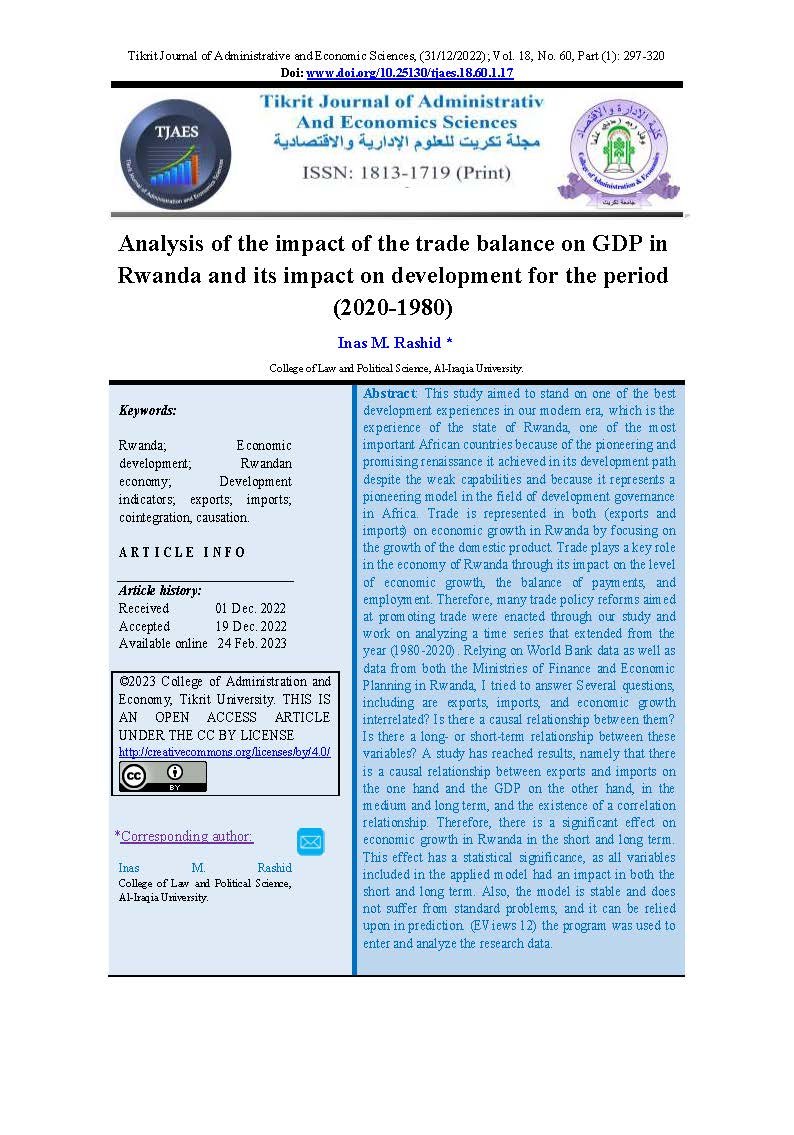
Analysis of the impact of the trade balance on GDP in Rwanda and its impact on development for the period (2020-1980)
Article Sidebar
THIS IS AN OPEN ACCESS ARTICLE UNDER THE CC BY LICENSE
Main Article Content

Abstract
This study aimed to stand on one of the best development experiences in our modern era, which is the experience of the state of Rwanda, one of the most important African countries because of the pioneering and promising renaissance it achieved in its development path despite the weak capabilities and because it represents a pioneering model in the field of development governance in Africa. Trade is represented in both (exports and imports) on economic growth in Rwanda by focusing on the growth of the domestic product. Trade plays a key role in the economy of Rwanda through its impact on the level of economic growth, the balance of payments, and employment. Therefore, many trade policy reforms aimed at promoting trade were enacted through our study and work on analyzing a time series that extended from the year (1980-2020). Relying on World Bank data as well as data from both the Ministries of Finance and Economic Planning in Rwanda, I tried to answer Several questions, including are exports, imports, and economic growth interrelated? Is there a causal relationship between them? Is there a long- or short-term relationship between these variables? A study has reached results, namely that there is a causal relationship between exports and imports on the one hand and the GDP on the other hand, in the medium and long term, and the existence of a correlation relationship. Therefore, there is a significant effect on economic growth in Rwanda in the short and long term. This effect has a statistical significance, as all variables included in the applied model had an impact in both the short and long term. Also, the model is stable and does not suffer from standard problems, and it can be relied upon in prediction. (EViews 12) the program was used to enter and analyze the research data.
Downloads
Article Details
References
اولاً. المصادر العربية:
عبد الحفیظ، محبوب (2006، خلق القیمة بین العقلیة الریعیة والعقلیة الاقتصادیة في دول مجلس التعاون، مركز الابحاث، دبي. (
البطاحني، عطا الحسن البطاحني، (2013) إستراتيجيا- نزاعات إقليم البحيرات الكبرى في إفريقيا، آفاق المستقبل.
حايد حميد، البشير عبد الكريم (2018)، دراسة قياسية لعلاقة الصادرات بالنمو الاقتصادي في الجزائر (1966-2015)، مجلة اقتصاديات شمال افريقيا، المجلد 14، العدد 19.
ثانياً. المصادر الأجنبية:
International Development Association, International Finance Corporation (2019), Rwanda Systematic Country Diagnostic, Document of the World Bank, Report No.138100-RW, p 134-157
Government of Rwanda (2000), Vision 2020, Final Report, MINECFIN, p53-67
IMF (2021), Fourth review of the policy coordination instrument and request of an extension of the policy coordination instrument—press release; staff report; and statement by the executive director for Rwanda’ IMF Country Report No. 21/164
World Bank, (2021), Macro poverty outlook. Country-by-country analysis and projections for the developing world’
The orld Bank (2011), Rwanda Economic update: Seeds for higher growth. Available at: http://siteresources.worldbank.org/INTRWANDA/Resources/Rwanda_Economic_ Rwanda_Update_Spring_Edition_April_2011.pdf.
EDPRS 1, (2008), Available at: http:// www.edprs.gov.rw/
EDPRS 2, (2013), Available at: http:// www.edprs.gov.rw/
World Bank, (2020), Accelerating Digital Transformation in Rwanda.
Dickey, D. W., (1981), Likelihood ratio Staiatics for autoregressive time series with a unit root. Econometrica,49(4):1057-72.
MINECOFIN, (2003), Rwanda development Indicators Report. Ministry of Economics and Finance, Kigali, Rwanda.
The World Bank, (2022), Rwanda Economic update: Boosting Exports Through Technology, Innovation and Trade in Services,September 2022 , Edition No.19.
Brooks, Elizabeth, (2005), From the frying pan into the fire’: A case study of Rwandan refugees” Journal of international social work:500-510.
U.S. DEPARTMENT of STATE, (2022), 2021 Investment Climate Statements: Rwanda”, at: https://www.state.gov/reports/2021-investment-climate-statements/rwanda/
Koffi, S., (2019), Nonlinear impact of public debt on economic growth: evidence from SubSaharan African Countries, MPRA Paper No 96067.
Dawar, K. and Lipimile, G., (2020), Africa: harmonizing competition policy under the AfCFTA’ Concurrences Review 2. a93472 242-250. ISSN 1773-9578.
Jones, B.D., (2001), Peacemaking in Rwanda: The Dynamics of Failure London, Lynne Rienner Publishers, Inc, p13.
MINECOFIN (2017), The Annual Economic Report, Fiscal Year 2015/2016
Ndoricimpa, A., (2020), Threshold effects of public debt on economic growth in Africa: new evidence, Journal of Economics and Development, 22:187-207
AU-African Union, (2020), State parties: ratification status list’. African Union Report
(https://afcfta.au.int/en/documents/2020-12-28/state-parties-ratification-status-list).
NISR, (2020), Statistical Report of Economic Trade. Kigali/Rwanda: National Institute of Statistics of Rwanda.
Onuoha, D. O., Ibe, A., Njoku, C., & Onuoha, J. I., (2015), Analysis of the Gross Domestic Product (GDP) of Nigeria: 1960 – 2012, West African Journal of Industrial & Academic Research, 14 (1): 81-90.
Gómez-Puig, M. and Sosvilla-Rivero, S., (2015), On the bi-directional causal relationship between public debt and economic growth in EMU countries, Research Institute of Applied Economics, Working Paper, No. 12: 1-32.
World Trade, (2003), Fundamental Economic Factors Affecting International Trade. World Trade Report.
Rusuhuzwa Kigabo Thomas, (2008), Leadership, Policy Making, Quality of Economic Policies, and Their Inclusiveness: The Case of Rwanda, pp 1-2.
DFID, (2008), Source and obstacles to economic growth in Rwanda: An analytical overview, discussion draft for working meeting of 30/31 January 2008, UK Department for International Development
Murenzi, Romain, and M. Hughes, (2006), Building a Prosperous Global Knowledge Economy in Rwanda: Rwanda as a Case Study, International Journal of Technology and Globalization, 2(3-4), pp 254-269.
Mwai, C., (2021), AfCFTA: what is Rwanda’s export-ready products?’ The New Times
(www.newtimes.co.rw/news/afcfta-what-are-rwandas-export-ready-products)
NBR (2020) Annual report 2019–2020 (www.bnr.rw/news-publications/publications/annual-reports/).
NBR (2021) Annual report 2020-2021 (www.bnr.rw/news-publications/publications/annual-reports/).
Mmuhammed O. Z., Fatima P. I. & Omade S. I., (2011), Co-integration Analysis of Foreign Direct Investment Inflow and Development in Nigeria”, Developing Country Studies, Vol. 1, No. 1, PP 56-66
Simplice A. Asongu, Voxi H. S. Amavilah & Antonio R. Andres (2019), Business Dynamics, Knowledge-Economy, and the Economic Performance of African Countries, African Governance and Development Institute.