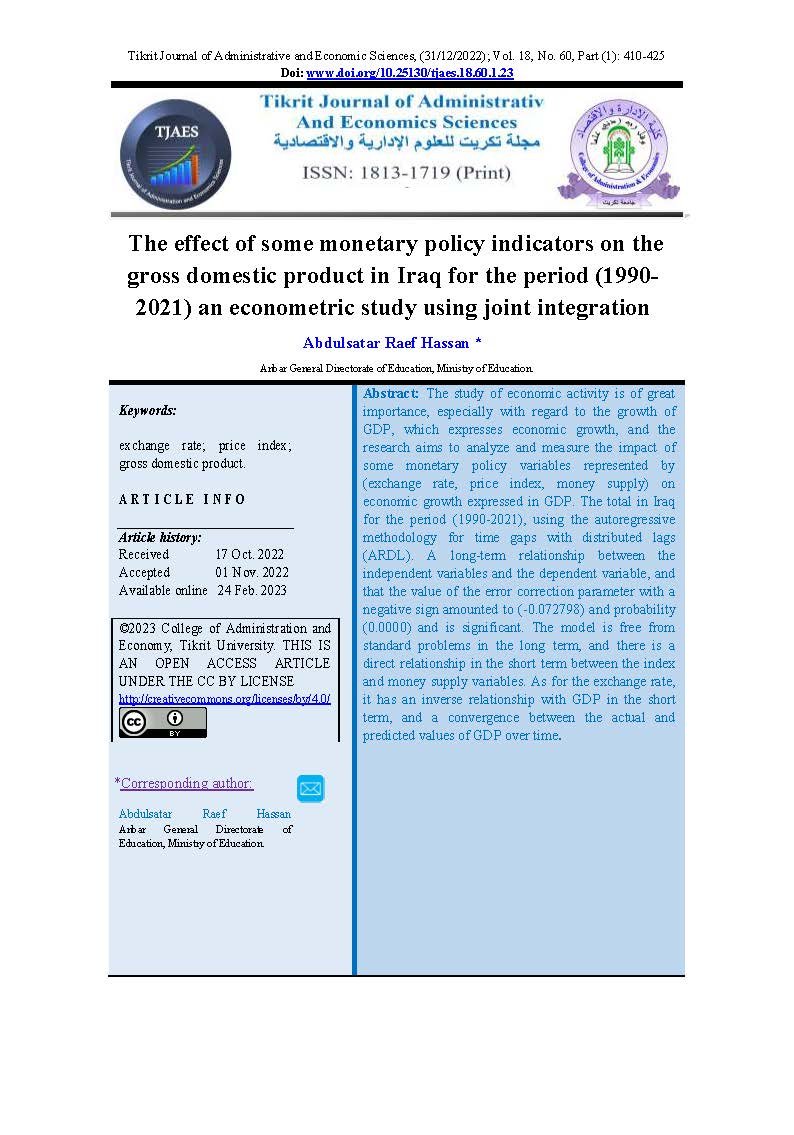
The effect of some monetary policy indicators on the gross domestic product in Iraq for the period (1990-2021) an econometric study using joint integration
Article Sidebar
THIS IS AN OPEN ACCESS ARTICLE UNDER THE CC BY LICENSE
Main Article Content

Abstract
The study of economic activity is of great importance, especially with regard to the growth of GDP, which expresses economic growth, and the research aims to analyze and measure the impact of some monetary policy variables represented by (exchange rate, price index, money supply) on economic growth expressed in GDP. The total in Iraq for the period (1990-2021), using the autoregressive methodology for time gaps with distributed lags (ARDL). A long-term relationship between the independent variables and the dependent variable, and that the value of the error correction parameter with a negative sign amounted to (-0.072798) and probability (0.0000) and is significant. The model is free from standard problems in the long term, and there is a direct relationship in the short term between the index and money supply variables. As for the exchange rate, it has an inverse relationship with GDP in the short term, and a convergence between the actual and predicted values of GDP over time.
Downloads
Article Details
References
اولاً. المصادر العربية:
احميد، محمد الصيد، 2019، تأثير عرض النقود وسعر الصرف على الناتج المحلي الحقيقي دراسة تطبيقية على الاقتصاد الليبي للفترة (1990-2017)، مجلة كلية التربية، العدد الرابع عشر.
بوخاري، محمد، 2021، تأثير عرض النقود على الناتج المحلي الاجمالي –دراسة تحليلية قياسية لحالة الجزائر خلال الفترة (1970-2018)، مجلة ادارة الاعمال والدراسات الاقتصادية، مجلد 7، العدد 1.
البنك المركزي العرقي، دائرة الاحصاء والابحاث، النشرة الاحصائية السنوية لسنوات مختلفة.
شدهان، عمار مجيد، 2016، تقييم دور السياسة النقدية في العراق خلال المدة (2004-2014)، المجلة العلمية للدراسات التجارية والبيئية، المجلد السابع، العدد الرابع.
عبدة، عبير شعبان، العلاقة بين العرض النقدي وسعر الصرف والنمو الاقتصادي في مصر خلال الفترة (1989-2019)، مجلة جامعة الاسكندرية للعلوم الادارية، المجلد 58، العدد الثالث.
المعماري، صلاح حنظل احمد، السبعاوي، عبدالله خضر عبطان، اثر المتغيرات النقدية في تحقيق النمو الاقتصادي-البحرين انموذجا للمدة 1995-2020، مجلة تكريت للعلوم الادارية والاقتصادية، مجلد 18، العدد 58".
ثانياً. المصادر الأجنبية:
Abel, A.B. Blanchard, O.J., Bernanke, B., &Croushore, D., (2017), Macroeconomics. Pearson UK.
Alhamdany, A. L. S. N. Factors affecting the gross domestic product in Iraq for the period 1990-2018. Journal of Xi'an University of Architecture & Technology, Volume XII, Issue III, 2020, Page No: 6213.
Andolfatto, D., (2005), Macroeconomic theory and policy: Preliminary Draft. Simon Fraser University, dandolfa@ sfu. ca August.
Hameed, I., (2010), Impact of monetary policy on gross domestic product (GDP). Interdisciplinary journal of contemporary research in business, 3(1), 1348-136.
Kasidi, F., & Mwakanemela, K., (2013), Impact of inflation on economic growth: A case study of Tanzania. Asian Journal of empirical research, 3(4), 363-380.
Lavoie, M., (1996), Monetary policy in an economy with endogenous credit money. In Money in motion (pp. 532-545). Palgrave Macmillan, London.
Mahmoud, L. O. M., (2015), Consumer price index and economic growth: a case study of Mauritania 1990-2013. Asian Journal of Empirical Research, 5(2), 16-23.
Semuel, H., & Nurina, S., (2014), Analysis of the effect of inflation, interest rates, and exchange rates on Gross Domestic Product (GDP) in Indonesia (Doctoral dissertation, Petra Christian University).