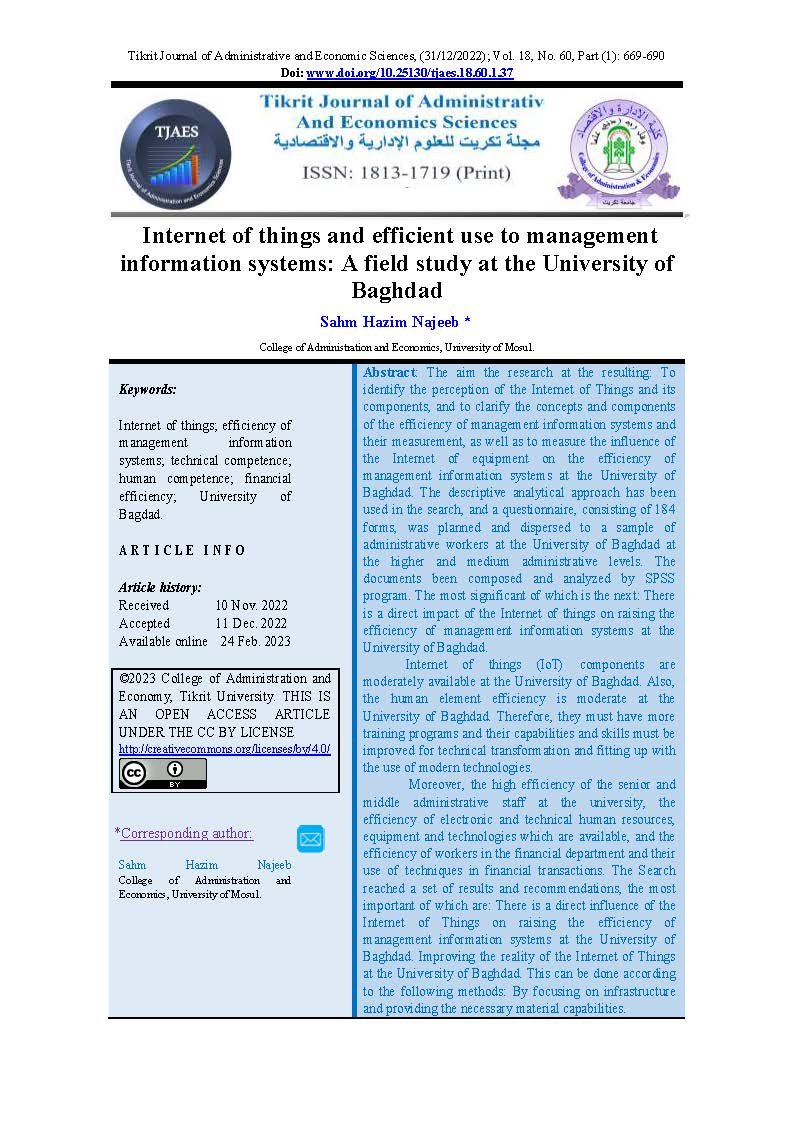
Internet of things and efficient use to management information systems: A field study at the University of Baghdad
Article Sidebar
THIS IS AN OPEN ACCESS ARTICLE UNDER THE CC BY LICENSE
Main Article Content

Abstract
The aim the research at the resulting: To identify the perception of the Internet of Things and its components, and to clarify the concepts and components of the efficiency of management information systems and their measurement, as well as to measure the influence of the Internet of equipment on the efficiency of management information systems at the University of Baghdad. The descriptive analytical approach has been used in the search, and a questionnaire, consisting of 184 forms, was planned and dispersed to a sample of administrative workers at the University of Baghdad at the higher and medium administrative levels. The documents been composed and analyzed by SPSS program. The most significant of which is the next: There is a direct impact of the Internet of things on raising the efficiency of management information systems at the University of Baghdad.
Internet of things (IoT) components are moderately available at the University of Baghdad. Also, the human element efficiency is moderate at the University of Baghdad. Therefore, they must have more training programs and their capabilities and skills must be improved for technical transformation and fitting up with the use of modern technologies.
Moreover, the high efficiency of the senior and middle administrative staff at the university, the efficiency of electronic and technical human resources, equipment and technologies which are available, and the efficiency of workers in the financial department and their use of techniques in financial transactions. The Search reached a set of results and recommendations, the most important of which are: There is a direct influence of the Internet of Things on raising the efficiency of management information systems at the University of Baghdad. Improving the reality of the Internet of Things at the University of Baghdad. This can be done according to the following methods: By focusing on infrastructure and providing the necessary material capabilities.
Downloads
Article Details
References
Arabic references:
احمد فرج (2016) استثمار تقنيات انترنت الأشياء لتعزيز آليات الوعي المعلوماتي في مؤسسات المعلومات: دراسة تخطيطية- منشور في المؤتمر 27 للاتحاد العربي للمكتبات والمعلومات (اعلم) "الثقافة المعلوماتية في مجتمع المعرفة العربي: تحديات الواقع ورهانات المستقبل"- الاقصر (مصر)، ص 3-14.
الحارثي، محمد بن عطية (2014)، إطار مقترح لتطبيق إنترنت الأشياء في المؤسسات التعليمية- مجلة الدراسات التربوية والانسانية كلية التربية جامعة دمنهور المجلد السادس - العدد الرابع- الجزء الرابع، ص 4-9. DOI: https://doi.org/10.12816/0033185
الحمامي، علاء حسين (2016)، كل شيء عن انترنت الاشياء وتطبيقات المدن الذكية – دار الراية للنشر – عمان – الاردن، ص 12-44.
صلاح الدين، أشرف (2017)، إنترنت الأشياء الفرص والتحديات- مجلة لغة العصر، مجلة الاهرام للكمبيوتر والانترنت والاتصالات، ص 6-13.
الكلبي، علي بن ذیب (2017)، تطبيقات إنترنت الأشياء في مؤسسات المعلومات – مجلة الاتحاد العربي للمكتبات والمعلومات – العدد 19، ص 161-180.
English references:
Bassel Asaad, (2020), The importance of using artificial intelligence models in economic forecasting during a crisis period (Using the NARX model to predict demand for hospital health services), World Academics Journal of Management, Volume8, Issue3.
Bassel Asaad, Habeeb Mahmood, (2016), Measuring the quality of health service in latakia province patient (failed study of health centers in jahble city), Journal of Social Economics Research, Volume3, Issue 4. DOI: https://doi.org/10.18488/journal.35/2016.3.4/35.4.41.56
El-Ebiary, Y. A. B., Al-Sammarraie, N. A., Al Moaiad, Y., & Alzubi, M. M. S., (2016), The impact of Management Information System in educational organizations processes. In-Learning, e-Management and e-Services (IC3e), 2016 IEEE Conference on (pp. 166-169). DOI: https://doi.org/10.1109/IC3e.2016.8009060
Gallier, Robert D., & Eleidner, Drothy, and Baker, Bernadette, S.H. 2019. Strategic Information Management, Fifth Edition, Butter Worth Heinemann, Hong kong. P18-28.
Qin, J., (2018), The Research of the Library Services Based on Internet of Things. In 4th International Symposium on Social Science. Atlantis Press.P11-22. DOI: https://doi.org/10.2991/isss-18.2018.83
Rasmus, DW., (2018), Don’t Deploy IoT Without Knowledge Management. Serious Insights. Retrieved November, 25, 2018, from https://www.seriousinsights.net/dont-deploy-iot-withoutknowledge management/
Rot, A. & Sobinska, M., (2018), The potential of the Internet of Things in knowledge management system. In FedCSIS Position Papers (pp. 63-68). DOI: https://doi.org/10.15439/2018F379
Salah Eddin, Ashraf, (2017), Internet Things Opportunities and Challenges - Journal of the Age Language, Al-Ahram Journal of Computer, Internet and Communications– Cairo. p2-14.
Wang, Yi-Ning; Wang, Rong; Li, Weiyi; Tang, Chuyang Y., (2017), Whey recovery using forward osmosis-Evaluating the factors limiting the flux performance. Journal of Membrane Science, Vol.533, pp.179-189. DOI: https://doi.org/10.1016/j.memsci.2017.03.047
Yan, Yuwei; Huang, Chuanchao; Wang, Qian; Hu, Bin, (2020), Data mining of customer choice behavior in internet of things within relationship network. International Journal of Information Management, Vol.55, pp.566-574. DOI: https://doi.org/10.1016/j.ijinfomgt.2018.11.013
Zhang, Xiong; Yue, Wei T., (2020), A 2020 perspective on transformative value of the Internet of things and pricing decisions. Electronic Commerce Research and Applications, Vol.41, pp.1-3. DOI: https://doi.org/10.1016/j.elerap.2020.100967