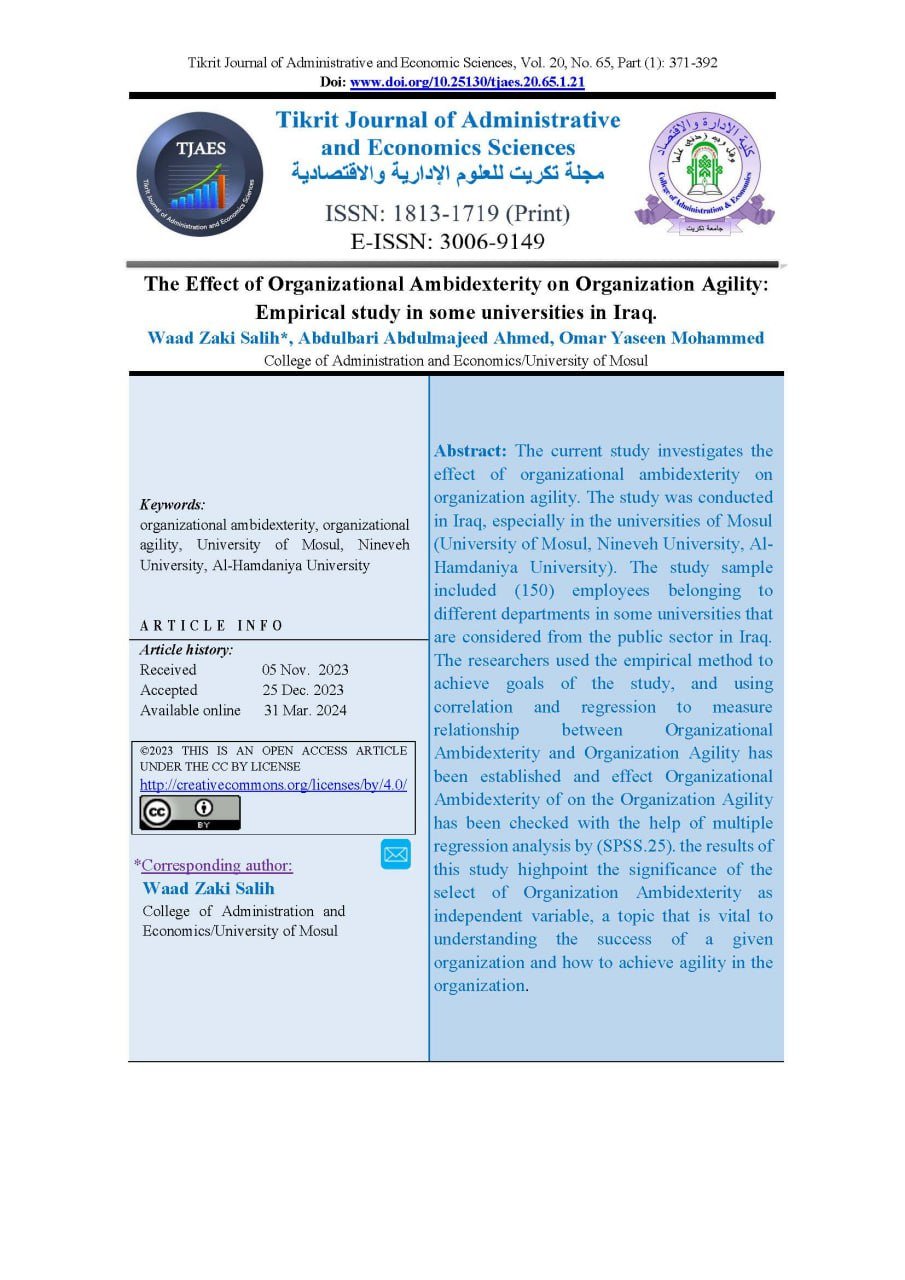
The Effect of Organizational Ambidexterity on Organization Agility: Empirical study in some universities in Iraq
Article Sidebar
THIS IS AN OPEN ACCESS ARTICLE UNDER THE CC BY LICENSE
Main Article Content

Abstract
The current study investigates the effect of organizational ambidexterity on organization agility. The study was conducted in Iraq, especially in the universities of Mosul (University of Mosul, Nineveh University, Al-Hamdaniya University). The study sample included (150) employees belonging to different departments in some universities that are considered from the public sector in Iraq. The researchers used the empirical method to achieve goals of the study, and using correlation and regression to measure relationship between Organizational Ambidexterity and Organization Agility has been established and effect Organizational Ambidexterity of on the Organization Agility has been checked with the help of multiple regression analysis by (SPSS.25). the results of this study highpoint the significance of the select of Organization Ambidexterity as independent variable, a topic that is vital to understanding the success of a given organization and how to achieve agility in the organization.
Downloads
Article Details
References
Al-Quraishi, Khayria, (2008) Financial evaluation of human capital and its impact on profitability Enterprise. Master thesis, Al Mustansiriya University, Baghdad, Iraq.
Bodwell, W & Chermack, T., (2010), “Organizational ambidexterity- Integrating deliberate & emergent strategy with scenario planning”, Technological Forecasting & Social Change, 77 (2): pp 193–202.
Cao, Q; Gedajlovic, E & Zhang, H. (2009). “Un-packing organizational ambidexterity: dimensions, contingencies, & synergistic effects”. Organization Science, 20(4): pp 781-796.
Chakravarty, A., Grewal, R & Sambamurthy, V. (2013), “Information technology competencies, organizational agility, firm performance: Enabling & facilitating roles”. Information Systems Research, 24(4): 976-997.
Chandrasekaran, A. (2009). ”Multiple levels of ambidexterity in managing the innovation- improvement dilemma:- Evidence from high technology organizations. University of Minnesota,USA.
Daniel, O; Sambamurthy, V; Lim, K & Wei, K. (2015). “How Does (IT) Ambidexterity Impact Organizational Agility?”. Journal Information Systems Research, 26 (2): 398-417.
Del Giudice, M. and Della Peruta, R. (2016),“The impact of IT-based knowledge managementsystems on internal venturing and innovation: a structural equation modelling approach to corporate performance”,Journal of Knowledge Management, Vol. 20 No. 3, pp. 484-498.
Diaye, Anthuriman, N. (2002), "Second International Forum on creativity and Invention: A better Future for Humanity in 21 century". (www.wipo.org).
Dove, R. (2001). “Response Ability: The Language, Structure, & Culture of the Agile Enterprise”. John Wiley &Sons, New York, U.S.A.
Duncan, R. B. (1976). The ambidextrous organization: Designing dual structures for innovation.the management of organization,1(1), 167-188.
Erande, K & Verma, A. (2008). “Measuring Agility of Organizations – A Comprehensive Agility Measurement Tool (CAMT)”., Proceedings of the IAJC-IJME International Conference.
Friedman, H.H. and Friedman, L.W. (2018), “Does growing the number of academic departments improve the quality of higher education?”, Psychosociological Issues in Human Resource Management, Vol. 6 No. 1, pp. 96-114.
Gambatese, A & Hallowell, M. (2011). “Enabling and measuring innovation in the construction industry”. Construction Management and Economics, 29 (6): pp.553-567.
Garson, G., (2012). Testing statistical assumptions, North Carolina state university School of Public and International Affairs.USA
Ghilic-Micu, B., Mircea, M. & Stoica, M. (2011), “Knowledge based economy–technological perspective: implications and solutions for agility improvement and innovation achievement in higher education”, Amfiteatru Economic Journal, Vol. 13 No. 30, pp. 404-419
Gibson, C., & Birkinshaw, J. (2017). The antecedents, consequences, and mediating role of organizational ambidexterity. Academy of Management Journal, 47(2), 209-226.
Hill, W & Jones, G. (2009). “Essentials of Strategic Management”. 2nd ed., South-Western, Cengage Learning.
Hitt, M; Ireland, D & Hoskisson, E. (2007). “Strategic Management Competitiveness and Globalization”. 6th ed., Sowth College Publishing, U.S.A.
Howells, J.R., Karatas¸-€Ozkan, M., Yavuz, Ç. and Atiq, M. (2014), “University management and organisational change: a dynamic institutional perspective”, Cambridge Journal of Regions, Economy and Society, Vol. 7 No. 2, pp. 251-270.
Lee,One-Ki (Daniel), Sambamurthy,Vallabh, Lim, Kai H., Wei,Kwok Kee (2015) How Does IT Ambidexterity Impact OrganizationalAgility?. Information Systems Research 26(2):398-417
Lorange, P. (2013), “Business school culture: customer-focused, virtual and cooperative”, Education Training Journal, Vol. 55 Nos 4/5, pp. 336-347
Lubatin, M.,Simsek, Z., Ling, Y. & Veiga,J. (2006). Ambidexterity and performance in small-medium-sized firms-the pivotal role of top management team behavioral integration, Journal of Management, 32,pp646-672.
Luo, Y & Rui, H. (2009). “An Ambidexterity Perspective toward Multinational Enterprises from Emerging Economies”. Academy of Management Perspectives Journal, 23 (4): pp.49-70.
Luu Trong Tuan (2016) Organisational ambidexterity and supply chainagility: the mediating role of external knowledge sharing and moderating role of competitiveintelligence, International Journal of Logistics Research and Applications, 19:6, pp 583-603.
Madsen, P. & Desai, V. (2010). “Failing to learn? The effects of failure and success on organizational learning in the global orbital launch vehicle industry”. Academy of Management Journal, 53 (3): pp 451–476.
Mahasna, Lamis, (2017), The mediating role of organizational Ambidexterity in the relationship between dynamic capabilities and organizational agility: a field study on Jordanian pharmaceutical companies, unpublished master's thesis, Middle East University, Jordan
Miles, M & Darroch, J. (2006). “Large Firms, Entrepreneurial Marketing Processes ،and the cycle of Competitive advantage”. European Journal of Marketing, 40 (5/6):485 – 501.
Mitra, Aditi, Gaur,Sanjaya Singh, Giacosa, Elisa ,(2019), Combining organizational change management and organizational ambidexterity using data transformation, Management Decision,Vol. (57) No. (8).
Mukerjee, S. (2014), “Agility: a crucial capability for universities in times of disruptive change and innovation”, Australian Universities Review, Vol. 56 No. 1, p. 56.
O’Reilly, C.A. and Tushman, M.L. (2008),“Ambidexterity as a dynamic capability: resolving the innovator’s dilemma”,Research in Organizational Behavior, Vol. 28, pp. 185-206.
O’Reilly, C. and Tushman, M. (2013),“Organizational ambidexterity: past, present, and future”,Academy of Management Perspectives, Vol. 27 No. 4, pp. 324-338
Obeidi, Bashar M, (2005) Technical innovation and its impact on achieving competitive advantage thesis Master, AlMustansiriya University, Baghdad: Iraq.
Pai, A. (2007). “Overcoming the Innovator’s Dilemma through Organizational Ambidexterity within the Indian Pharmaceutical Industry”. Master Thesis, University of Nottingham.
Panda, S & Rath, S. (2016). “Investigating the structural linkage between IT capability and organizational agility: A study on Indian financial enterprises”. Journal of Enterprise Information Management, 29(5): 751-773.
Raisch, S., Birkinshaw, J., Probst, G., & Tushman, M. L. (2009).Organizational ambidexterity: Balancing exploitation&exploration for sustained performance.Organization Science, 20(4),685–695.
Rialti, Riccardo, Marzi, Giacomo, Silic, Mario&Ciappei, Cristiano, Ciappei,(2018), Ambidextrous Organization and Agility in Big Data Era: The Role of Business Process Management Systems, Business Process Management Journal, vol. (24) No. (5).
Sambamurthy, V; Bharadwaj, A & Grover, V. (2003). “Shaping agility through digital options: reconceptualizing the role of information technology in contemporary firms”. MIS Quarterly, 27 (2): 237-263.
Santala. M. (2009).“Strategic Agility in a Small Knowledge Intensive Business Services Company: Case Swot Consulting”. Master Thesis, Kelsingin Kauppakorkeakoulu, Helsinki school of economics, Espoo, Finland.
Simsek, Z., Heavey, C., Veiga, J., & Souder, D. (2009). A typology for aligning organizational ambidexterity’s conceptualizations, antecedents and outcomes. Journal of Management, 46(5), 865-894.
Suzuki, S. (2011). “A Contingency Perspective on Organizational Ambidexterity”. Kwansei Gakuin University Social Sciences Review, 16: 73-94.
Tuan, L. (2016). “Organizational ambidexterity and supply chain agility: the mediating role of external knowledge sharing and moderating role of competitive intelligence”. International Journal of Logistics Research & Applications, 19 (6): 583-603.
Tushman, M.. and O’Reilly, C. (1996), “Ambidextrous organizations: managing evolutionary andrevolutionary change”, California Management Review, Vol. 38 No. 4, pp. 8-29.
Veisi, H. (2010), “Organizational learning in the higher education institutions (A case study of agricultural and natural recourses campus of university of Tehran”, International Online Journal of Educational Sciences, Vol. 2 No. 1, pp. 21-36
Yan, Mengling, Yu, Yan & Dong, Xiaoying, (2016), “Contributive roles of multi-level organizational learning for the evolution of organizational ambidexterity”, Information Technology & People journal, Vol. 29 No.3