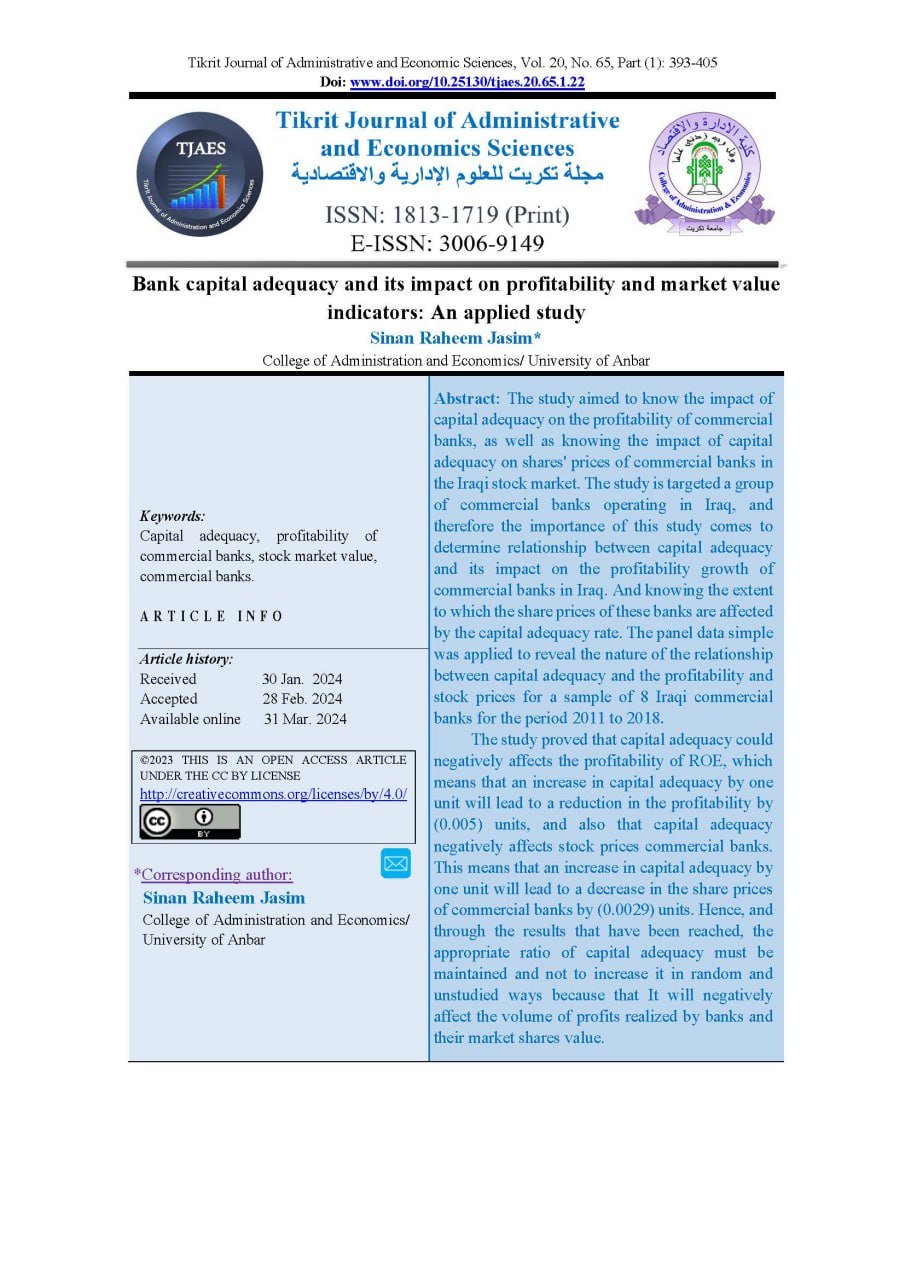
Bank capital adequacy and its impact on profitability and market value indicators: An applied study
Article Sidebar
THIS IS AN OPEN ACCESS ARTICLE UNDER THE CC BY LICENSE
Main Article Content

Abstract
The study aimed to know the impact of capital adequacy on the profitability of commercial banks, as well as knowing the impact of capital adequacy on shares' prices of commercial banks in the Iraqi stock market. The study is targeted a group of commercial banks operating in Iraq, and therefore the importance of this study comes to determine relationship between capital adequacy and its impact on the profitability growth of commercial banks in Iraq. And knowing the extent to which the share prices of these banks are affected by the capital adequacy rate. The panel data simple was applied to reveal the nature of the relationship between capital adequacy and the profitability and stock prices for a sample of 8 Iraqi commercial banks for the period 2011 to 2018.
The study proved that capital adequacy could negatively affects the profitability of ROE, which means that an increase in capital adequacy by one unit will lead to a reduction in the profitability by (0.005) units, and also that capital adequacy negatively affects stock prices commercial banks. This means that an increase in capital adequacy by one unit will lead to a decrease in the share prices of commercial banks by (0.0029) units. Hence, and through the results that have been reached, the appropriate ratio of capital adequacy must be maintained and not to increase it in random and unstudied ways because that It will negatively affect the volume of profits realized by banks and their market shares value.
Downloads
Article Details
References
El-Gamal, Z., (2012), Choosing the Model in Fixed and Random Longitudinal Data Models, Iraqi Journal of Statistical Sciences, University of Mosul, (12) 21.
Muhammad, A., (2021), the relationship between capital adequacy and liquidity in the Saudi banking sector, Journal of the Islamic University of Economic and Administrative Studies, Gaza Islamic University, Vo 29, Issue 3.
Al-Harith, M., Majeed, H., & Hassan A., (2018), credit risk and its impact on banking capital adequacy: an applied study. Al-Quds Open University Journal for Research and Studies, Vo (2), Issue 43.
Dubeek, H., (2015), The relationship between the application of the capital adequacy criterion according to Basel decisions and the profitability of local commercial banks in Palestine, unpublished thesis, The Islamic University of Gaza, Palestine.
Najat, B., (2017), The effect of solvency on the market value of the bank’s shares, a study of a sample of banks listed on the Qatar Stock Exchange during the period (2005-2015), an unpublished master’s thesis, Kasdi Merbah University, Ouargla, Algeria.
Nazeeh, M. Ahlam, B., (2019), Liquidity Risk Management and its Role in Improving the Profitability of Algerian Public Commercial Banks (for the period from 2006-2015), Al Maaref Journal, University of Ghardaia, Algeria, (14) 1.
Sheikh, I., (2015), The impact of announcing the distribution of profits and earnings per share on the market value of the shares of Jordanian companies listed on the Amman Stock Exchange (unpublished master’s thesis), Applied Science Private University, Jordan.
Ghazi. F., (2018), The impact of banking competition on indicators of financial stability in the Iraqi economy for the period (2005-2016), unpublished PhD thesis, University of Anbar, Iraq.
Al-Salmani, A. Battal, A., & Hamad, A., (2019), Using time-series methods to predict the trading prices of the Iraqi stock market: for the period 2005-2018, Anbar University Journal for Economic and Administrative Sciences, (11)27.
Wooldridge, Jeffrey M., (2016), Introductory Econometrics: A Modern Approach, Sixth Edition, Cengage Learning, United States of America.
Baltagi, B., (2005), Econometric Analysis of Panel Data, Third Edition, John Wiley & Sons Ltd, England
Saleh, A., Rashid, A. & Jasim, S., (2021), Analysis of Nonperforming Debts' Impact on Profitability and Liquidity of Some Iraqi Commercial Banks for the Period between 2011-2018, Webology, Vo (18), Special Issue.