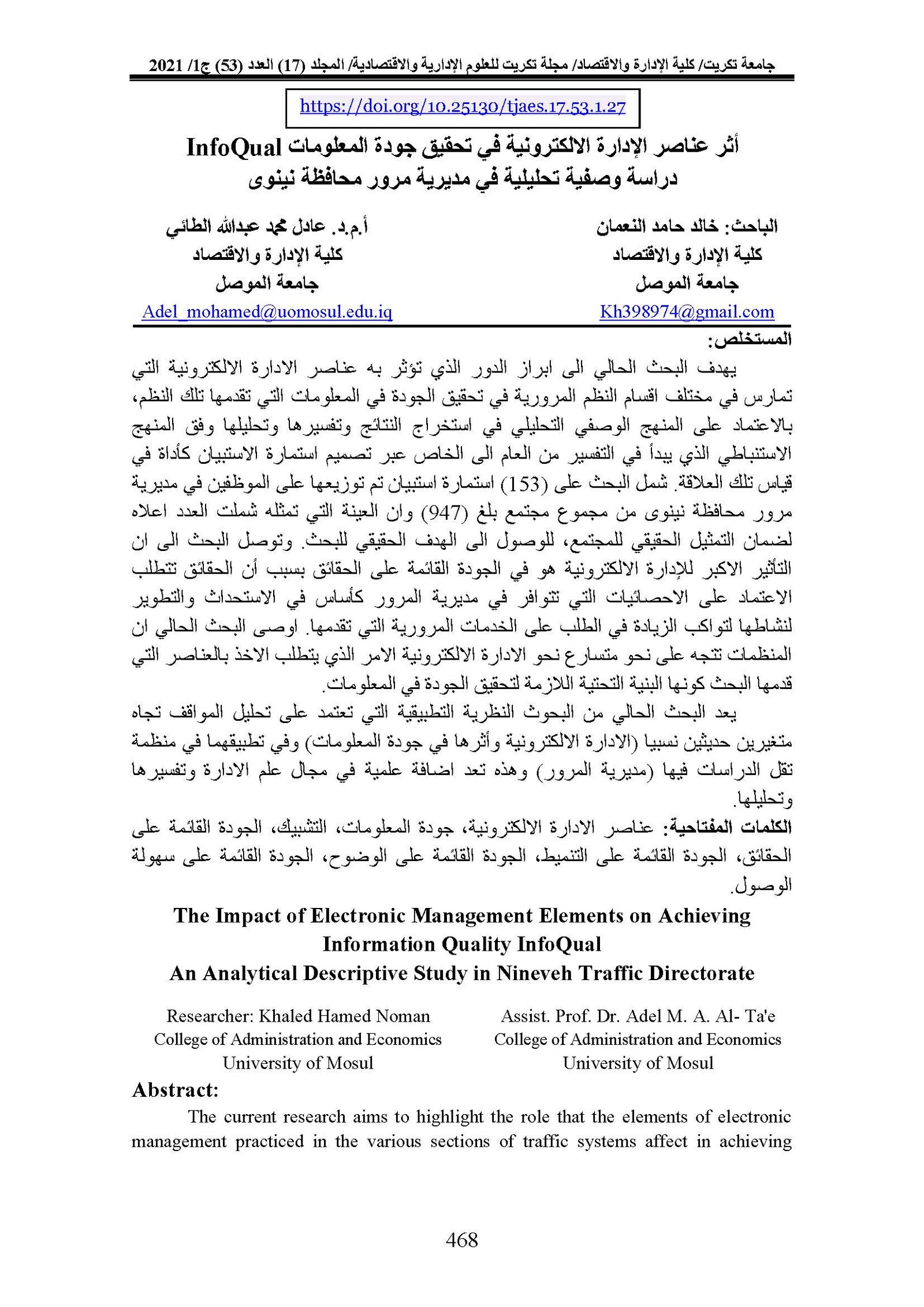
The Impact of Electronic Management Elements on Achieving Information Quality InfoQual An Analytical Descriptive Study in Nineveh Traffic Directorate
Article Sidebar
THIS IS AN OPEN ACCESS ARTICLE UNDER THE CC BY LICENSE
Main Article Content

Abstract
The current research aims to highlight the role that the elements of electronic management practiced in the various sections of traffic systems affect in achieving quality in the information provided by those systems. By relying on the descriptive and analytical approach to extracting, interpreting and analyzing results according to the deductive approach that begins with interpretation from the general to the specific By designing a questionnaire as a tool in measuring that relationship. The research included 153 questionnaire forms that were distributed to employees in the Nineveh Traffic Directorate out of a total population of 947, and the sample that represented it included the above number to ensure a true representation of the community, in order to reach the real goal of the research. The research found that the greatest impact of electronic management is on fact-based quality because the facts require relying on the statistics that are available in the Traffic Directorate as a basis for the creation and development of its activity to keep pace with the increase in demand for the traffic services it provides. The current research recommended that organizations are moving rapidly towards electronic management, which requires taking the elements presented by the research as the necessary infrastructure to achieve quality in information. The current research is an applied theoretical research that depends on analyzing attitudes towards two relatively recent variables (electronic management and its effect on the quality of information) and in their application in an organization in which studies are conducted (Traffic Directorate) and this is a scientific addition in the field of management science, its interpretation and analysis.
Downloads
Article Details
References
اولاً. المصادر العربية:
الرشيدي، علي بن ضبيان، (2009)، الهندسة الالكترونية للخدمات المرورية، سلسلة رسائل الدكتوراه، رسالة منشورة، جامعة نايف العربية للعلوم الامنية، الرياض، المملكة العربية السعودية.
السبعاوي، احمد يونس، (2019)، "اختبار انموذج قياس تصميم نظام المعلومات الادارية باستخدام التحليل العاملي التوكيدي التفصيلي في إطار دراسة تطبيقية"، مجلة المثنى للعلوم الادارية والاقتصادية، المجلد (9)، العدد (2).
ثانياً. المصادر الأجنبية:
Abbas, A. A., (2020), Educational Competiotion as a Moderating variable of the relationship between electronic management and intelligent organizations. Revista Tempos e Espaços em Educação, 13 (32), 25.
Al Shobaki, M. J., Abu-Naser, S. S., Abu Amuna, Y. M., & El Talla, S. A., (2018), Support Extent Provided by Universities Senior Management in Assisting the Transition to e-Management.
Al-Bayati, A. S. W., (2016), Electronic management and its role in achieving competitive advantage in industrial organizations. Journal of University of Human Development, 2 (4), 249-289.
Azmi, F., & Sri, M., (2020), Factors that affect accounting information system success and its implication on accounting information quality. SIMILIARITY.
Bashayreh, M. M. M., (2016), the effect of using the elements of the electronic management in improving the quality of accounting internal control in Jordanian banks. Communications, 7(12).
Bataineh, K. A., (2017), the impact of electronic management on the employees' performance field study on the public organizations and governance in Jerash governorate. Journal of Management and Strategy, 8(5), 86-100.
Bikfalvi, A., Rosa, J. L. D. L., & Keefe, T. N., (2013), E-Government service evaluation: A multiple-item scale for assessing information quality. Electronic Government and Electronic Participation-Joint Proceedings of Ongoing Research of IFIP EGOV and IFIP ePart 2017.
Bshayreh, M. M., Tawaha, M. S., & Al-Khasawneh, R. O. H., (2019), The Effect of Electronic Management in Improving the Quality of Internal Audit through Developing the Performance of Internal Auditor: An Empirical Study in the Jordanian Insurance Companies. Academy of Accounting and Financial Studies Journal, 23 (5), 1-10.
Castro, I. D., Varon, C., Torfs, T., Van Huffel, S., Puers, R., & Van Hoof, C., (2018), Evaluation of a multichannel non-contact ECG system and signal quality algorithms for sleep apnea detection and monitoring. Sensors, 18(2), 577.
Crede, M., & Harms, P., (2019), Questionable research practices when using confirmatory factor analysis. Journal of Managerial Psychology.
Eppinger, S. D., (2001), Innovation at the speed of information. Harvard business review, 79(1), 149-158.
Hasan, A. H., (2019), the Contribution of the Elements of Electronic Management in Support of some of the Functions of Human Resources Management. Tikrit Journal of Administrative and Economic Sciences, 1(41), 136-165.
Hold, P., Erol, S., Reisinger, G., & Sihn, W., (2017), Planning and evaluation of digital assistance systems. Procedia Manufacturing, 9, 143-150.
Kebede, M., Adeba, E., & Chego, M., (2020), Evaluation of quality and use of health management information system in primary health care units of east Wollega zone, Oromia regional state, Ethiopia. BMC Medical Informatics and Decision Making, 20(1), 1-12.
Kvon, G. M., Vaks, V. B., Masalimova, A. R., Kryukova, N. I., Rod, Y. S., Shagieva, R. V., & Khudzhatov, M. B., (2017), Risk in implementing new electronic management systems at universities. EURASIA Journal of Mathematics, Science and Technology Education, 14 (3), 891-902.
Kvon, G. M., Vaks, V. B., Masalimova, A. R., Kryukova, N. I., Rod, Y. S., Shagieva, R. V., & Khudzhatov, M. B., (2017), Risk in implementing new electronic management systems at universities. EURASIA Journal of Mathematics, Science and Technology Education, 14 (3).
Lee, Y. W., Strong, D. M., Kahn, B. K., & Wang, R. Y., (2002), AIMQ: a methodology for information quality assessment. Information & management, 40 (2), 133-146.
Mayhew, E., (2018), Implementing electronic management of assessment: four key barriers faced by higher education providers moving to online submission and feedback. Research in Learning Technology, 26.
Mirza, K. İ., (2018), Electronic public distribution system e-government food department (Master's thesis, Hasan Kalyoncu Üniversitesi).
Peter F. Druker, (1955), the Practice of Management, Cox & Wyman ltd., London, Great Britain.
Phylonin, O., Belokonov, I., & Nikolaev, P., (2017), Traffic Control Systems of Nanosatellites in the Zone of the International Space Station. Procedia engineering, 185, 380-387.
Priyadarshini, C., Sreejesh, S., & Anusree, M. R., (2017), Effect of information quality of employment website on attitude toward the website. International Journal of Manpower.
Scherler, S., Goellner, M., & Liu-Henke, X., (2020, September), Design of a Self-Optimized Electronic Management for Autonomous Electric Vehicles with Fuel Cells as Range Extenders using the Intelligent Guidance Platform doplar. In 2020 Fifteenth International Conference on Ecological Vehicles and Renewable Energies (EVER) (pp. 1-11). IEEE.
Slaveykov¹, K., Stoyanov, V., Stoyanov, K., & Trifonova, K., (2015, June), E-Management: Using ICT to Accomplish Desired Goals. In VII Международна Научна Конференция „Е-управление” в рамките на „Дни на науката–2015 “на ТУ-София VII-th International Scientific Conference (p. 117).
Vitas, B., (2013), Community-driven information quality standards: How IBM developed and implemented standards for information quality. Technical Communication, 60 (4), 307-315.
Waswas, D., & Jwaifell, M., (2019), The Role of Universities' Electronic Management in Achieving Organizational Excellence: Example of Al Hussein Bin Talal University. World Journal of Education, 9 (3), 53-66.