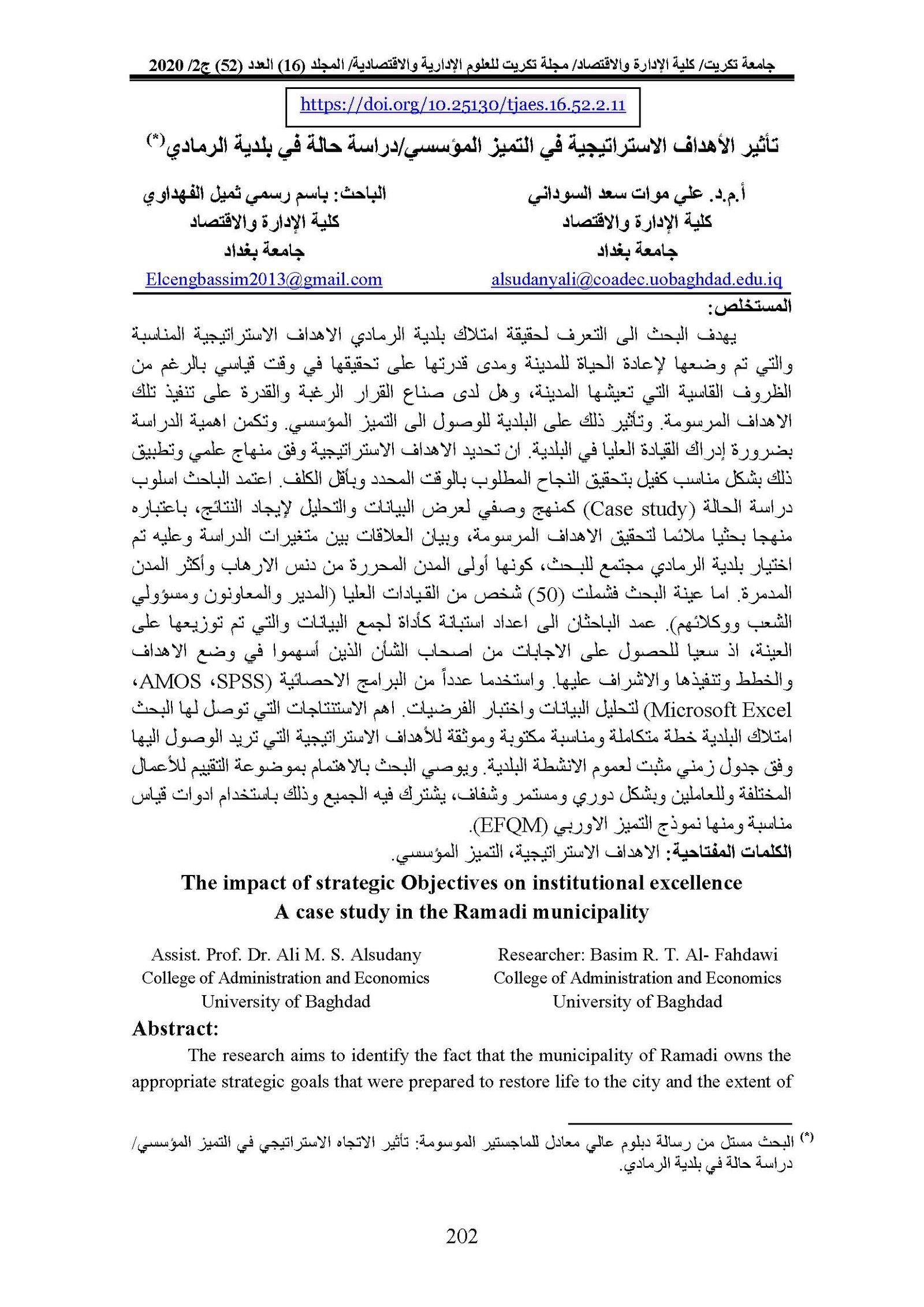
The impact of strategic Objectives on institutional excellence A case study in the Ramadi municipality
Article Sidebar
THIS IS AN OPEN ACCESS ARTICLE UNDER THE CC BY LICENSE
Main Article Content

Abstract
The research aims to identify the fact that the municipality of Ramadi owns the appropriate strategic goals that were prepared to restore life to the city and the extent of its ability to achieve them in record time despite the harsh conditions that the city lives in, and do decision-makers have the desire and ability to implement those objectives set? and the impact of this on the municipality to reach institutional excellence. The importance of the study lies in the need for the higher leadership in the municipality to realize that defining strategic goals according to a scientific approach and applying that appropriately will ensure the required success in the specified time and with the lowest costs. The researcher adopted the case study method as a descriptive method for presenting data and analyzing to find results, as it is an appropriate research approach to achieve the goals drawn, and to show the relationships between the study variables. Accordingly, the municipality of Ramadi was chosen as a research community, as it is the first city liberated from the filth of terrorism and the most destroyed city. As for the research sample, it included (50) people from the higher leaders (the director, assistants, people’s officials and their agents). The researcher prepared a questionnaire as a tool to collect data, which was distributed to the sample. As he sought answers from stakeholders who contributed to setting goals, plans, implementation and supervision thereof. and use statistical programs (SPSS, AMOS, Microsoft Excel) to analyze the data and test the hypotheses. The most important conclusions reached by the researcher: The municipality has an integrated and appropriate written and documented plan for the strategic objectives that it wants to reach according to a fixed schedule for all municipal activities. The study recommends paying attention to the evaluation topic for different businesses and employees on a regular, continuous and transparent manner, in which everyone participates, using appropriate measuring tools, including the European Excellence Model (EFQM).
Downloads
Article Details
References
أولاً. المصادر العربية:
أ. الكتب:
الخالدي، ابراهيم بدر، (2011)، معجم الإدارة/موسوعة شاملة لمصطلحات الادارة العامة وادارة الاعمال، دار اسامة، عمان.
الدوري، زكريا مطلك، (2005)، الادارة الاستراتيجية مفاهيم وعمليات وحالات دراسية، دار اليازوري العلمية للنشر والتوزيع، عمان.
العامري، صالح مهدي محسن والغالبي، طاهر محسن منصور، (2008)، الادارة والاعمال، مكتبتنا العربية، الطبعة الثانية، دار وائل للنشر والتوزيع، عمان.
ادريس، وائل محمد صبحي والغالبي، طاهر محسن منصور، (2009)، سلسلة ادارة الاداء الاستراتيجي أساسيات الاداء وبطاقة التقييم المتوازن، دار وائل للنشر والتوزيع، الطبعة الاولى، عمان.
العيساوي محمد حسين والعارضي، جليل كاظم والعبادي، هاشم فوزي، (2012)، الادارة الاستراتيجية المستدامة مدخل لإدارة المنظمات في الالفية الثالثة، مؤسسة الوراق للنشر والتوزيع.
جرادات، ناصر محمد سعود، (2013)، الادارة الاستراتيجية، منضور تكاملي حديث اثراء للنشر والتوزيع، عمان.
ياسين، سعيد غالب، (1998)، الادارة الاستراتيجية، دار اليازوري، الطبعة (1) عمان.
ب. البحوث والرسائل:
العزاوي، سهير احمد محمد، (2016)، التوجه الاستراتيجي للجامعات العراقية ودور مؤشـــرات الأداء القطاعي لديوان الرقابة المالية الاتحادي فيه، (بحث ميداني)، رسالة ماجستير مقدمة الى مجلس كلية الادارة والاقتصاد/جامعة بغداد.
المغربي، عبد الحميد فتاح، (2006)، الادارة الاستراتيجية لقياس الاداء المتوازن، المكتبة العصرية للنشر والتوزيع، المنصورة -مصر.
العامري، فراس محمد اسماعيل، (2015)، التوجه الاستراتيجي للمنظمات في إطار التفاعل بين القدرات القيادية وممارسات نظرية الفوضى، اطروحة دكتوراه مقدمة الى مجلس كلية الادارة والاقتصاد/جامعة بغداد.
حسون، ليث نعمان، (2018)، دور نظام التكاليف على اساس النشاط المركز على الاداء (PFABC) في تحقيق التميز المؤسسي، دراسة ميدانية في مصرف بابل، مجلة تكريت للعلوم الادارية والاقتصادية، المجلد (4)، العدد (44).
سلمان، سعدون محسن، (2018)، تحليل العلاقة التبادلية بين ادارة مخاطرة المعرفة والتوجه الاستراتيجي وانعكاسها على فاعلية المنظمة، بحث تحليلي في قطاع المصارف الحكومية، اطروحة دكتوراه مقدمة الى مجلس كلية الادارة والاقتصاد/بغداد.
ج. المجلات:
عبد الوهاب، محمود اسامة، (2016)، الشفافية الادارية أثرها على التميز المنظمي، دراسة ميدانية على جامعة المستنصرية، مجلة المستنصرية للدراسات العربية والدولية، المجلد (13)، العدد، (53).
كاظم، هناء حسن، (2019)، اعادة هندسة العمليات الادارية وأثرها في تحقيق التميز المؤسسي، دراسة تطبيقية لآراء المدراء في عينة في فنادق الدرجة الممتازة والاولى لمدينة بغداد، مجلة الادارة والاقتصاد/المستنصرية، العدد (42).
ثانياً. المصادر الأجنبية:
Books:
Arthur A. Thompson, Margaret A. Peteraf, John E. Gamble,& A. J. Strickland III, (2016), Crafting and ExecutingStrategy,20th , Published by McGraw-Hill Education, New York.
Daft, R, L., (2008), Organization Theoryand and Design 10th ed (Thompson: South Western).
Gunderman, Richard B., (2006), Achieving Excellence in Medical Education, British Library, and London.
L. J. Porter and S. J. Tanner, (2004), Assessing Business Excellence, Second edition, Typeset by Newgen Imaging Systems (P) Ltd., Chennai, India Printed and bound in the Netherlands.
Lasrado, Flevy, (2018), Achieving Organizational Excellence A Quality Management Program for Culturally Diverse Organizations ,Springer International Publishing AG, part of Springer Nature, Switzerland
Oakland, John S., (2001), Total Organizational Excellence, Achieving world-Class Performance, Butterworth-Heinemann.
Oakland S. John, (2014) Total Quality Management and Operational Excellence, 4th. London & New York.
Articles:
Dahlgaard, J. J., Chen, C. K., Jang, J. Y., Banegas, L. A., & Dahlgaard-Park, S. M. (2013), Business excellence models: Limitations, reflections and further development, Total Quality Management & Business Excellence, Vol. (24) No. (5-6), PP. (519-538).
Dubey, M. (2016), Developing an agile business excellence model for organizational sustainability, Global Business and Organizational Excellence, Vol. (35), No. (2), PP. (60-71).
Liu, Y. L., & Ko, P. F., (2018), A modified EFQM Excellence Model for effective evaluation in the hotel industry, Total Quality Management & Business Excellence, Vol. (29), No. (13-14), PP. (1580-1593).
McFarlane, D. A., (2014), Contemporary barriers to excellence in business education, Journal of Business Studies Quarterly, Vol. (6), No. (2), PP.(125).
Metaxas, I. N., & Koulouriotis, D. E., (2014), a theoretical study of the relation between TQM, assessment and sustainable business excellence. Total Quality Management & Business Excellence, Vol. (25), No. (5-6), PP. (494-510).
Mohan, K., & Gomathi, S., (2014), A study on empowering employee capabilities towards organizational excellence, Mediterranean Journal of Social Sciences, Vol.(5), No.(20), PP. (557).
Qawasmeh, F. M., Darqal, N., & Qawasmeh, I. F., (2013), the role of organization culture in achieving organizational excellence, Jadara University as a case study. International Journal of Economics and Management Sciences, Vol. 2, No. 7, PP. 5-19.