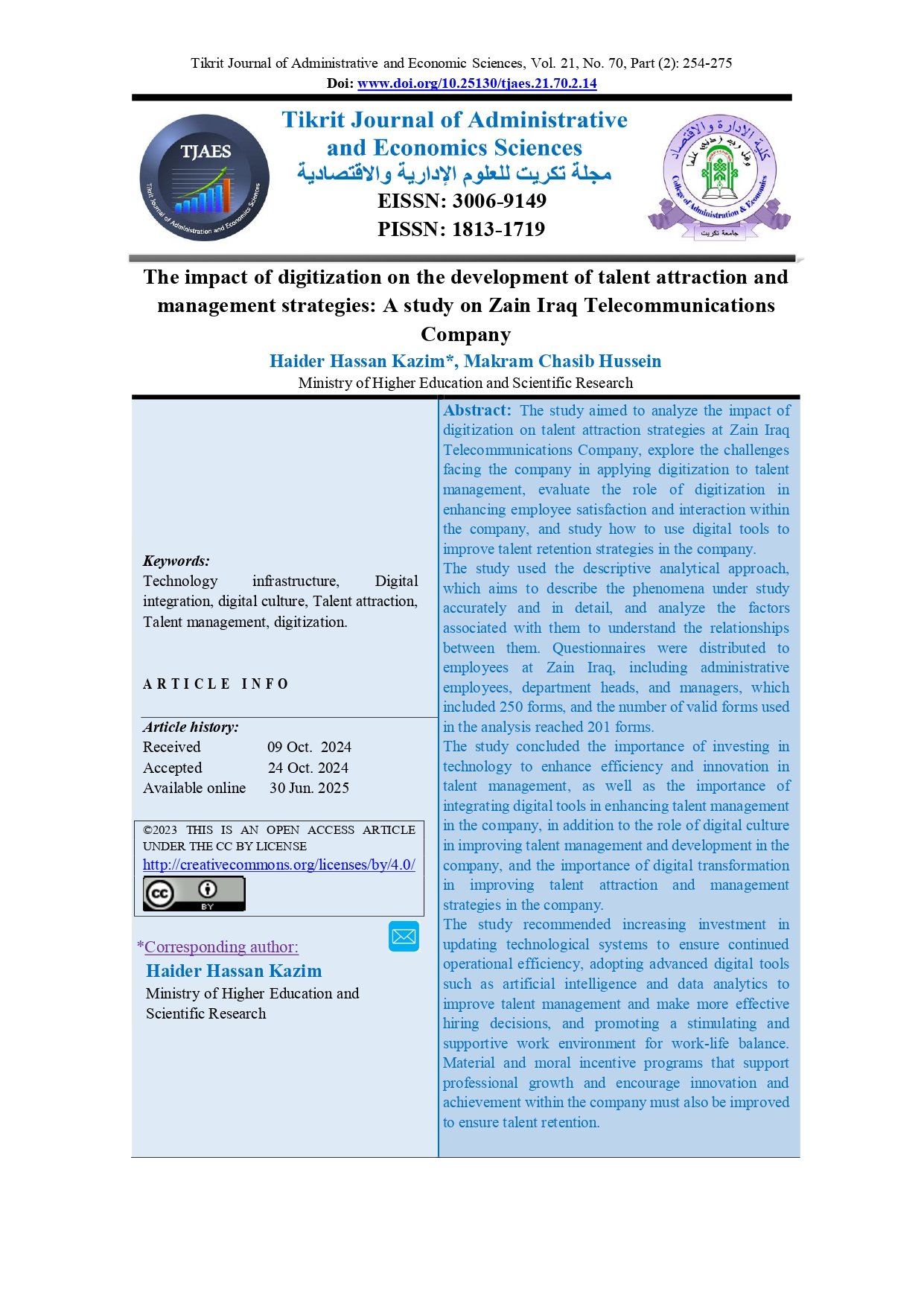
The impact of digitization on the development of talent attraction and management strategies: A study on Zain Iraq Telecommunications Company
Article Sidebar
THIS IS AN OPEN ACCESS ARTICLE UNDER THE CC BY LICENSE
Main Article Content

Abstract
The study aimed to analyze the impact of digitization on talent attraction strategies at Zain Iraq Telecommunications Company, explore the challenges facing the company in applying digitization to talent management, evaluate the role of digitization in enhancing employee satisfaction and interaction within the company, and study how to use digital tools to improve talent retention strategies in the company.
The study used the descriptive analytical approach, which aims to describe the phenomena under study accurately and in detail, and analyze the factors associated with them to understand the relationships between them. Questionnaires were distributed to employees at Zain Iraq, including administrative employees, department heads, and managers, which included 250 forms, and the number of valid forms used in the analysis reached 201 forms.
The study concluded the importance of investing in technology to enhance efficiency and innovation in talent management, as well as the importance of integrating digital tools in enhancing talent management in the company, in addition to the role of digital culture in improving talent management and development in the company, and the importance of digital transformation in improving talent attraction and management strategies in the company.
The study recommended increasing investment in updating technological systems to ensure continued operational efficiency, adopting advanced digital tools such as artificial intelligence and data analytics to improve talent management and make more effective hiring decisions, and promoting a stimulating and supportive work environment for work-life balance. Material and moral incentive programs that support professional growth and encourage innovation and achievement within the company must also be improved to ensure talent retention.
Downloads
Article Details
References
اولاً. المصادر العربية:
الجيوسي، امنة سعيد فريد، (2024)، مهارات القيادة المستقبلية لمديري المدارس المهنية وعلاقتها باستخدام تقنيات الذكاء الاصطناعي، (رسالة دكتوراه).
الحربي، محمد، (2020)، استخدام التكنولوجيا الحديثة في تحسين عملية التوظيف، مجلة إدارة الأعمال، 211-263.
الحمادي، فاطمة، (2022)، تطبيقات الذكاء الاصطناعي في تنمية الموارد البشرية وتحسين مهارات الموظفين، المجلة العربية للتنمية المستدامة، 206-230.
الزيدي، خالد، (2020)، التحول الرقمي في الشركات: أثره على عملية التوظيف: دار النهضة العربية.
السيد، عمر، (2019)، العلامة التجارية لصاحب العمل وتأثيرها على جذب المواهب، مجلة الموارد البشرية العربية، 98-145.
العمري، عبد الله، (2021)، أثر التكنولوجيا الرقمية في تحسين أداء الموارد البشرية وتطوير المهارات، مجلة الاقتصاد والإدارة الرقمية، 39(3) 89-122.
شرهان، أرفق محمد، حكم، أسماء محمد، المقبلي، أشواق علي، لميح، ريم خالد، الحداد، فتحيه عبدالله، والصبري، لينا عبدالحكيم، (2022)، أثر مفهوم البيانات الضخمة في تطوير عمل التدقيق الداخلي بالبنوك اليمنية دراسة تطبيقية على البنوك العاملة بمدينة ذمار، Albaydha University Journal، 4(1)، 34-56.
عبد الفتاح، أحمد، (2021)، التحول الرقمي وتأثيره على استراتيجيات الموارد البشرية: دار الفكر العربي.
عبد الله، علي، (2022)، دور البيانات الضخمة في تطوير استراتيجيات التوظيف: المركز العربي للدراسات.
فغول، جنات، (2020)، إدارة الموارد البشرية في ظل الرقمية: دراسة حالة مؤسسة اتصالات الجزائر، (رسالة دكتوراه)، جامعة الجزائر 3.
محمد علام، نهال، (2022)، تأثير العلامة التجارية لصاحب العمل على إدارة المواهب، المجلة العلمية للبحوث والدراسات التجارية، 36(4)، 145-231.
ثانياً. المصادر الأجنبية:
Cappelli, P. (2018). Talent on Demand: Managing Talent in an Age of Uncertainty. Harvard Business Review Press.
Deloitte. (2019). Global Human Capital Trends 2019: Leading the social enterprise‑Reinvent with a human focus. Deloitte Insights.
Gregor, S., & Hevner, A. R. (2020). Positioning and presenting design science research for maximum impact. MIS Quarterly. 337-355
Kane, G. C., Palmer, D., Phillips, A. N., & Kiron, D. (2015). Strategy, not technology, drives digital transformation. MIT Sloan Management Review.
Molodchik, M., & Jardon, C. M. (2020). The impact of digitalization on human capital and organizational capabilities. Human Resource Management Journal. 583-604.
Schmidt, G., Spann, M., & Weinhardt, C. (2020). The role of digital transformation in business model innovation: Insights from the service industry. Journal of Business Research.
Sebastian, I. M., Ross, J. W., & Beath, C. M. (2020). How big old companies navigate digital transformation. MIS Quarterly Executive: Routledge, 133-150.
Stone, D. L., Deadrick, D. L., Lukaszewski, K. M., & Johnson, R. (2020). The influence of technology on the future of human resource management. Human Resource Management Review, 216-231
Tarique, I., & Schuler, R. S. (2017). Global talent management: Literature review, integrative framework, and suggestions for further research. Journal of World Business. 45(2), 122-133
Thuan, N. H., Drechsler, A., & Antunes, P. (2019). Construction of design science research questions. Communications of the Association for Information Systems, 44(1), 20.
Vey, K., Fandel-Meyer, T., Zipp, J. F., & Schneider, C. (2017). Learning and development in times of digital transformation: Facilitating a culture of change and innovation. International Journal of Advanced Corporate Learning. 10(1), 22-32.
Vial, G. (2019). Understanding digital transformation: A review and a research agenda. The Journal of Strategic Information Systems. 13-66
Westerman, G., Bonnet, D., & McAfee, A. (2014). Leading digital: Turning technology into business transformation. Harvard Business Review Press.1