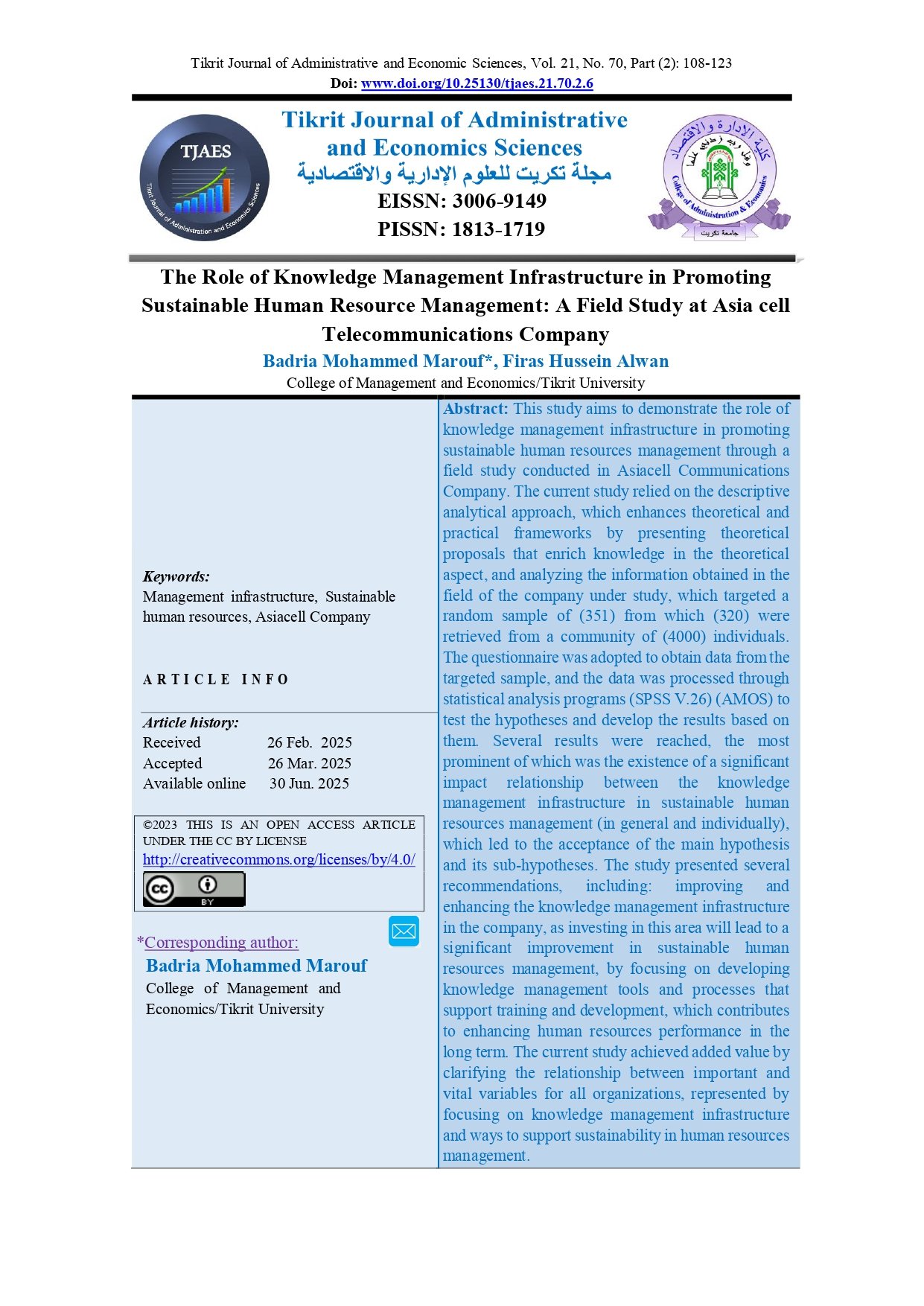
The Role of Knowledge Management Infrastructure in Promoting Sustainable Human Resource Management: A Field Study at Asia cell Telecommunications Company
Article Sidebar
THIS IS AN OPEN ACCESS ARTICLE UNDER THE CC BY LICENSE
Main Article Content

Abstract
This study aims to demonstrate the role of knowledge management infrastructure in promoting sustainable human resources management through a field study conducted in Asiacell Communications Company. The current study relied on the descriptive analytical approach, which enhances theoretical and practical frameworks by presenting theoretical proposals that enrich knowledge in the theoretical aspect, and analyzing the information obtained in the field of the company under study, which targeted a random sample of (351) from which (320) were retrieved from a community of (4000) individuals. The questionnaire was adopted to obtain data from the targeted sample, and the data was processed through statistical analysis programs (SPSS V.26) (AMOS) to test the hypotheses and develop the results based on them. Several results were reached, the most prominent of which was the existence of a significant impact relationship between the knowledge management infrastructure in sustainable human resources management (in general and individually), which led to the acceptance of the main hypothesis and its sub-hypotheses. The study presented several recommendations, including: improving and enhancing the knowledge management infrastructure in the company, as investing in this area will lead to a significant improvement in sustainable human resources management, by focusing on developing knowledge management tools and processes that support training and development, which contributes to enhancing human resources performance in the long term. The current study achieved added value by clarifying the relationship between important and vital variables for all organizations, represented by focusing on knowledge management infrastructure and ways to support sustainability in human resources management.
Downloads
Article Details
References
اولاً. المصادر العربية:
أبو علوش، شادي (2018)، "تقييم العلاقات المتبادلة بين البنية التحتية لإدارة المعرفة ورأس المال الفكري" رسالة ماجستير غير منشورة، جامعة إربد الوطنية، الأردن.
جمعه، ن. ونجلاء حسن، (2023)، أثر ممارسات إدارة الموارد البشرية المستدامة على الأداء التنافسي للفنادق الخمس نجوم بالقاهرة: الدور الوسيط للمرونة الاستراتيجية. مجلة البحوث الإدارية, 41(2).
الراوجي، محمد سليمان ايوب، (2022)، "دور البنية التحتية لإدارة المعرفة في تعزيز الجاهزية التنظيمية: دراسة مسحيّة في شركة آسياسيل للاتصالات النقالة في العراق"، رسالة ماجستير غير منشورة، كلية الإدارة والاقتصاد، جامعة الموصل، العراق.
الساعدي، احمد مكي جبار، (2023)، "تأثير الذكاء الاستراتيجي في تعزيز الأداء الإبداعي–البنى التحتية لإدارة المعرفة متغير تفاعلي: دراسة استطلاعية لآراء عينة من العاملين في ديوان محافظة البصرة، رسالة ماجستير غير منشورة، الكلية التقنية الإدارية/البصرة، الجامعة التقنية الجنوبية، العراق.
نور الهدى، مجول، وشهيناز. إدارة الموارد البشرية المستدامة وأثرها على الأداء التنظيمي دارسة حالة بمديرية العملية الاتصالات الجزائر–ورقلة 2023 ((Doctoral dissertation، جامعة قاصدي مرباح-ورقلة).
ثانياً. المصادر الأجنبية:
Al Aqrabawi, R., Alkhazali, Z., Dabaghia, M. N., & Helalat, A. (2023). The Impact of Knowledge Management Infrastructure on Promoting Innovation: An Applied Study on Jordanian Communications and Information Technology Companies.
Arbabi, H., Salehi-Taleshi, M. J., & Ghods, K. (2020). The role of project management office in developing knowledge management infrastructure. Engineering, Construction and Architectural Management, 27(10), 3261-3287.
Benitez, J., Ray, G., & Henseler, J. (2018). Impact of information technology infrastructure flexibility on mergers and acquisitions. MIS Quarterly: Management Information Systems, 42(1), 25-43.
Bibi, N., & Saeed Akhtar, M. M. (2020). Relationship between Organizational Structure and Job Performance of Teaching Faculty at Higher Education Level. Journal of Research & Reflections in Education (JRRE), 14(1).
Carroll, A. B. (2015). Corporate social responsibility. Organizational dynamics, 44(2), 87-96.
Dabić, M., Maley, J. F., Švarc, J., & Poček, J. (2023). Future of digital work: Challenges for sustainable human resources management. Journal of Innovation & Knowledge, 8(2), 100353.
Ejere, S.I. (2011). Human Capital Formation as Catalyst for National Development: Nigeria in Perspective. International Business and Management, 2(2), 98-104.
Gold, A. H., Malhotra, A., & Segars, A. H. (2016). Knowledge management: An organizational capabilities perspective. Journal of management information systems, 18(1), 185-214
Iqbal, Q. (2020). The era of environmental sustainability: Ensuring that sustainability stands on human resource management. Global Business Review, 21(2), 377-391.
Joseph, T. P., & Radhika, R. (2023). Human resources management practices-a key to achieving organizational sustainability. Journal of Pharmaceutical Negative Results, 7253-7264.
Khari, U. (2022). Green human resource management: A review and research agenda. EDITORIAL BOARD, 85.
Lam, L., Nguyen, P., Le, N., & Tran, K. (2021). The relation among organizational culture, knowledge management, and innovation capability: Its implication for open innovation. Journal of Open Innovation: Technology, Market, and Complexity, 7(1), 66.
Lu, Y., Zhang, M. M., Yang, M. M., & Wang, Y. (2023). Sustainable human resource management practices, employee resilience, and employee outcomes: Toward common good values. Human Resource Management, 62(3), 331-353.
Maraqa, M., Omari, G., & Jarrah, M. (2021). The impact of knowledge management infrastructure on the innovation process and products: The mediating role of knowledge management technologies and mechanisms. Management Science Letters, 11(1), 261-270.
Masa’deh, R, Hajir, J. A., Obeidat, B. Y., & Al-dalahmeh, M. A., (2015). The role of knowledge management infrastructure in enhancing innovation at mobile telecommunication companies in Jordan. European Journal of Social Sciences, 50(3), 313-330.
Meng, J., & Berger, B. K. (2019). The impact of organizational culture and leadershipperformance on PR professionals’ job satisfaction: Testing the joint mediating effects of engagement and trust. Public Relations Review, 45(1), 64-75.
Vidotto, J. D. F., Ferenhof, H. A., Selig, P. M., & Bastos, R. C. (2017). A human capital measurement scale. Journal of Intellectual Capital.
Wang, C., & Li, X. (2024). Optimizing the utilization of mineral assets and human resources for enhanced social welfare and sustainable development. Resources Policy, 90, 104755.