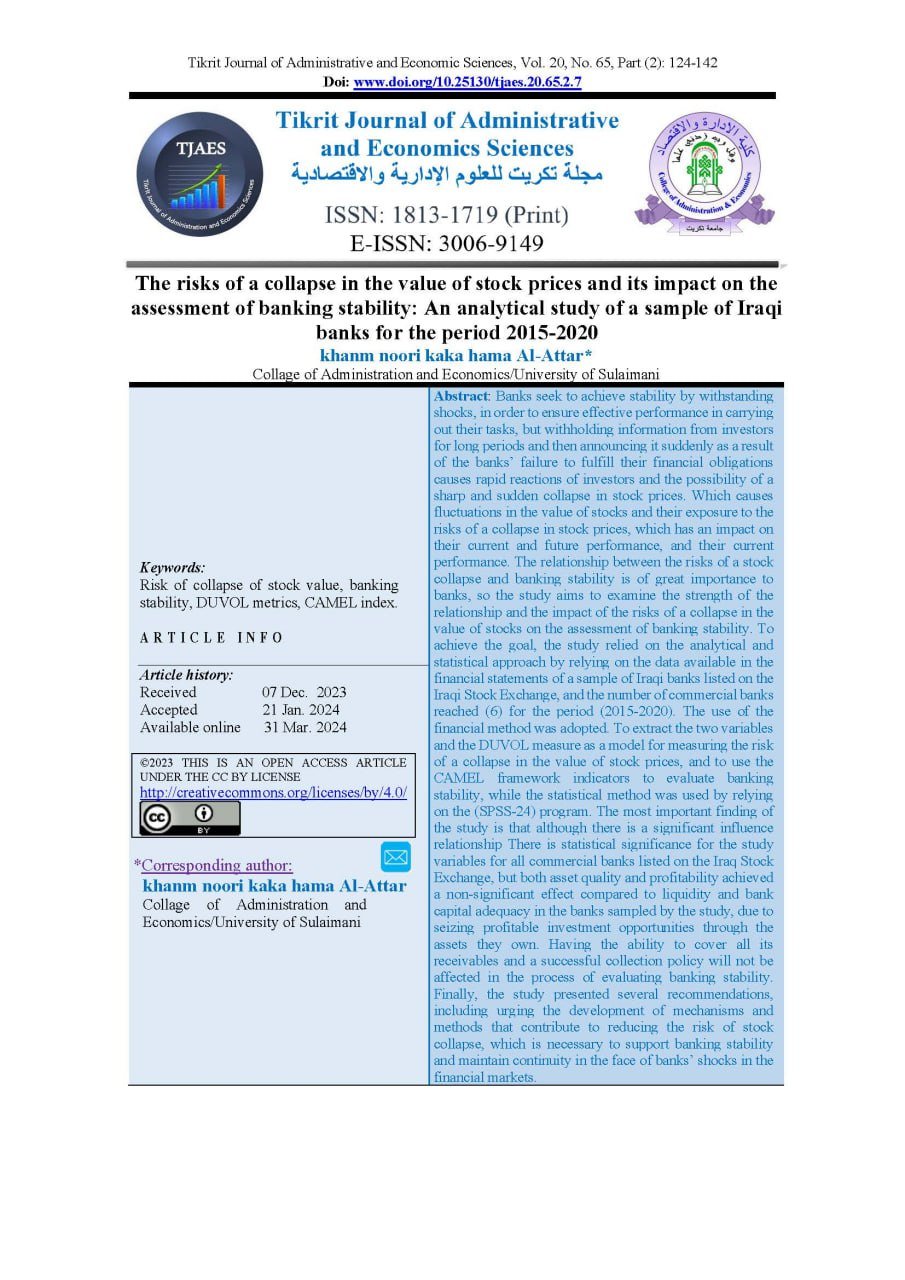
مخاطر انهيار قيمة اسعار الأسهم وأثرها على تقييم الاستقرار المصرفي: دراسة تحليلية للعينة من المصارف العراقية للفترة 2015-2020
الشريط الجانبي للمقالة
THIS IS AN OPEN ACCESS ARTICLE UNDER THE CC BY LICENSE
محتوى المقالة الرئيسي

الملخص
تسعى المصارف إلى تحقيق الاستقرار من خلال تحمل الصدمات، ذلك لضمان الأداء الفعال في انجاز مهامها، إلا أن حجب المعلومات عن المستثمرين للفترات طويلة من ثم اعلانها بشكل مفاجئ نتيجة فشل المصارف في الوفاء بالتزاماتها المالية يسبب في ردود فعل سريعة للمستثمرين واحتمال حدوث انهيار حاد ومفاجئ للأسعار لأسهم، وحظت العلاقة بين مخاطر انهيار الأسهم والاستقرار المصرفي أهمية كبيرة لدى المصارف لذا تهدف الدراسة إلى فحص قوة ارتباط وتأثير مخاطر انهيار قيمة الأسهم على تقييم الاستقرار المصرفي، ولتحقيق الهدف اعتمد الدراسة على المنهج التحليلي والاحصائي من خلال الاعتماد على البيانات المتوفرة في القوائم المالية لعينة من المصارف العراقية المدرجة في سوق العراق للأوراق المالية، وبلغت عدد المصارف التجارية (6) مصرفا للمدة (2015-2020). تم اعتماد على استخدام الأسلوب المالي لاستخراج المتغيرين ومقايس ((DUVOL كنموذج لقياس مخاطر انهيار قيمة أسعار الأسهم، واستخدام مؤشرات إطار CAMEL للتقييم الاستقرار المصرفي، فيما استخدم الأسلوب الإحصائي من خلال الاعتماد على برنامج (SPSS-24). وأهم ما توصلت إليها الدراسة إلى أنه بالرغم من وجود علاقة تأثير معنوية ذو دلالة احصائية للمتغيرات الدراسة لكافة المصارف التجارية المدرجة في سوق العراق للأوراق المالية، إلا أن كل من جودة الموجودات والربحية حققتا تأثيرا غير معنوي مقارنة بالنسبة للسيولة وكفاية رأس المال المصرفي في المصارف عينة الدراسة، يعود إلى أن اغتنام الفرص الاستثمارية المربحة من خلال ما يمتلكه من موجوداته وامتلاكها القدرة على تغطية كافة مستحقاتها وسياسة التحصيل الناجحة لن تتأثر في عملية تقييم الاستقرار المصرفي. وأخير قدمت الدراسة توصيات عدة منها الحث على تطوير الآليات والأساليب المساهمة في تخفيض مخاطر انهيار الأسهم اللازمة لدعم الاستقرار المصرفي والمحافظة على استمرارية في مواجهة الصدمات المصارف في الأسواق المالية.
التنزيلات
تفاصيل المقالة
المراجع
Al Ali, M. S., AlShamali, M. M., AlAwadhi, K. M., & AlSabah, A. M., (2018), The use of Zmijewski model in examining the financial soundness of oil and gas companies listed at Kuwait Stock Exchange. International Journal of Economics, Commerce and Management Research Studies, 1(2), 15-21.
AL-NajjarI, Dania, & Assous,Hamzeh F., (2021), Key determinants of deposits volume using CAMEL rating system: The case of Saudi banks, PLOS ONE, https://doi.org/10.1371/journal.pone.0261184.
Al-Sabaawi, Muhammad Ahmed Ibrahim and Al-Naimi, Zahraa Ahmed, (2023), The impact of access to financial services in the banking sector in a group of Arab countries, Tikrit Journal of Administrative and Economic Sciences, Volume (19), Issue (63), p.533- 554.
Anginer, D., Demirguc-Kunt, A., & Zhu, M., (2014), How Does Competition Affect Bank Systemic Risk? Journal of Financial Intermediation, 23(1), 1–26.
https://doi.org/10.1016/j.jfi.2013.11.001 .
Bleck, A., & Liu, X., (2007), Market transparency and the accounting regime. Journal of Accounting Research, 45(2), 229-256.
Boateng, K., (2019), Credit Risk Management and Performance of Banks in Ghana: the ‘Camels’ Rating Model Approach, International Journal of Business and Management Invention (IJBMI). Vol. 8, Issue.2, PP. 41-48.
Callen, J. L., & Fang, X., (2015), Short interest and stock price crash risk. Journal of Banking & Finance, 60, 181-194.
Campbell, J. Y., & Hentschel, L., (1992), No news is good news: An asymmetric model of changing volatility in stock returns. Journal of Financial Economics, 31(3), 281-318.
Chang, X., Chen. Y and Zolotoy, L., (2017), "Stock Liquidity and Suxk Price Crash Risk". Journal of Financial and Quantitative Analysis, 52(4): 1605-1637.
Cihak,Martin; Hesse, Heiko (2008), Islamic Banks and Financial Stability: An Empirical Analysis, International Monetary Fund, IMF Working Paper.
Cihak, M., Mare, D. S., & Melecky, M., (2016), The nexus of financial inclusion and financial stability: A study of trade-offs and synergies (WPS7722). https://papers.ssrn.com/sol3/papers.cfm?abstractid=2811371
Dang, VA, Lee, E, Liu, Y & Zeng, C., (2018), Corporate Debt Maturity and Stock Price Crash Risk", European Financial Management, 24 (3). 451-484.
De Bondt, W. F. M., & Thaler, R. (1985). Does the stock market overreact? Journal of Finance, 40(3), 793-805.
Defond, M.L., Hung, M., Li, S., & Li, Y., (2015), Does Mandatory IFRS adoption affect crash Risk? The Accounting Review, 90(1).265-299. Available at http://doi.org/10.2308/CCT-50859 .
Ghosh,D.yoti&kohli,R.Bindya,.BASEL TO BASEL2 TO BASEL3:AIMAjournal of management &research, volume 7,issue 2/4
Habib, A., Hasan, M. M., & Jiang, H., (2018). Stock price crash risk: Review of the empirical literature. Accounting & Finance,58(S1), 211–251.
Hammad, Muhammad Faisal and Nimah, Imad Saleh, (2023), The effect of intellectual capital disclosure on financial performance, an applied study of a sample of Iraqi banks, Tikrit Journal of Administrative and Economic Sciences, Volume (19), Issue (63), p.92-109
Hong, H., & Stein, J.C., (2003), Differences of Opinion, Shortsales Constraints and Market Crashers". The Review of Financial Studies.16(2):487-525.Available athttps://scholar.harvard.edu/stein/publications/differencesopinion-short-sales-constraints-and-market-crashes
Hamid, F., (2012), Essays on Liquidity Risk and Banking Fragility, Dynamic Depositor Discipline and Information Disclosure: An Empirical Analysis on the East Asian Banks, Thesis University of Exeter.
Hutton A.P, Marcus A.J, &Tehranian H., (2009), Opaque financial reports, R2, and crash risk. Journal of Financial Economics, 94 (1), 67-86.
Jeon, K., (2019), Corporate Governance and Stock PriceCrash Risk". Academy of Accounting and Financial Studies Journal. 23 (4). 1-13.
Jin, L., Myers, S.C., 2006. R2 around the world: new theory and new tests. Journal of Financial Economics 79 (2), 257-292.
Khalaf, Muhammad Hamad and Ayyash, Abbas Muhammad, (2023), The impact of adopting the IFRS-9 standard for financial instruments in achieving banking stability, a field study on a sample of Iraqi banks, Tikrit Journal of Administrative and Economic Sciences, Volume (19), Issue (63),46-93P.
Kočišová, K., & Stavárek, D., The evaluation of banking stability in the European Union countries. International Journal of Monetary Economics and Finance, (2018).
Poulos, Apostolos G. Christo, (2011), Could Lehman Brothers Collapse Be Anticipated? An Examination Using CAMELS Rating System: International Business Research. Vol. 4, No. 2.
Mahmoud, Ammar Mustafa and Muhammad, Jamal Hadash, (2023), Measuring the Financial Fragility of Iraqi Private Banks, An Applied Study in Private Commercial Banks, Tikrit Journal of Administrative and Economic Sciences, Volume (19), Issue (63), 559-580p.
Mondal, Kach,. & Hossain, Tanbir, & Sarkar, Shangkari Bala, (2015), Performance Analysis of Nachanmahal HatBranch of Sonali Bank Limited, International Journal of Research in Management &Business Studies Vol. 2 Issue 2.
Naseem, Nurtawfiq Muhammad, (2023), Gold price changes and their reflection on stock prices, a study of a sample of selected sectors in the Saudi stock market for the period 2003-2020, Tikrit Journal of Administrative and Economic Sciences, Volume (19), Issue (62) 512-496. P.
Hussein, A. I., ALSaqa, Z. H., & Mahmood, S. M. (2020). Enhance financial efficiency under IFRS standards to reduce financial fragility/An empirical study of the reality of crises in Iraq using Data envelopment analysis. Tikrit Journal of Administration and Economics Sciences, 16(Special Issue part 1).
Soana MG, Barbieri L, Lippi A, Rossi S., (2021), The Effect of Multiple Large Shareholders on Banks’ Profitability and Risk. Sustainability. 2021; 13(4): 1–15. https://doi.org/https%3A//doi.org/10.3390/su13041888.
Trad, Khodor, (2023), Banking Competition, Efficiency and Stability in the MENA Region, International Business Research; Vol. 16, No. 9;
Ratnovski, L., (2013), Liquidity and transparency in Bank risk management", Journal of Financial Intermediation, 22(3).
Wang, A. T. (2018). A Reexamination on the Effect of Bank Competition on BankNon Performing Loans. Applied Economics, 50(57), 6165–6173.
https://doi.org/10.1080/00036846.2018.1489505 .
Xu, N, Li, X., Yuan, Q. & Chan, K. C., (2014), Excess perks and stock price crash risk: Evidence from China. Journal of Corporate Finance, 25, 419-434.
Yusgiantoro, I., Soedarmono, W., & Tarazi, A. (2019). Bank Consolidation and Financial Stability in Indonesia. International Economics, 159, 94–104.
https://doi. org/10.1016/j.inteco.2019.06.002.
Zaman, Rashid, Bahadar, Stephen, Mahmood, Haroon, (2020), Corporate irresponsibility and stock pricecrash risk International Review of Finance Ltd.p. 1–35. See discussions, stats, and author profiles for this publication at:
https://www.researchgate.net/publication/338692409.
Zhang, Hongbo, Nam, Chun Hyun, (2016), The Effect of Information Disclosure Quality on Stock Price Crash Risk: Evidence from Listed Companies in China, Journal of Modern Accounting and Auditing, August 2016, Vol. 12, No. 8, 401-409.