دراسة إحصائية عن تصورات الطلاب والمعلمين حول استخدام شبكات التواصل الاجتماعي في عملية المعرفة والتعلم
الشريط الجانبي للمقالة
THIS IS AN OPEN ACCESS ARTICLE UNDER THE CC BY LICENSE
محتوى المقالة الرئيسي

الملخص
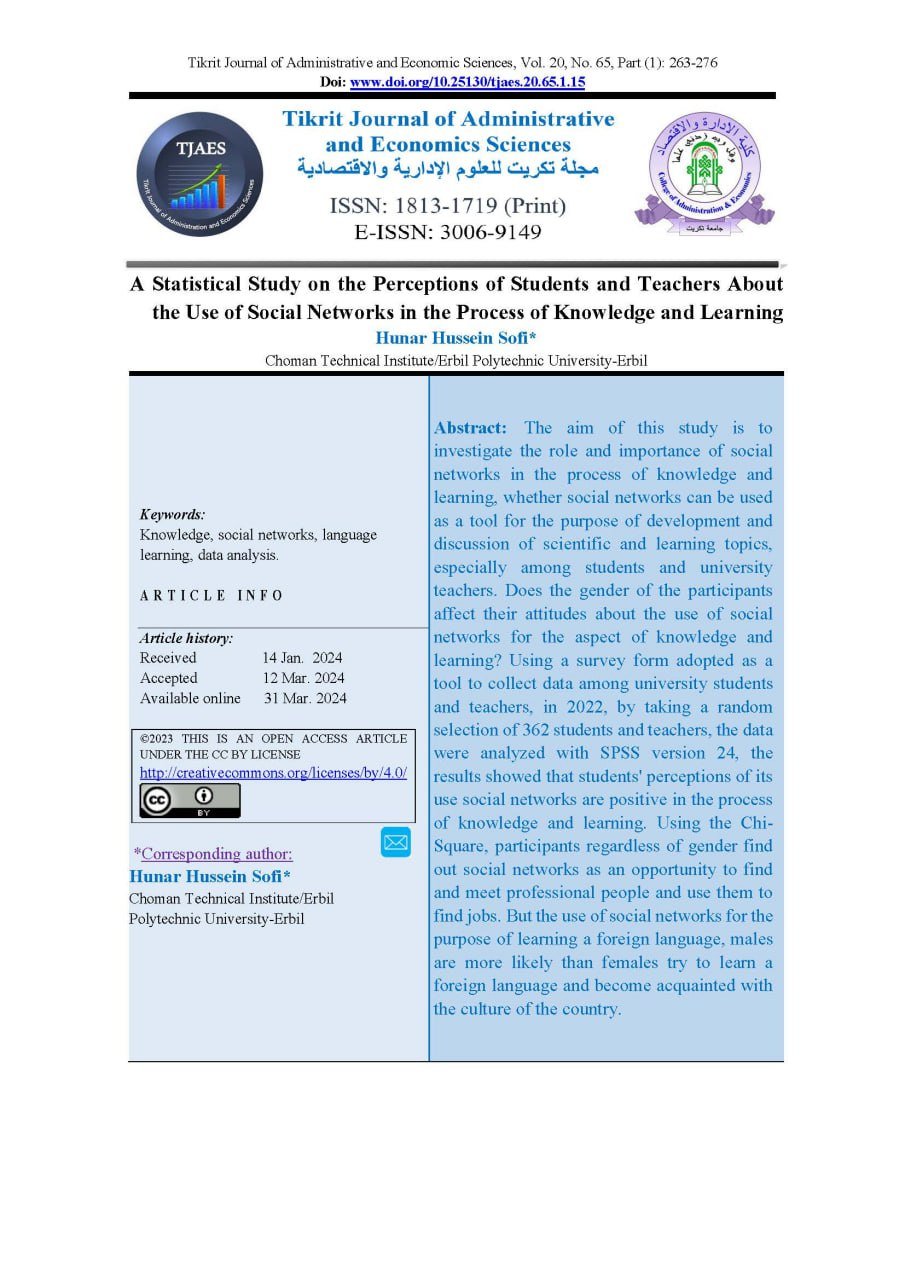
تهدف هذه الدراسة إلى معرفة دور وأهمية شبكات التواصل الاجتماعي في عملية المعرفة والتعلم، وهل يمكن استخدام شبكات التواصل الاجتماعي كأداة لغرض تطوير ومناقشة المواضيع العلمية والتعليمية، خاصة بين الطلاب ومعلمون جامعات. هل يؤثر جنس المشاركين على اتجاهاتهم نحو استخدام شبكات التواصل الاجتماعي في الجانب المعرفي والتعلمي؟ استخدام استمارة المسح المعتمدة كأداة لجمع البيانات بين طلاب الجامعة والمعلمين، عام 2022، وذلك من خلال اختيار عشوائي 362 طالباً ومعلماً، وتم تحليل البيانات باستخدام برنامج SPSS الإصدار 24، وأظهرت النتائج أن تصورات الطلاب لاستخدام شبكات التواصل الاجتماعي إيجابية في عملية المعرفة والتعلم. مع Chi-Square، يكتشف المشاركون، بغض النظر عن جنسهم، الشبكات الاجتماعية كفرصة للعثور على أشخاص محترفين والالتقاء بهم واستخدامهم للعثور على وظائف. لكن باستخدام شبكات التواصل الاجتماعي لغرض تعلم لغة أجنبية، فإن الذكور أكثر ميلاً من الإناث إلى محاولة تعلم لغة أجنبية والتعرف على ثقافة البلد.
التنزيلات
تفاصيل المقالة
المراجع
Abreu, R., Leal, A., & Figueiredo, P., (2018), EEG-informed fMRI: a review of data analysis methods. Frontiers in human neuroscience, 12, 29.
Ansari, J. A. N., & Khan, N. A., (2020), Exploring the role of social media in collaborative learning the new domain of learning. Smart Learning Environments, 7(1), 1-16.
Ahmed, S., Abdulqadir, S., Hussein, S., Qurbani, K., Omar, R., Mohamed, M. and Blbas, H., (2023), Knowledge, Attitudes, and Willingness to Vaccinate for Mpox among Healthcare Workers in Kurdistan Region of Iraq: A Nationwide Cross-Sectional Study, pp.1-20, file:///C:/Users/RFC/Downloads/preprints202308.1737.v2%20(16).pdf.
Aroian, K., Uddin, N. and Blbas, H., (2017), Longitudinal study of stress, social support, and depression in married Arab immigrant women. Health care for women international, 38(2), pp.100-117.
Blbas, H.T.A., Kahwachi, W.T.S., Ahmed, S.K., Aziz, K.G., Faraj, S.M. and Mohammed, M.S., (2024), Factors contributing to vitamin D deficiency in Erbil, Iraq: A statistical investigation. Clinical Nutrition Open Science, pp.151-162.
Aziz, K.G., Blbas, H.T.A. and Tofiq, A.H., (2023), Evaluation of significant factors influencing the survival time of breast cancer patients using the Cox regression model. Journal of Public Health, pp.1-6.
Baber, H., (2020), Determinants of students’ perceived learning outcome and satisfaction in online learning during the pandemic of COVID-19. Journal of Education and e-learning Research, 7(3), 285-292.
Bartosik-Purgat, M., Filimon, N., & Kiygi-Calli, M., (2017), social media and higher education: An international perspective. Economics and Sociology, 2017, vol. 10, núm. 1, p. 181-191.
Bicen, H., & Uzunboylu, H., (2013), The use of social networking sites in education: A case study of Facebook. J. Univers. Comput. Sci., 19(5), 658-671.
Blbas, H., (2019), Statistical analysis for the most influential reasons for divorce between men and women in Erbil-Iraq, International Journal of Innovation, Creativity and Change, 6 (2), pp.207-216, https://ww.ijicc.net/images/Vol6Iss2/6215_Blbas_2019_TD_R1.pdf.
Blbas, H., (2020), Student’s Knowledge and Practices Regarding Standard Use of The Mobile Phone at Cihan University-Erbil–Iraq. Journal of Al-Rafidain University College For Sciences (Print ISSN: 1681-6870, Online ISSN: 2790-2293), (1), pp.466-472. https://www.iasj.net/iasj/download/1267bfbf34ce133a
Blbas, H.T.A., Aziz, K.F., Nejad, S.H. and Barzinjy, A.A., (2020), Phenomenon of depression and anxiety related to precautions for prevention among population during the outbreak of COVID-19 in Kurdistan Region of Iraq: based on questionnaire survey. Journal of Public Health, pp.1-5.
https://link.springer.com/article/10.1007/s10389-020-01325-9
Blbas, H.T.A., Mahmood, S.H. and Omer, C.A., (2017), A Comparison results of factor analysis and cluster analysis to the migration of young people from the Kurdistan Region to Europe. ZANCO Journal of Pure and Applied Sciences, 29(4), pp.44-55.
Blbas, H.T.A., (2021), Statistical Analysis About Negative Reasons of Summer Training at Salahaddin University Using Factor Analysis By SPSS. Pragya, 81, p.64-69.
Boyd, D. M., & Ellison, N. B., (2007), Social network sites: Definition, history, and scholarship. Journal of computer‐mediated Communication, 13(1), 210-230.
Carpineto, C., & Romano, G., (2004), Concept data analysis: Theory and applications. John Wiley & Sons.
Cheng, C., Lau, Y. C., Chan, L., & Luk, J. W., (2021), Prevalence of social media addiction across 32 nations: Meta-analysis with subgroup analysis of classification schemes and cultural values. Addictive behaviors, 117, 106845.
Daly, A. J., Moolenaar, N. M., Bolivar, J. M., & Burke, P., (2010), Relationships in reform: The role of teachers' social networks. Journal of educational administration, 48(3), 359-391.
Faraj, S.M; Blbas, H.T. and, Ahmed A. I., (2022), A statistical study of the influence of COVID-19 on the agricultural supply chain (vegetative) production in Halabja governorate. Cihan University-Erbil Scientific Journal, 6(1), pp.1-6.
Hamid, S., Waycott, J., Kurnia, S., & Chang, S., (2015), Understanding students' perceptions of the benefits of online social networking use for teaching and learning. The Internet and higher education, 26, 1-9.
Ma, C., Zhang, H. H., & Wang, X., (2014), Machine learning for big data analytics in plants. Trends in plant science, 19(12), 798-808.
Ophus, J. D., & Abbitt, J. T., (2009), Exploring the potential perceptions of social networking systems in university courses. Journal of Online Learning and Teaching, 5(4), 639-648.
Sharpe, D., (2015), Chi-square test is statistically significant: Now what? Practical Assessment, Research, and Evaluation, 20(1), 8.
Smith, E. E., (2016), “A real double-edged sword:” Undergraduate perceptions of social media in their learning. Computers & Education, 103, 44-58.
Saadi, H.O., Sdeeq, H.S., Hussein, M.M., Blbas, H.T., Qadir, K. and Muhammed, S.M., (2023), Umbilical Cord Care Knowledge and Practice among Sample of Kurdish Women. Technium Bio hemmed, 6, pp.41-55.
Tekin, C., & Van der Schaar, M., (2013, October), Distributed online big data classification using context information. In 2013 51st Annual Allerton Conference on Communication, Control, and Computing (Allerton) (pp. 1435-1442). IEEE.
Tsai, C. W., Lai, C. F., Chao, H. C., & Vasilakos, A. V., (2015), Big data analytics: a survey. Journal of Big data, 2(1), 1-32
Wartberg, L., Kriston, L., & Thomasius, R., (2020), Internet gaming disorder and problematic social media use in a representative sample of German adolescents: Prevalence estimates, comorbid depressive symptoms and related psychosocial aspects. Computers in Human Behavior, 103, 31-36.
Wickham, H., & Wickham, H., (2016), Data analysis (pp. 189-201). Springer International Publishing.
Zhao, L., Detlor, B., & Connelly, C. E., (2016), Sharing knowledge in social Q&A sites: The unintended consequences of extrinsic motivation. Journal of Management Information Systems, 33(1), 70-100.