تأثير الهجمات الإرهابية في دول مختارة على سعر سلة أوبك باستخدام نموذج البيانات اللوحيّة
الشريط الجانبي للمقالة
THIS IS AN OPEN ACCESS ARTICLE UNDER THE CC BY LICENSE
محتوى المقالة الرئيسي

الملخص
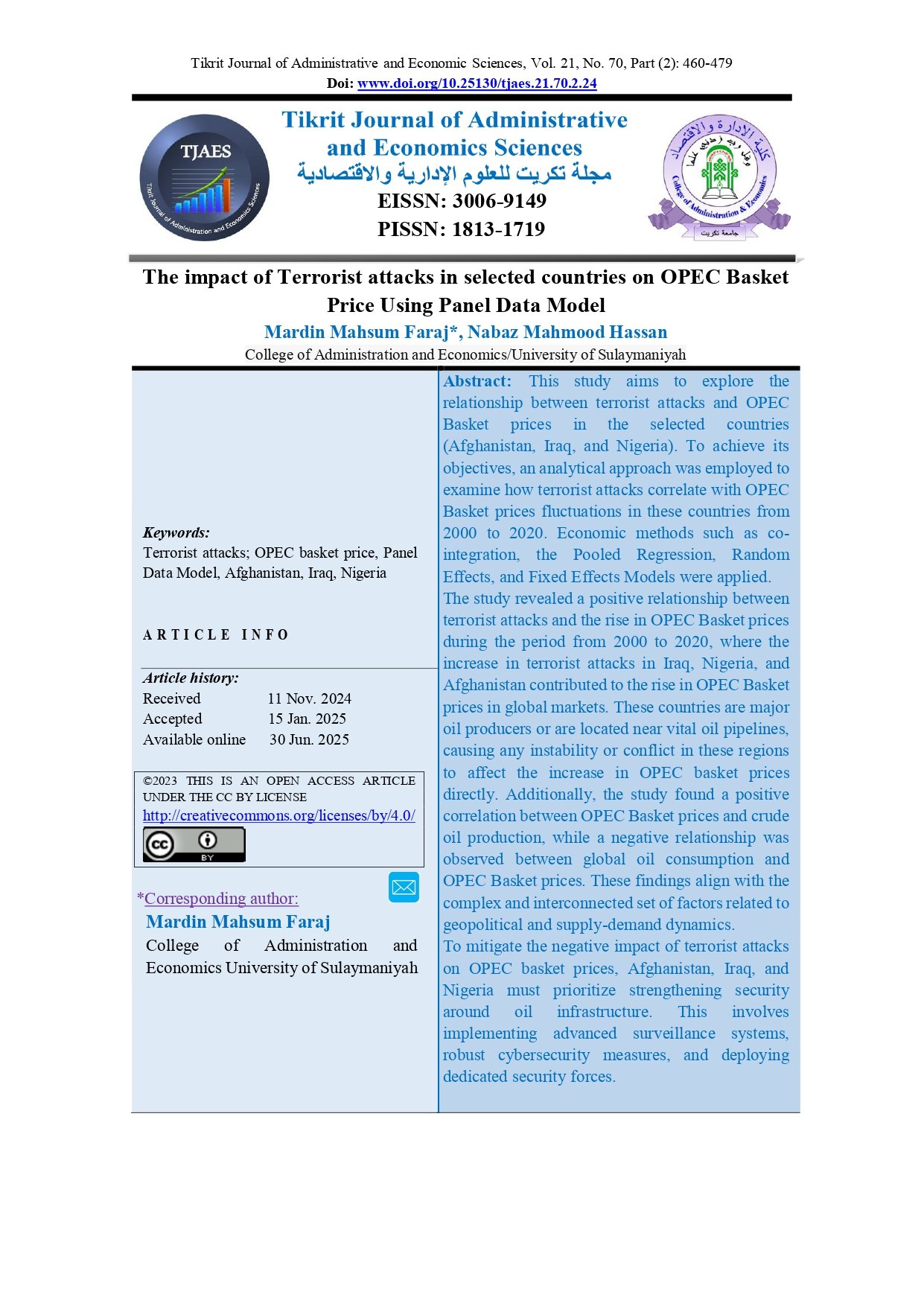
تهدف هذه الدراسة إلى استكشاف العلاقة بين الهجمات الإرهابية وأسعار النفط في الدول المختارة (أفغانستان، العراق، ونيجيريا). لتحقيق أهدافها، تم استخدام نهج تحليلي لفحص كيفية ارتباط الهجمات الإرهابية بتقلبات أسعار النفط في هذه الدول خلال الفترة من 2000 إلى 2020. تم تطبيق أساليب اقتصادية مثل التكامل المشترك، نموذج الانحدار التجميعي، ونماذج التأثيرات العشوائية والثابتة
توصلت الدراسة الى وجود علاقة إيجابية بين الهجمات الإرهابية وارتفاع أسعار سلة أوبك خلال الفترة من 2000 إلى 2020، حيث أسهم زيادة الهجمات الإرهابية في العراق ونيجيريا وأفغانستان في رفع أسعار سلة أوبك في الأسواق العالمية. وتُعد هذه الدول من كبار منتجي النفط أو تقع بالقرب من خطوط أنابيب النفط الحيوية، مما يجعل أي حالة عدم استقرار أو صراع في هذه المناطق تؤثر بشكل مباشر على ارتفاع أسعار سلة أوبك. بالإضافة إلى ذلك، وجدت الدراسة وجود علاقة إيجابية بين أسعار سلة أوبك وإنتاج النفط الخام، بينما لوحظت علاقة سلبية بين استهلاك النفط العالمي وأسعار سلة أوبك. تتوافق هذه النتائج مع المجموعة المعقدة والمترابطة من العوامل المتعلقة بالجغرافيا السياسية وديناميكيات العرض والطلب. للتخفيف من التأثيرات السلبية للإرهاب على أسعار سلة أوبك، يجب على أفغانستان والعراق ونيجيريا أن تعطي الأولوية لتعزيز الأمن حول البنية التحتية النفطية. يشمل ذلك تنفيذ أنظمة مراقبة متقدمة، تدابير قوية للأمن السيبراني، ونشر قوات أمن متخصصة.
التنزيلات
تفاصيل المقالة
المراجع
Lee, C. Y. (2018). Oil and terrorism: Uncovering the mechanisms. Journal of conflict resolution, 62(5), 903-928.
Bassil, C., Hamadi, H., & Bteich, M. (2018). Terrorism in OPEC countries and oil prices. International Journal of Emerging Markets, 13(6), 1732-1750.
Bayar, Y., & Gavriletea, M. D. (2018). Peace, terrorism and economic growth in Middle East and North African countries, Quality & Quantity: International Journal of Methodology, 52(5), 2373-2392.
Blomberg, B., Hess, G., & Jackson, J. H. (2009). Terrorism and the Returns to Oil. Economics & Politics, 21(3), 409-432.
Chesney, M., Reshetar, G., & Karaman, M. (2011). The Impact of Terrorism on Financial Markets: An Empirical Study. Journal of Banking & Finance, 35(2), 253-267.
Coccia, M. (2018). The Relation Between Terrorism and High Population Growth. Journal of Economics and Political Economy, 5(1), 84-104. .
Demirer, R., Gupta, R., Ji, Q., & Tiwari, A. K. (2019). Geopolitical risks and the predictability of regional oil returns and volatility. OPEC Energy Review, 43(3), 342-361.
Ditté, P., & Roell, P. (2006). Past oil price shocks: Political background and economic impact. Evidence from three cases. Institute for Strategic, Political, Security and Economic Consultancy (ISPSW), Berlin, German.
Ditté, P., & Roell, P. (2006). Past oil price shocks: Political background and economic impact. Evidence from three cases. Institut für Strategie-Politik-Sicherheits-und Wirtschaftsberatung (ISPSW) website.
Farrell, D. F. (2016). Oil & Terrorism: How Terrorism Affects Oil RentsE (Doctoral dissertation, Mercyhurst University, Pennsylvania.),Retrieved from https://www.mercyhurst.edu/sites/default/files/uploads/801347-farrell-thesis-final.pdf
Ghosh. Sh. (2014). Understanding Terrorism in the context of Global Security. Socrates, 2(2), 89-106.
Global. Terrorism Index. (2015). MEASURING AND UNDERSTANDING THE IMPACT OF TERRORISM. Retrieved from www.economicsandpeace.org
Gong, X., & Xu, J. (2022). Geopolitical risk and dynamic connectedness between commodity markets. Energy Economics, 110, 106028.
Im, K. S., Pesaran, M. H., & Shin, Y. (1997). Testing for Unit Roots in Heterogeneous Panels', University of Cambridge. Revised version of the DAE working paper, (9526).
Institute for Economics & Peace (2019). Global Terrorism Index 2019: Measuring the Impact of Terrorism, Sydney, Retrived from: http://visionofhumanity.org/app/uploads/2019/11/GTI-2019web.pdf
Institute for Economics & Peace, (2018), Global Peace Index 2018: Measuring Peace in a Complex World, Sydney. Retrieved from: http://visionofhumanity.org/reports
Jones, T. C. (2012). America, oil, and war in the Middle East. The Journal of American History, 99(1), 208-218.
Kao, C. (1999). Spurious regression and residual-based tests for cointegration in panel data. Journal of econometrics, 90(1), 1-44.
Kao, C., Chiang, M.H., (2000). On The Estimation and Inference of a Cointegrated Regression in Panel data. In: Baltagi, B. (Ed.), Nonstationary Panels, Panel Cointegration, and Dynamic Panels. Advances in Econometrics, 15., JAI Press, Amsterdam, 161–178.
Khan, K., Su, C. W., Tao, R., & Umar, M. (2021). How do geopolitical risks affect oil prices and freight rates? Ocean & Coastal Management, 215, 105955.
Kollias, C., Kyrtsou, C., & Papadamou, S. (2013). The effects of terrorism and war on the oil price–stock index relationship. Energy Economics, 40, 743-752..
Kollias, C., Papadamou, S., & Stagiannis, A. (2011). Terrorism and capital markets: The effects of the Madrid and London bomb attacks. International Review of Economics & Finance, 20(4), 532-541
Liu, J., Ma, F., Tang, Y., & Zhang, Y. (2019). Geopolitical risk and oil volatility: A new insight. Energy Economics, 84, 104548.
Looney, R. E. (2003). Oil prices and the Iraq war: Market interpretations of military developments. The Journal of Energy and Development, 29(1), 25-41.
Maddala, G.S. and Wu, S. (1999), A Comparative Study of Unit Root Tests with Panel Data and a New Simple Testî, Oxford Bulletin of Economics and Statistics, Special Issue, 631- 652.
Faraj, M. M. (2021). The impact of financial development on economic growth in Iraq for the period (2004-2018): An Analytical Econometric Study. journal of Economics and Administrative Sciences, 27(126).
Matseketsa, B., & Mapolisa, T. (2013). The Effects of Terrorism On International Peace and Security and Educational Systems in Africa and Beyond-A New Millennium Perspective. International Journal of Advanced Research, 1(8), 694-710.
Monge, M., & Cristóbal, E. (2021). Terrorism and the behavior of oil production and prices in OPEC. Resources Policy, 74, 102321.
Nyadera, I. N., & Bincof, M. O. (2019). Human security, terrorism, and counterterrorism: Boko Haram and the Taliban. International Journal on World Peace, 36(1), 4-15.
OPEC, Annual Report, Retrieved from https://www.opec.org/opec_web/en/publications/337.htm
Orbaneja, J. R. V., Iyer, S. R., & Simkins, B. J. (2018). Terrorism and oil markets: A cross-sectional evaluation. Finance Research Letters, 24, 42-48.
Osita-Njoku, A., & Chikere, P. (2015). Consequences of Boko Haram Terrorism on Women in Northern Nigeria. Applied research journal, 1(3), 101-107.
Pesaran, M. H. (2003). kA Simple Panel Unit Root Test in the Presence of Cross Section Dependence, Mimeo. Cambridge University, Cambridge, United Kingdom.
Phan, D. H. B., Narayan, P. K., & Gong, Q. (2021). Terrorist attacks and oil prices: Hypothesis and empirical evidence. International Review of Financial Analysis, 74, 101669.
Piazza, J. A. (2016). Oil and terrorism: an investigation of mediators. Public Choice, 169(3-4), 251-268.
Procasky, W. J., & Ujah, N. U. (2016). Terrorism and its impact on the cost of debt. Journal of International Money and Finance, 60, 253-266.
STATISTA: https://www.statista.com/statistics/262858/change-in-opec-crude-oil-prices-since-1960/
Steinhäusler, F., Furthner, P., Heidegger, W., Rydell, S., & Zaitseva, L. (2008). Security risks to the oil and gas industry: terrorist capabilities. Strategic Insights, 7(1).
Ugoani, J. (2017). Mismanagement and reform failures in Nigeria: historical perspectives. Independent Journal of Management & Production (IJM&P), 8(2).
UN, (2004). Security Council resolution 1566 (2004) on Threats to international peace and security caused by terrorist acts,Unite Nation. http://unscr.com/en/resolutions/1566
United Nations Office on Drugs and Crime (UNODC), (2018), University Module Series. Counter-Terrorism. Module 1: Introduction to international terrorism, Retrieved from: https://www.unodc.org/documents/e4j/1804932_CT_Mod_01_ebook_FINALpdf.pdf
Williamson, M. (2016). Terrorism, war and international law: the legality of the use of force against Afghanistan in 2001. Routledge, United Kingdo
Al-Anzi, Rawaa Mohammed Zabbar & Hussein, Abdul Razzaq Hamad. (2024). Oil price fluctuations and their relationship to government spending in Iraq for the period 2004-2022. Tikrit Journal of Administrative and Economic Sciences, 20(67, part 1), 1–17. https://doi.org/10.25130/tjaes.20.67.1.1
Faraj, M. M., & Karim, H. O. (2020). Analyzing the relationship between human capital and economic growth in Iraq During the period (1990-2018). Tikrit Journal of Administrative and Economic Sciences, 16(52, 3), 237–257. https://doi.org/10.25130/tjaes.16.52.3.15