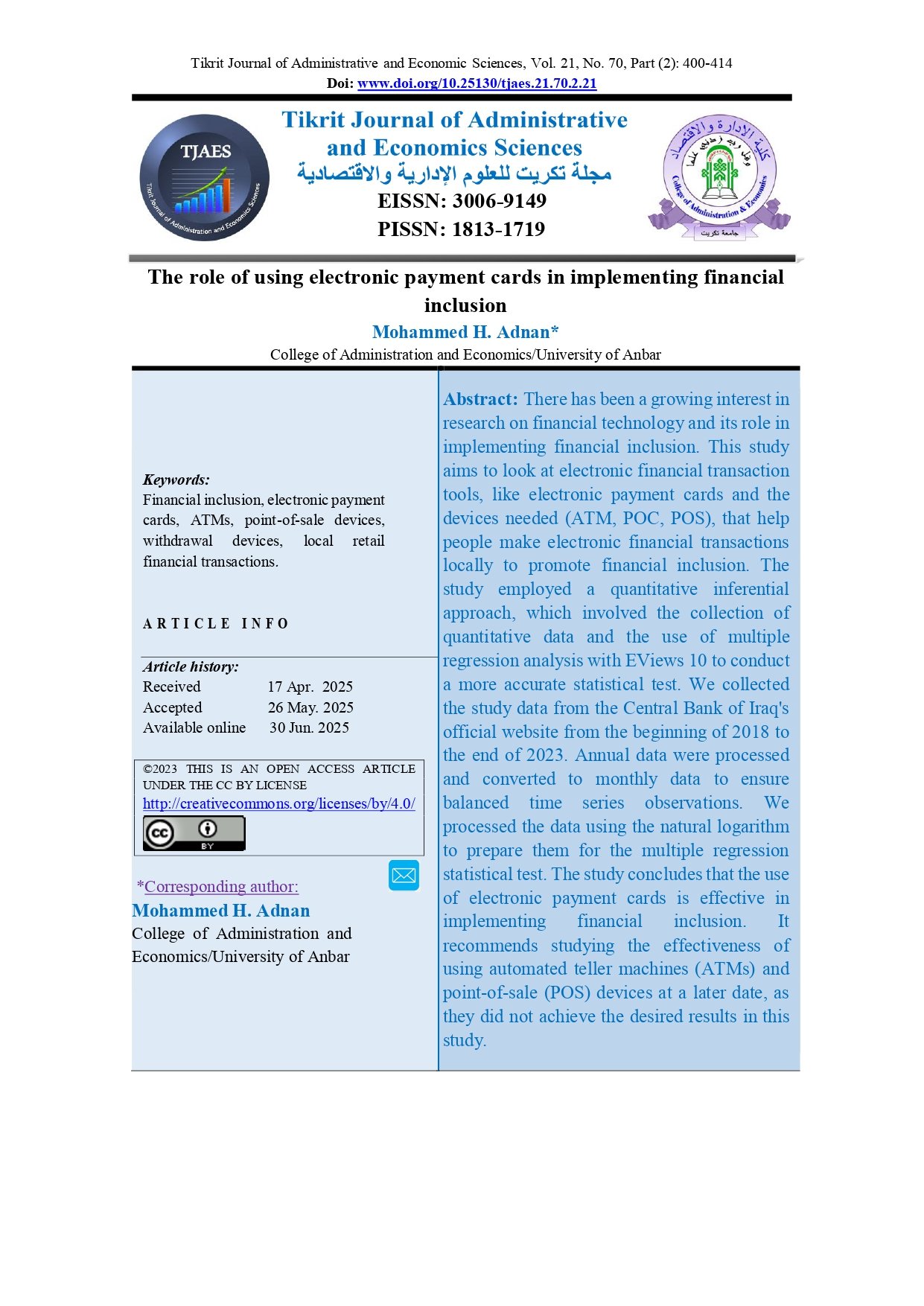
دور استعمال بطاقات الدفع الإلكتروني في تطبيق الشمول المالي
الشريط الجانبي للمقالة
THIS IS AN OPEN ACCESS ARTICLE UNDER THE CC BY LICENSE
محتوى المقالة الرئيسي

الملخص
تزايد الاهتمام بالبحث في مجال التكنولوجيا المالية ودورها في تحقيق الشمول المالي. تهدف هذه الدراسة إلى دراسة أدوات المعاملات المالية الإلكترونية، مثل بطاقات الدفع الإلكتروني والأجهزة اللازمة (أجهزة الصراف الآلي، ونقاط البيع، ونقاط السحب)، التي تُمكّن الأفراد من إجراء معاملات مالية إلكترونية محليًا لتعزيز الشمول المالي. اعتمدت الدراسة على منهج استدلالي كمي، تضمن جمع البيانات الكمية واستخدام تحليل الانحدار المتعدد باستخدام برنامج EViews 10 لإجراء اختبار إحصائي أكثر دقة. جمعت بيانات الدراسة من الموقع الإلكتروني الرسمي للبنك المركزي العراقي من بداية عام 2018 إلى نهاية عام 2023. تمت معالجة البيانات السنوية وتحويلها إلى بيانات شهرية لضمان توازن السلاسل الزمنية. تم معالجة البيانات باستخدام اللوغاريتم الطبيعي لإعدادها لاختبار الانحدار المتعدد الإحصائي. وخلصت الدراسة إلى أن استخدام بطاقات الدفع الإلكتروني فعال في تحقيق الشمول المالي. وتوصي بدراسة فعالية استخدام أجهزة الصراف الآلي ونقاط البيع لاحقًا، نظرًا لعدم تحقيقها النتائج المرجوة في هذه الدراسة.
التنزيلات
تفاصيل المقالة
المراجع
Abdullah, D. S., & Hamad, M. J. (2023). Measuring and analyzing the impact of some financial inclusion variables on sustainable development in Iraq for the period 2004-2021. 19(64), 399–412.
Aigbe, P., & Akpojaro, J. (2014). Analysis of Security Issues in Electronic Payment Systems. International Journal of Computer Applications, 108(10), 10–14. https://doi.org/10.5120/18946-9993
Al-hujaimy, S. A., & Hussien, I. A. (2025). The role of banking digitization in developing the profitability of the Iraqi banking sector: International experiences with special reference to Iraq. 21(69), 120–134.
Alrabei, A. M., Al-Othman, L. N., Al-Dalabih, F. A. N., Taber, T. A., Ali, B. J. A., & Amareen, S. M. (2022). The Impact of Mobile Payment on the Financial Inclusion Rates. In Information Sciences Letters (Vol. 11, Issue 4, pp. 1033–1044). https://doi.org/10.18576/isl/110404
Bhutta, M. N. M., Bhattia, S., Alojail, M. A., Nisar, K., Cao, Y., Chaudhry, S. A., & Sun, Z. (2022). Towards Secure IoT-Based Payments by Extension of Payment Card Industry Data Security Standard (PCI DSS). Wireless Communications and Mobile Computing, 2022. https://doi.org/10.1155/2022/9942270
Chen, W., & Yuan, X. (2021). Financial inclusion in China: an overview. Frontiers of Business Research in China, 15(1). https://doi.org/10.1186/s11782-021-00098-6
Hamid, S., Ali, A., & Ali, M. A. (2023). Economic Analysis of The Electronic Payment System in Iraq: Study of Trends, Impacts and Opportunities for The Period (2018-2023) for Selected Companies (Asiahawala & Zaincash & Nasspay). 20(67), 109–134.
Hassan, G. J., & Faihan, M. A. (2024). The impact of some financial inclusion variables on green banking: an applied study on the Iraqi private banking sector. 20(67), 111–130.
Kabir, M. A., Saidin, S. Z., & Ahmi, A. (2017). Analysis of factors that influence electronic payment adoption. Journal of Engineering and Applied Sciences, 12(Specialissue3), 6560–6568. https://doi.org/10.3923/jeasci.2017.6560.6568
Le, T. H., Chuc, A. T., & Taghizadeh-Hesary, F. (2019). Financial inclusion and its impact on financial efficiency and sustainability: Empirical evidence from Asia. Borsa Istanbul Review, 19(4), 310–322. https://doi.org/10.1016/j.bir.2019.07.002
Mousa, H., & Maabreh, A. (2024). The Role of Financial Technology (Fintech) in Promoting Financial Inclusion A Literature Review. International Journal of Digital Accounting and Fintech Sustainability (IJDAFS), 1(1), 2024. https://ijdafs.com/
Mustapha, S. A. (2018). E-Payment technology effect on bank performance in emerging economies-evidence from Nigeria. Journal of Open Innovation: Technology, Market, and Complexity, 4(4). https://doi.org/10.3390/joitmc4040043
Noreen, M., Mia, M. S., Ghazali, Z., & Ahmed, F. (2022). Role of Government Policies to Fintech Adoption and Financial Inclusion: A Study in Pakistan. Universal Journal of Accounting and Finance, 10(1), 37–46. https://doi.org/10.13189/ujaf.2022.100105
Okello Candiya Bongomin, G., Ntayi, J. M., Munene, J. C., & Malinga, C. A. (2018). Mobile Money and Financial Inclusion in Sub-Saharan Africa: the Moderating Role of Social Networks. Journal of African Business, 19(3), 361–384. https://doi.org/10.1080/15228916.2017.1416214
Omar, M. A., & Inaba, K. (2020). Does financial inclusion reduce poverty and income inequality in developing countries? A panel data analysis. Journal of Economic Structures, 9(1). https://doi.org/10.1186/s40008-020-00214-4
Peterson K. Ozili. (2018). Impact Of Digital Finance On Financial Inclusion And Stability. Borsa Istanbul Review, 18(4).
Philippon, T. (2019). Nber Working Paper Series on Fintech and Financial Inclusion. In National Bureau of Economic Research. http://www.nber.org/papers/w26330
Salloum, S. A., Al-Emran, M., Khalaf, R., Habes, M., & Shaalan, K. (2019). An innovative study of e-payment systems adoption in higher education: Theoretical constructs and empirical analysis. International Journal of Interactive Mobile Technologies, 13(6), 68–83. https://doi.org/10.3991/ijim.v13i06.9875
Tay, L. Y., Tai, H. T., & Tan, G. S. (2022). Digital financial inclusion: A gateway to sustainable development. Heliyon, 8(6), e09766. https://doi.org/10.1016/j.heliyon.2022.e09766
Teoh, W. M. Y., Chong, S. C., Lin, B., & Chua, J. W. (2013). Factors affecting consumers’ perception of electronic payment: An empirical analysis. Internet Research, 23(4), 465–485. https://doi.org/10.1108/IntR-09-2012-0199
Van Dinh, D. (2024). Digital economy and the electronic payment behavior: An empirical analysis. Transnational Corporations Review, 16(4), 200078.
Xun, Z., Guanghua, W., Jiajia, Z., & Zongyue, H. (2020). Digital Economy, Financial Inclusion and Inclusive Growth. China Economist, 15(3), 92–105. http://finance.sina.com.cn/roll/2019-04-24/doc-ihvhiqax4733019.shtml.