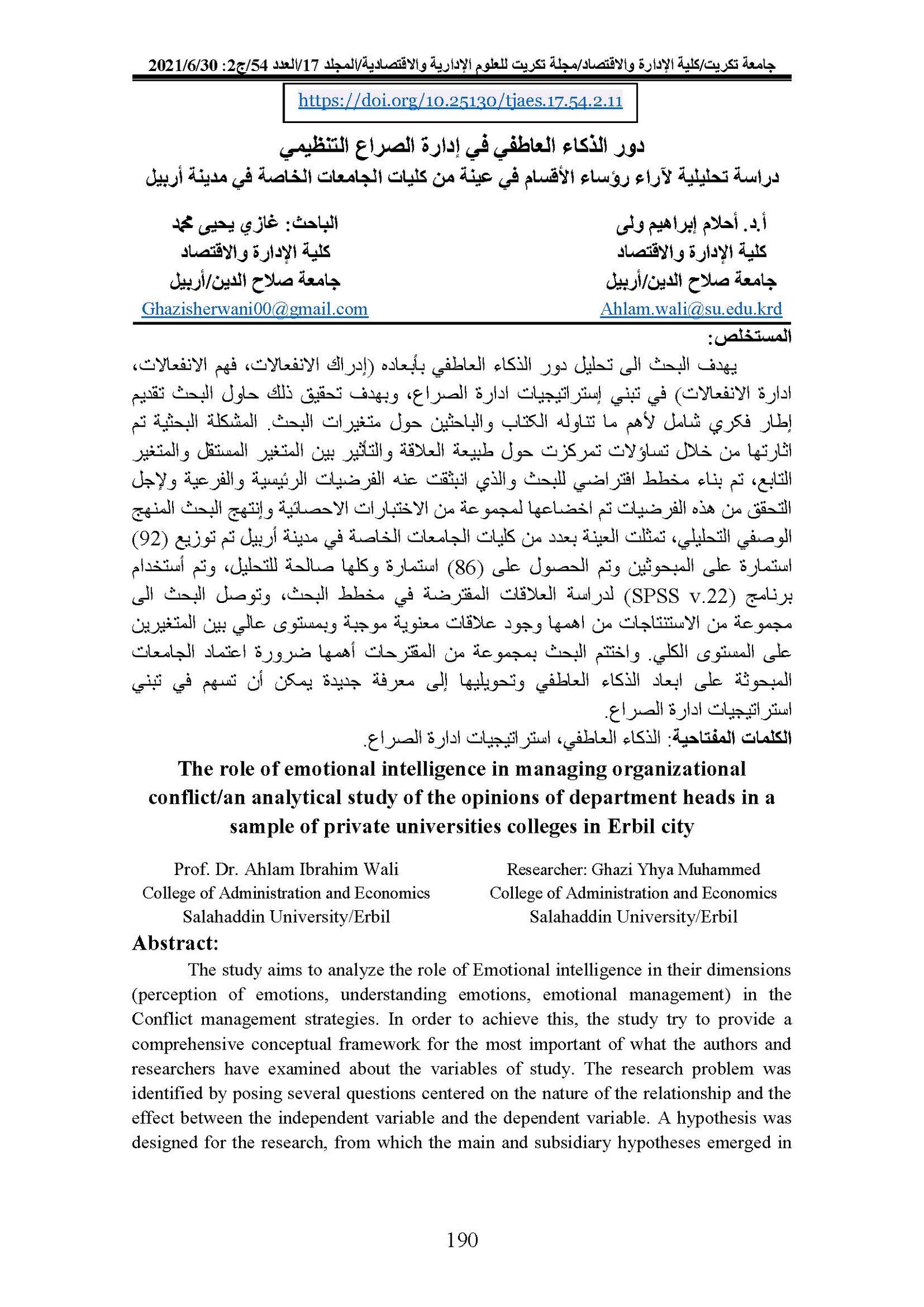
The role of emotional intelligence in managing organizational conflict/an analytical study of the opinions of department heads in a sample of private universities colleges in Erbil city
Article Sidebar
THIS IS AN OPEN ACCESS ARTICLE UNDER THE CC BY LICENSE
Main Article Content

Abstract
The study aims to analyze the role of Emotional intelligence in their dimensions (perception of emotions, understanding emotions, emotional management) in the Conflict management strategies. In order to achieve this, the study try to provide a comprehensive conceptual framework for the most important of what the authors and researchers have examined about the variables of study. The research problem was identified by posing several questions centered on the nature of the relationship and the effect between the independent variable and the dependent variable. A hypothesis was designed for the research, from which the main and subsidiary hypotheses emerged in order to verify these hypotheses, they were subjected to a set of statistical tests and a descriptive analytical approach. The sample of the research was determined from the number Head of Departments of the number of private universities in the city of Erbil. (92) questionnaires were distributed to the responding individuals and (86) samples were obtained, all valid for analysis, SPSS v.22 was used to study the assumed relationships in the research model, The research found a number of conclusions. The study concluded with a number of proposals, the most important of which is the need for universities to explore new Emotional intelligence dimensions that can contribute to the Conflict management strategies.
Downloads
Article Details
References
أولاً. المصادر العربية:
ابو عمشة، إبراهيم، (٢٠١٣)، الذكاء الاجتماعي والذكاء الوجداني وعلاقتهما بالشعور بالسعادة، رسالة ماجستير غير منشورة، جامعة الازهر، غزة، فلسطين.
الاسطل، مصطفى رشاد، (٢٠١٠)، الذكاء العاطفي وعلاقته بمهارات مواجهة الضغوط، رسالة ماجستير غير منشورة، جامعة الازهر، غزة، فلسطين.
حسين، ابو رياش، (٢٠٠٧)، الدافعية والذكاء العاطفي، ط١، دار الفكر، عمان، الأردن.
خضير كاظم، موسى سلامة، الشهابي، (2009)، السلوك التنظيمي، مفاهيم معاصرة، ط1، آثار للنشر والتوزيع، عمان الاردن.
الخليل، إبراهيم، استراتيجيات ادارة الصرلاع، مقال جريدة باب، المقال 18/2/2008، الرياض:
http://www.bab.com/artical/full artical.cfm?id=4734
الدوسري، ناصر محمد، (٢٠١٧)، الذكاء العاطفي من اهم العناصر المؤثرة في نجاح القيادة الإدارية، مجلة العرب الاقتصادية، مجلد (٨).
الدوسري، فيصل، (2013)، الذكاء الوجداني اصنع نفسك وغير حياتك، دار المسيلة للنشر والتوزيع، الكويت.
العميان محمود سليمان، (2002)، السلوك التنظيمي في منظمات الأعمال، ط1، دار وائل للنشر عمان، الأردن.
الفقعاوي، ميسون إسماعيل، (2017)، استراتيجيات ادارة الصراع التنظيمي وأثرها على الاداء الوظيفي لدى العاملين في المنظمات الاهلية، رسالة ماجستير غير منشورة، جامعة الازهر، مصر.
محمد، عبدالله خوالدة، (٢٠٠٩)، الذكاء العاطفي: الذكاء الانفعالي، دار الشروق للنشر والتوزيع، عمان.
مصدر، عبدالعظيم سليمان، (٢٠٠٨)، الذكاء الانفعالي وعلاقته ببعض المتغييرات، مجلة الجامعة الاسلامية سلسلة الدراسات الانسانية، مجلد ١٦، عدد (١).
مغربي، عمر بن عبدالله، (٢٠٠٨)، الذكاء الانفعالي وعلاقته بالكفاءة المهنية، دراسة ماجستير غير منشورة، جامعة ام القرى، مكة المكرمة.
المللي، سهاد، (٢٠١٠)، الذكاء الانفعالي وعلاقته بالتحصيل الدراسي، مجلة جامعة دمشق، مجلد ٢٦، عدد ٣.
النعيمي، مهند، (٢٠١١)، الذكاء الانفعالي وعلاقته بالاتجاه نحو المستقبل، رسالة ماجستير غير منشورة، جامعة ديالى، العراق.
والمرسي جمال الدين وادريس محمد، (2004)، السلوك التطمی نظریات لعلاج وتعطل: السلوك في المتلئة بالدار الجامعية، مصر.
ثانياً. المصادر الأجنبية:
Bar-on, R., (2006), emotional-scocial intelligence psicthema, 18, supl.25.
Blake, R. & Mouton, J., (1974), The Managerial Grid. Houston, Texas: Gulf Publishing Co.
Gardner, H., (1983), Frames of mind: thetheory of multiple intelligence, New York Books Ny.
John, D. and Peter, S., (2018), Emotional intelligence: theory, finding and implications psychological inquiry, 15(3).
Mayer, J. and Salovey. p., (1990), perceiving Affective content in ambiguous, Journal of personality Assessment, 54.
Nagar, Annamalai, (2015), influence of emotional intelligence on decisions making, American lnternstion journal of social sciences No (1).
Robbins Stephen, P., (2007), Organizational Behavior, 12th ed. Ypper Saddle, River, New Jersey, Prentice Hall International Inc.144.
Schermerhorn, Jr. John, R. & Hunt, James, G. & Osborn, Richard, (2015), Organizational Behavior, (ned.). New York: John Wiley & Sons, Inc.