Formulating a Strategic Scenario for Health Security Management: Coronavirus 'Covid-19' Example/Field Study in Kirkuk Health Director
Article Sidebar
THIS IS AN OPEN ACCESS ARTICLE UNDER THE CC BY LICENSE
Main Article Content

Abstract
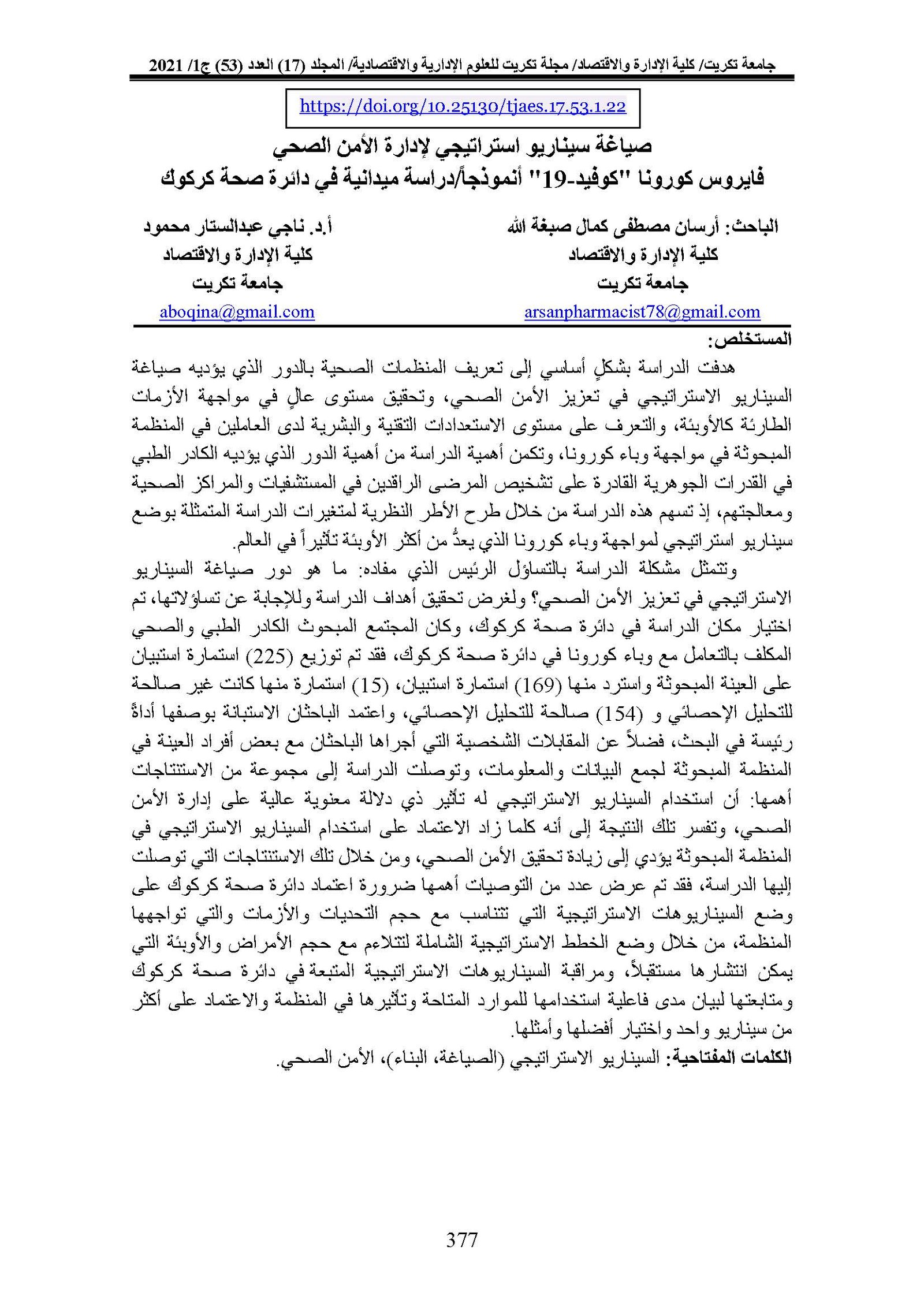
The study aims mainly at introducing health organizations to the role that the formulation of the strategic scenario plays in promoting health security, achieving a high level of facing emergency crises such as epidemics, identifying the level of technical and human preparations of workers in the researched organization in facing the corona epidemic. The importance of the study is represented by the importance of the role that the medical staff performs in the essential capabilities that are able of diagnosing and treating incumbent patients in hospitals and health centers. This study contributes by proposing theoretical frameworks for the study variables represented in developing a strategic scenario to confront the Corona epidemic, which is one of the most influential epidemics in the world.
The study problem is represented by the main question which is: What is the role of formulating the strategic scenario in enhancing health security? For the purpose of achieving the objectives of the study and answering its questions, the location of study was chosen in the Kirkuk Health Director. The researched community was the medical and health staff assigned to deal with the Corona epidemic in the Kirkuk Health Director. Thus (225) questionnaires were distriuted to the researched sample, of which (15) were not valid for statistical analysis and (154) were valid for statistical analysis. The researcher adopted the questionnaire as a main tool in the research as well as the personal interviews that the researcher conducted with some members of the sample in the research organization to collect data and information. The study reached a set of conclusions, the most important of which are: The use of the strategic scenario has a high moral impact on the health security management. This conclusion explains that the more reliance on the use of the strategic scenario in the researched organization leads to an increase in the achievement of health security. Through these conclusions reached by the study, a number of recommendations were presented. The most important of which is the need of the Kirkuk Health Director to adopt the development of strategic scenarios commiserating with the size of the challenges and crises that the organization faces by developing comprehensive strategic plans to suit the size of diseases and epidemics that can spread in the future. Monitoring and following-up the strategic scenarios followed in the Kirkuk Health Director to demonstrate the effectiveness of its use of available resources and their impact on the organization, and relying on more than one scenario and choosing the best and ideal ones.
Downloads
Article Details
References
أولاً. المصادر العربية:
باسم، حسين، (2019)، تأثير فيروس نقص المناعة البشرية على الأمن الصحي "القارة الأفريقية أنموذجاً"، مجلة أهل البيت عليهم السلام، العدد 23.
دليل توعوي شامل لمنظمة الانوروا على الموقع الالكتروني:
https://wwwunrwa.org/sites/default/files/health_awareness_on_public__arabic.pdf.
ثانياً. المصادر الأجنبية:
Wright, A., (2005), The role of scenarios as prospective sensemaking devices. Management Decision, 43(1), 86-101.
Malone, T. W., Laubacher, R., & Morton, M. S. S., (Eds.), (2003), Inventing the Organizations of the 21st Century, MIT press.
Van Asselt, M. B., & Rotmans, J., (2002), Uncertainty in integrated assessment modelling, Climatic change, 54(1-2), 75-105.
Ratcliffe, J. S., (2006), Challenges for corporate foresight: towards strategic prospective through scenario thinking, Foresight.
Ringland, G., (2006), Scenario Planning, 2ed, published by John Wiley & Sons Ltd, Printed and bound in Great Britain by TJ International, Padstow, Cornwall, UK.
Heijden, K. & Sharpe, B., (2007), SCENARIOS FOR SUCCESS :Turning Insights into Action, John Wiley & Sons Ltd, The Atrium, Printed and bound in Great Britain by TJ International Ltd, Padstow, Cornwall, UK.
Crouch, A., (2008), The Competitive Mind: Strategy for Winning in Business, John Wiley & Sons Inc., Printed and bound in Great Britain.
Drew, S. A., (2006), Building technology foresight: using scenarios to embrace innovation. European Journal of Innovation Management.
Schoemaker, P. J., (1995), Scenario planning: a tool for strategic thinking, Sloan management review, 36(2), 25-50.
Othman, R., (2008), REFLECTIVE PRACTICE Enhancing the effectiveness of the balanced scorecard with scenario planning, International Journal of Productivity and Performance Management Vol. 57 No. 3.
Walsh, J., (2005), Learning from past success: the NPT and the future of non-proliferation, Stockholm: Weapons of Mass Destruction Commission.
Horton, R., (2009), Canada 2010: what should global health expect?. The Lancet, 374(9697), 1215-1216.
Wertheim, J. O., Chu, D. K., Peiris, J. S., Pond, S. L. K., & Poon, L. L., (2013), A case for the ancient origin of coronaviruses. Journal of Virology, 87(12), 7039-7045.
Woo, P. C., Lau, S. K., Lam, C. S., Lau, C. C., Tsang, A. K., Lau, J. H., ... & Zheng, B. J., (2012), Discovery of seven novel Mammalian and avian coronaviruses in the genus deltacoronavirus supports bat coronaviruses as the gene source of alphacoronavirus and betacoronavirus and avian coronaviruses as the gene source of gammacoronavirus and deltacoronavirus. Journal of virology, 86(7), 3995-4008.
Li, F., Li, W., Farzan, M., & Harrison, S. C., (2005), Structure of SARS coronavirus spike receptor-binding domain complexed with receptor, Science, 309(5742), 1864-1868.
Doucleef, M., (2012), Scientists go deep on genes of SARS-like virus, September, 26, 2012.