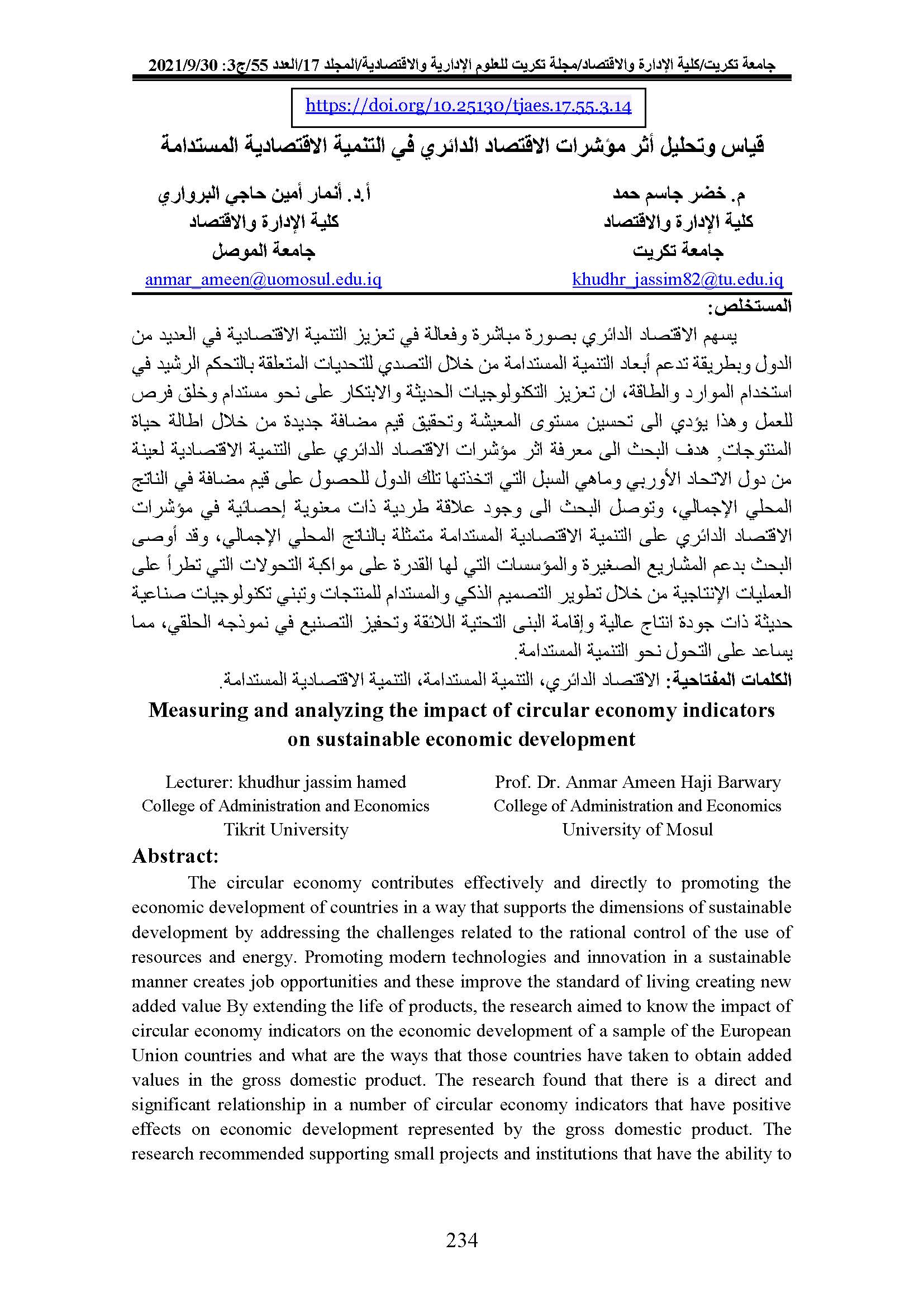
Measuring and analyzing the impact of circular economy indicators on sustainable economic development
Article Sidebar
THIS IS AN OPEN ACCESS ARTICLE UNDER THE CC BY LICENSE
Main Article Content

Abstract
The circular economy contributes effectively and directly to promoting the economic development of countries in a way that supports the dimensions of sustainable development by addressing the challenges related to the rational control of the use of resources and energy. Promoting modern technologies and innovation in a sustainable manner creates job opportunities and these improve the standard of living creating new added value By extending the life of products, the research aimed to know the impact of circular economy indicators on the economic development of a sample of the European Union countries and what are the ways that those countries have taken to obtain added values in the gross domestic product. The research found that there is a direct and significant relationship in a number of circular economy indicators that have positive effects on economic development represented by the gross domestic product. The research recommended supporting small projects and institutions that have the ability to keep pace with the transformations that occur in production processes through the development of smart and sustainable design of products, the adoption of modern industrial technologies of high production quality, the establishment of appropriate infrastructure, and the stimulation of industrialization in its ring model, which helps the transition towards sustainable development..
Downloads
Article Details
References
اولاً. المصادر العربية:
مجدي، سعيد، (2016)، الاقتصاد الدائري: اقتصاد صناعي أكثر استدامة، مشاركة بحثية في المؤتمر الدولي للتنمية المستدامة في جامعة بوسطيف عباس، كلية الاقتصاد وعلوم التيسير، الجزائر
وزارة البيئة والتنمية المستدامة والطاقة الفرنسية، الاقتصاد الدائري، حالة الخطط والتطلعات، تقرير رقم 009548-06، فرنسا، نوفمبر، (2018)، تاريخ التصفح 6/3/202.
عارف، محمد كمال، 1989، مستقبلنا المشترك، الطبعة الأولى، دار عالم المعرفة للنشر، المملكة الأردنية الهاشمية.
عبد الله، عبد الخالق، (التنمية المستديمة والعلاقة بين البيئة والتنمية) مركز دراسات الوحدة العربية، سلسلة كتب المستقبل العربي، (13)، الطبعة الأولى، بيروت، (1998).
سلوم، تأميم محمد، نور، خليل إبراهيم، (2019)، تقييم معمل فرز وتدوير النفايات في قضاء المحمودية (دراسة حالة)، بحث مستل من رسالة ماجستير، مجلة كلية الإدارة والاقتصاد، العدد 115، جامعة بغداد.
العاني، كمال محمد، (2011)، اقتصاديات التنمية المستدامة في العراق، مجلة الجمعية الجغرافية العراقية، المجلد (1)، العدد (63).
غنيم، محمد غنيم، أبو زلط، ماجدة، (2010)، التنمية المستدامة فلسفتها وأساليب تخطيطها وأدوات قياسها، الطبعة الأولى، دار الصفاء للنشر والتوزيع، عمان، الأردن، (2010).
ثانياً. المصادر الاجنبية:
https://ec.europa.eu/info/index_en. The site was visited on 10/1/2020 at 2 pm.
Esposito, M., Tse, T., & Soufani, K., (2016), is the circular economy a new fastexpanding market? Thunderbird International Business Review:
Corona, b, Li Shen, Denise Reike, Jesus Rosales Carreon, Ernst Worrell, (2019), Towards sustainable development through the circular economy-A review and critical assessment on current circularity metrics, Copernicus Institute of Sustainable Development, Utrecht University, Vening Meinesz Building A, Princetonlaan 8a, 3584 CB Utrecht, Netherlands.
Figge, F., Thorpe, A. S., Givry, P., Canning, L., Franklin-Johnson, E., (2018), Longevity and Circularity as Indicators of Eco Efficient Resource Use in the Circular Economy. Journal of Ecological Economics, 150, 297-306.
Furkan Sariatli, (2017), Linear Economy versus Circular Economy: A comparative and analyzer study for Optimization of Economy for Sustainability, Visegrad Journal on Bioeconomy and Sustainable Development, Slovak University of Agriculture in Nitra, Volume 6, Issue 1 (May 2017).
Franklin-Johnson, E., Figge, F., & Canning, L., (2016), Resource duration as a managerial indicator for circular economy performance. Journal of Cleaner Production, 133, 589–598.
Zhang X, Badurdeen F, Rouch KE, Jawahir IS., (2013), on improving the product sustainability of metallic automotive components by using the total lifecycle approach and 6R methodology. In: In: G. Seliger, Editor. Proc. Of the 11th Global Conf. on Sustainable Manufacturing, Berlin, Germany. p. 194-199.
DW Pearce, E Barbier, A Markandya, (1990), Sustainable development: economics and environment in the Third World, vol 34, p659-669.