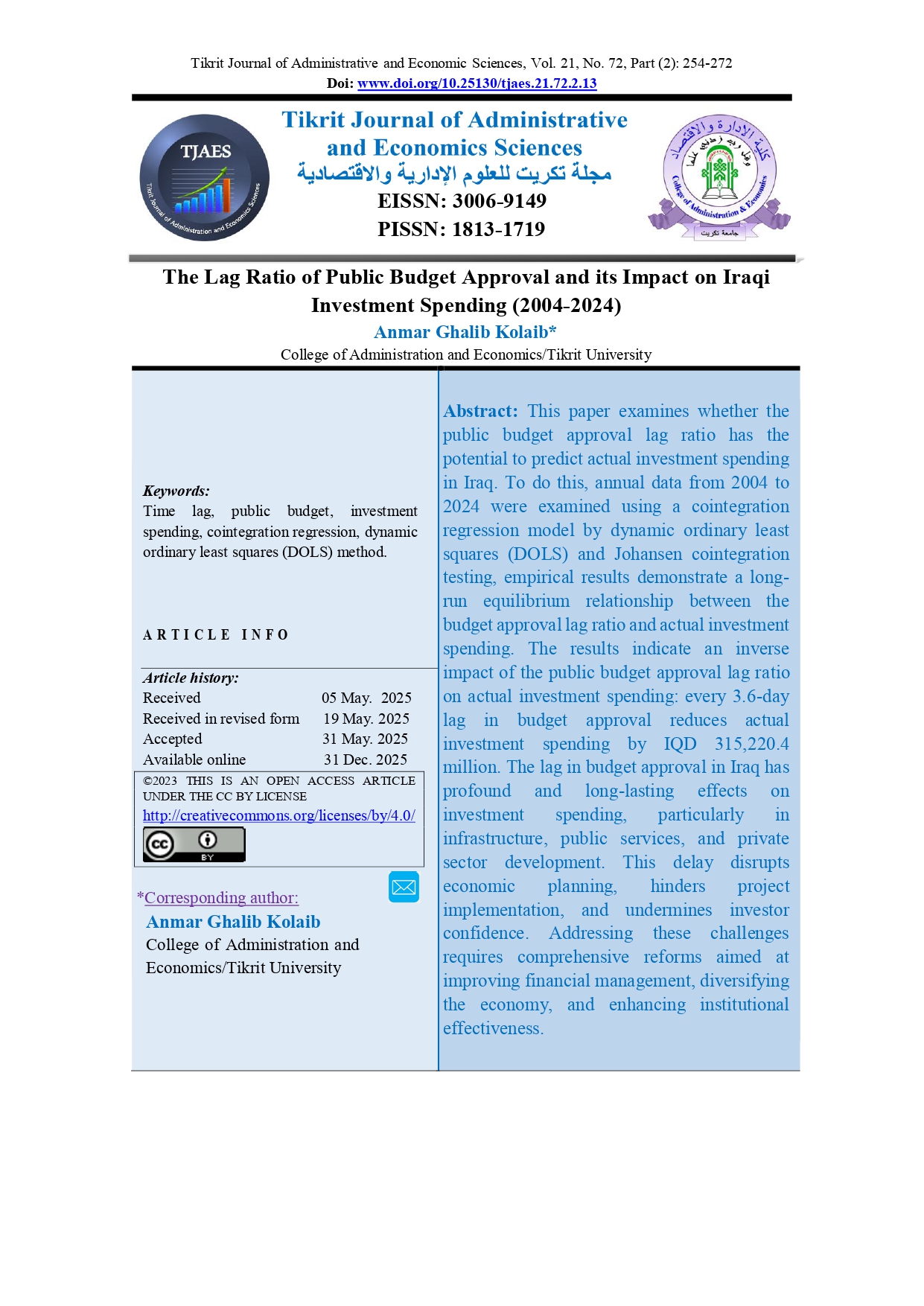
The Lag Ratio of Public Budget Approval and its Impact on Iraqi Investment Spending (2004-2024)
Article Sidebar
THIS IS AN OPEN ACCESS ARTICLE UNDER THE CC BY LICENSE
Main Article Content

Abstract
This paper examines whether the public budget approval lag ratio has the potential to predict actual investment spending in Iraq. To do this, annual data from 2004 to 2024 were examined using a cointegration regression model by dynamic ordinary least squares (DOLS) and Johansen cointegration testing, empirical results demonstrate a long-run equilibrium relationship between the budget approval lag ratio and actual investment spending. The results indicate an inverse impact of the public budget approval lag ratio on actual investment spending: every 3.6-day lag in budget approval reduces actual investment spending by IQD 315,220.4 million. The lag in budget approval in Iraq has profound and long-lasting effects on investment spending, particularly in infrastructure, public services, and private sector development. This delay disrupts economic planning, hinders project implementation, and undermines investor confidence. Addressing these challenges requires comprehensive reforms aimed at improving financial management, diversifying the economy, and enhancing institutional effectiveness.
Downloads
Article Details
References
اولاً. المصادر العربية:
الأفندي، محمد احمد، 2012، النظرية الاقتصادية الكلية – السياسة والممارسة، الطبعة الأولى، صنعاء، 2012.
البنك المركزي العراقي، مديرية الإحصاء والأبحاث، النشرات السنوية (سنوات مختلفة).
جاسم، مازن سعد، عواد، سعد سلمان، 2022، تأثير الإنفاق الحكومي الاستثماري على الحصيلة الضريبية في العراق من سنة (2008-2020)، مجلة دراسات محاسبية ومالية، جامعة بغداد، المجلد 17، العدد 61، العراق.
الجبوري، باقر كرجي، 2015، الآثار الاقتصادية لتأخير إقرار الموازنة العامة على الاقتصاد العراقي، مجلة القادسية للعلوم الإدارية والاقتصادية، المجلد 17، العدد 3، العراق.
الدعمي، زينب جبار عبدالحسين، 2018، إنتاجية الإنفاق العام في العراق وإشكالية التفاوت الزمني خلال السنة المالية، رسالة ماجستير في الاقتصاد، كلية الإدارة والاقتصاد، جامعة كربلاء.
الجريدة الرسمية لجمهورية العراق (الوقائع العراقية) للمدة من (2007-2016).
جمهورية العراق – ديوان الرقابة المالية الاتحادية – التقرير السنوي لديوان الرقابة المالية الاتحادية لسنة 2022.
جمهورية العراق – وزارة المالية – دائرة الموازنة العامة – قانون الموازنة العراقية لسنوات متعددة.
شندي، أديب قاسم، الزبيدي، بتول حسن رداد، تقييم أداء الموازنة في العراق للمدة من (2003-2012)، مجلة الكوت للعلوم الاقتصادية والإدارية، جامعة واسط، المجلد 1، العدد 15، العراق2014.
عبادي، بتول مطر، الخفاجي، غسان علي عبد الحسن، 2021، قياس العلاقة بين النفقات الاستثمارية العامة والاستثمار المحلي في العراق للمدة (2004-2018)، مجلة الدراسات الاقتصادية والإدارية، جامعة القادسية، المجلد 1، العدد 22، العراق.
عبد الغني، دينا نظام، 2024، التطورات الحديثة في سياسة إعداد الموازنة العامة العراقية، مجلة كلية القانون للعلوم القانونية والسياسية، جامعة كركوك، المجلد 13، العدد 50، العراق.
الفهداوي، صدى إبراهيم، العيساوي، محمد حاتم فرج علي، 2023، إثر تأخر إقرار الموازنة العامة للدولة وسبل معالجتها، مجلة كلية القانون للعلوم القانونية والسياسية، المجلد 12، العدد 45، العراق https://altaakhi.net/2024/12/131770/.
ثانياً. المصادر الأجنبية:
blogs.lse.ac.uk/mec/2020/03/11/between-a-rock-and-a-hard-place-iraqs-political-class.dilemma-between-budget-realties-and-protestor-demands.
Camille Karamaga, (2012), "Timing is Everything: Why Delays in Budget Approval are Undermining Fiscal Policy in Africa…And What Can Be Done About it”, IMF PFM BLOG, https://blog-pfm.imf.org/en/pfmblog/2012/09/timing-is-everything-why-delays-in-budget-approval-are-undermining-fiscal-policy
Dickey, D. & Fuller, W. (1979), “Distributions of the Estimators for Autoregressive Time Series with a Unit Root”, Journal of the American Statistical Association, 74: 427-431.
Engle, R.F. (1982), “Autoregressive Conditional Heteroscedasticity with Estimates of the Variance of United Kingdom Inflation”, Econometrica, 50(4): 987-1007.
www.imf.org/en/News/Articles/2024/03/01/mcs030324-iraq-staff-concluding-statement-of-the-2024-imf-article-iv-mission?
Johansen, S. & Juselius, K., (1990), "Maximum likelihood estimation and inference on cointegration with applications to the demand for money", Oxford Bulletin of Economics and Statistics, 52: 169-210.
Kao, C. & Chiang, M. (2000), “On the Estimation and Inference of a Co-integrated Regression in Panel Data”, Advances in Econometrics, 15: 179-222.
Kwiatkowski, D.; Phillips, P.C.B.; Schmidt, P. & Shin, Y. (1992). "Testing the null hypothesis of stationarity against the alternative of a unit root", Journal of Econometrics, 54(1–3): 159–178.
Ljung, G.M. & Box, G.E.P. (1978), “On a Measure of a Lack of Fit in Time Series Models”, Biometrika, 65(2): 297–303.
Mark, N. & Sul, D. (2003), “Co-integration Vector Estimation by Panel DOLS and Long-run Money Demand”, Oxford Bulletin of Economics and Statistics, 65(5): 655-680.
Pedroni, P. (2004), “Panel Cointegration; Asymptotic and Finite Sample Properties of Pooled Time Series Tests with an Application to the PPP Hypothesis”, Econometric Theory, 20, 597–625.
Phillips, P.C.B. & Perron, P. (1988), "Testing for a Unit Root in Time Series Regression", Biometrika, 75(2): 335–346.
Saikkonnen, P. (1991), “Asymptotically Efficient Estimation of Co-integration Regressions”, Economic Theory 7: 1-21.
www.shafaq.com/en/Report/Iraq-s-budget-in-limbo-Funding-woes-and-oil-risks-grow?
Stock, J.H. & Watson, M.W. (1993), “A Simple Estimator of Co-integrating Vectors in Higher Order Integrated Systems”, Econometrica, 61: 783-820.
Thadewald, T. & Büning, H. (2004), “Jarque-Bera test and its competitors for testing normality: A power comparison”, Diskussionsbeiträge, No. 2004/9, Freie Universität Berlin, Fachbereich Wirtschaftswissenschaft, Berlin.