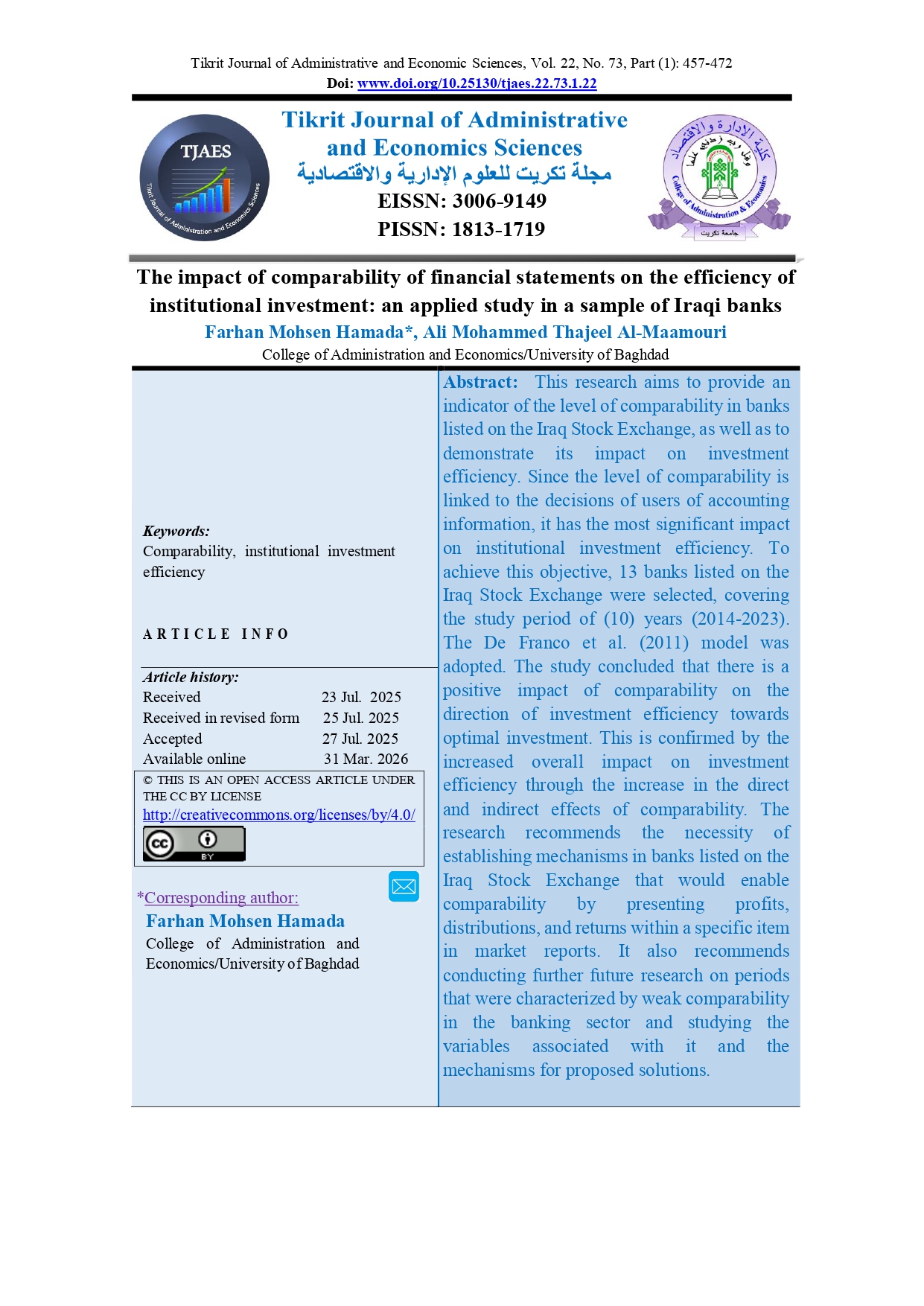
The impact of comparability of financial statements on the efficiency of institutional investment: an applied study in a sample of Iraqi banks
Article Sidebar
THIS IS AN OPEN ACCESS ARTICLE UNDER THE CC BY LICENSE
Main Article Content

Abstract
This research aims to provide an indicator of the level of comparability in banks listed on the Iraq Stock Exchange, as well as to demonstrate its impact on investment efficiency. Since the level of comparability is linked to the decisions of users of accounting information, it has the most significant impact on institutional investment efficiency. To achieve this objective, 13 banks listed on the Iraq Stock Exchange were selected, covering the study period of (10) years (2014-2023). The De Franco et al. (2011) model was adopted. The study concluded that there is a positive impact of comparability on the direction of investment efficiency towards optimal investment. This is confirmed by the increased overall impact on investment efficiency through the increase in the direct and indirect effects of comparability. The research recommends the necessity of establishing mechanisms in banks listed on the Iraq Stock Exchange that would enable comparability by presenting profits, distributions, and returns within a specific item in market reports. It also recommends conducting further future research on periods that were characterized by weak comparability in the banking sector and studying the variables associated with it and the mechanisms for proposed solutions.
Downloads
Article Details
References
أولاً. المصادر العربية:
حمادة، فرحان محسن (2018)، تأثير التحفظ المحاسبي على السلوك الاستثماري للشركات المدرجة في سوق العراق للارواق المالية دراسة تحليلية" رسالة ماجستير، قسم المحاسبة، كلية الإدارة والاقتصاد، جامعة بغداد.
ثانياً. المصادر الأجنبية:
Biddle, G. C., Hilary, G., & Verdi, R. S. (2009). How does financial reporting quality relate to investment efficiency? Journal of Accounting and Economics, 48(2–3), 112–131.
Bonucchi, M., Ferrari, M., Tomasini, S., & Tsenova, T. (2015). Tax policy, investment decisions and economic growth. Revue de l’OFCE, 141(5), 225–262. https://doi.org/10.3917/reof.141.0225
Bushman, R. M., Smith, A. J.(2001). Financial Accounting Information and Corporate Governance. Journal of Accounting and Economics, 32 237–333
Cascino, S., & Gassen, J. (2010). Mandatory IFRS adoption and accounting comparability. Work Paper, London School of Economics, United Kingdom.
Chen, A., & Gong, J. J. (2019). Accounting comparability, financial reporting quality, and the pricing of accruals. Advances in Accounting, 45. https://doi.org/10.1016/j.adiac.2019.03.003
Davis, D. R., & Weinstein, D. E. (2001). American Economic Association an Account of Global Factor Trade. In Source: The American Economic Review (Vol. 91, Issue 5).
De Franco, G., Kothari, S. P., & Verdi, R. S. (2011). The Benefits of Financial Statement Comparability. In Source: Journal of Accounting Research (Vol. 49, Issue 4).
De Souza, F. Ê. A., & Lemes, S. (2016). Comparability of accounting choices in subsequent measurement of fixed assets, intangible assets, and investment property in South American companies. Revista Contabilidade e Financas, 27(71), 169–184
Durnev, A., Morck, R., & Yeung, B. (2004). Value-Enhancing Capital Budgeting and Firm-specific Stock Return Variation. In The Journal of Finance: Vol. LIX (Issue 1).
Fang, X., Li, Y., Xin, B., & Zhang, W. (2016). Financial statement comparability and debt contracting: Evidence from the syndicated loan market. Accounting Horizons, 30(2), 277–303. https://doi.org/10.2308/acch-51437
Felski, E. (2017). How Does Local Adoption of IFRS for Those Countries That Modified IFRS by Design, Impair Comparability with Countries That Have Not Adapted IFRS? Journal of International Accounting Research, 16(3), 59–90.
Gong, G., Li, L. Y., & Zhou, L. (2013). Earnings non-synchronicity and voluntary disclosure. Contemporary Accounting Research, 30(4), 1560–1589. https://doi.org/10.1111/1911-3846.12007
Hodgson, T. M., Breban, S. J., Ford, C. L., Streatfield, M. P., & Urwin, R. C. (2000). The Concept of Investment Efficiency and its Application to Investment Management Structures. British Actuarial Journal, 6(3), 451–545. https://doi.org/10.2308/jiar-51807
Jensen, M. C. (1986). Agency Costs of Free Cash Flow, Corporate Finance, and Takeovers. The American Economic Review, 76(2), 323–329. http://www.jstor.org/stable/1818789
Jensen, M. C., & Meckling, W. H. (1976). Theory of the firm: Managerial behavior, agency costs and ownership structure. Journal of Financial Economics, 3(4), 305–360
Jeremy Stein. (2001). Agency, information and corporate investment. Working Paper. NBER Working Paper No. w834
Jonathan Law, 2005, Dictionary of Accounting, Great Clarendon Street, Oxford ox2 6dp.
Kim, R., Kim, S., & Musa, P. M. (2018). When does comparability better enhance relevance? Policy implications from empirical evidence. Journal of Accounting and Public Policy, 37(5), 436–457. https://doi.org/10.1016/j.jaccpubpol.2018.09.006
Kleinman, G., Lin, B. B., & Palmon, D. (2014). Audit quality: A cross-national comparison of audit regulatory regimes. Journal of Accounting, Auditing and Finance, 29(1), 61–87.
Lai, S.-M., Liu, C.-L., & Chen, S.-S. (2020). Internal Control Quality and Investment Efficiency. Accounting Horizons, Vol. 34, No. 2
Li, S. (2020). A Review of the Relationship between Agency Cost and Corporate Investment Efficiency. American Journal of Industrial and Business Management, 10(04), 734–748. https://doi.org/10.4236/ajibm.2020.104050
Malmendier, U., & Tate, G. (2005). CEO Overconfidence and Corporate Investment. The Journal of Finance •: Vol. LX (Issue 6).
Modiglian1, F., & Miller, M. H. (1958). The Cost of Capital, Corporation Finance and the Theory of Investment. The American Economic Review, Vol. 48, No. 3 (Jun., 1958), pp. 261-297
Myers, S. C., & Majluf, N. S. 1984" Corporate financing and investment decisions when firms have information that investors do not hav. In Journal of Financial Economics Volume 13, Issue 2.
Naeem, K., & Li, M. C. (2019). Corporate investment efficiency: The role of financial development in firms with financing constraints and agency issues in OECD non-financial firms. International Review of Financial Analysis, 62, 53–68
Prather-Kinsey, J., Boyar, S., & Hood, A. C. (2018). Implications for IFRS principles-based and US GAAP rules-based applications: Are accountants’ decisions affected by work location and core self-evaluations? Journal of International Accounting, Auditing and Taxation, 32, 61–69.
Prather-Kinsey, J., De Luca, F., & Phan, H. T. P. (2022). Improving the global comparability of IFRS-based financial reporting through global enforcement: a proposed organizational dynamic. International Journal of Disclosure and Governance, 19(3), 330–351. https://doi.org/10.1057/s41310-022-00145-5
Yolanda Wang, Y., Martin, S., Grundy, B., Neyland, J., Galpin, N., Moore, L., Pinder, S., Jung, H., Schwann, G., Gargano, A., & Lv, R. (2018). Corporate Diversification, Investment Efficiency and the Business Cycles Journal of Corporate Finance, Forthcoming
Zong, S. (2006). Corporate Investment Behavior in the Imperfect Capital Market Ph.D., Kent State University