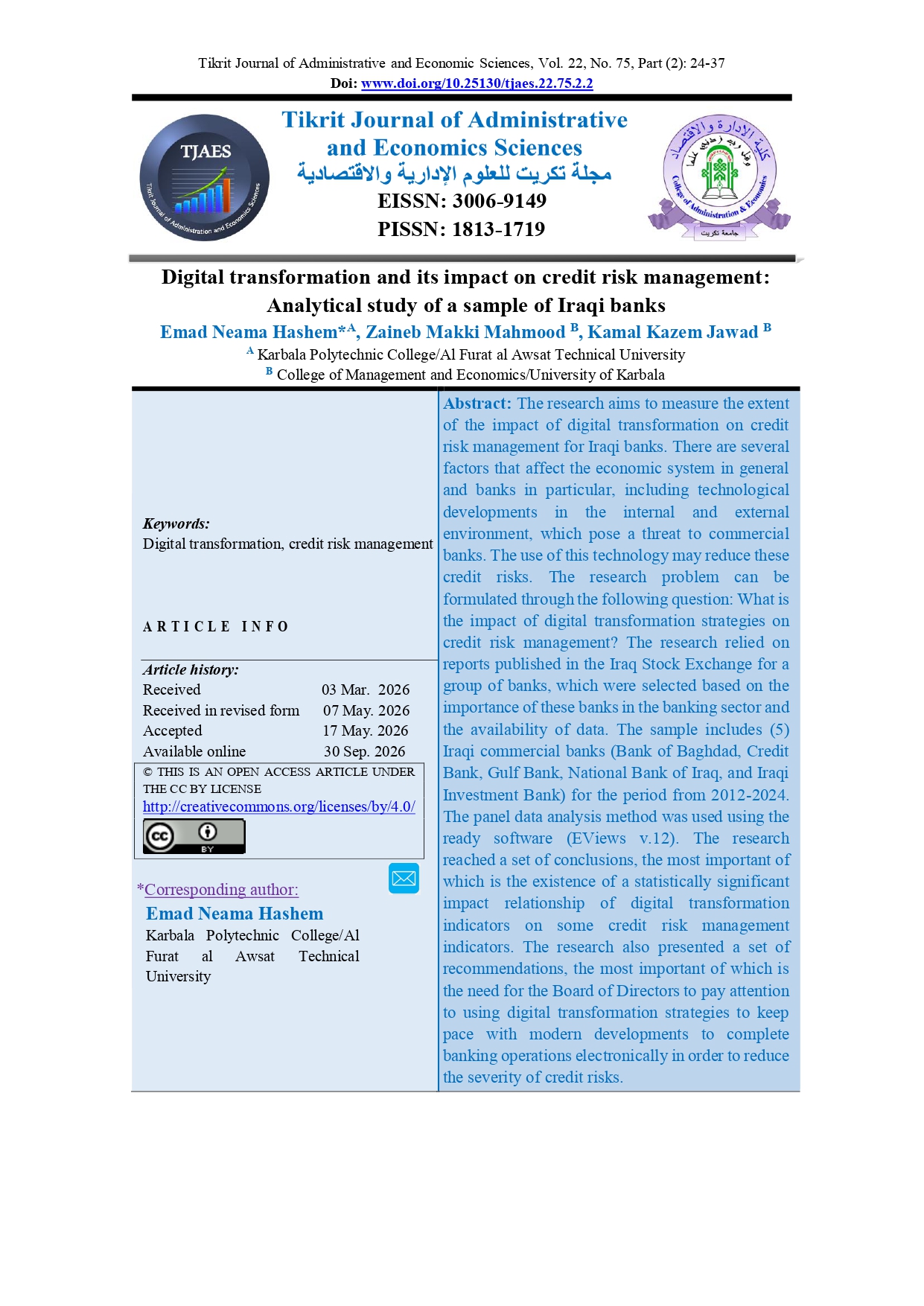
Digital transformation and its impact on credit risk management: Analytical study of a sample of Iraqi banks
Article Sidebar
THIS IS AN OPEN ACCESS ARTICLE UNDER THE CC BY LICENSE
Main Article Content

Abstract
The research aims to measure the extent of the impact of digital transformation on credit risk management for Iraqi banks. There are several factors that affect the economic system in general and banks in particular, including technological developments in the internal and external environment, which pose a threat to commercial banks. The use of this technology may reduce these credit risks. The research problem can be formulated through the following question: What is the impact of digital transformation strategies on credit risk management? The research relied on reports published in the Iraq Stock Exchange for a group of banks, which were selected based on the importance of these banks in the banking sector and the availability of data. The sample includes (5) Iraqi commercial banks (Bank of Baghdad, Credit Bank, Gulf Bank, National Bank of Iraq, and Iraqi Investment Bank) for the period from 2012-2024. The panel data analysis method was used using the ready software (EViews v.12). The research reached a set of conclusions, the most important of which is the existence of a statistically significant impact relationship of digital transformation indicators on some credit risk management indicators. The research also presented a set of recommendations, the most important of which is the need for the Board of Directors to pay attention to using digital transformation strategies to keep pace with modern developments to complete banking operations electronically in order to reduce the severity of credit risks.
Downloads
Article Details
References
Allen, F., A. Demiurgic-Kunt, A. L. Klapper, and M. S. Martinez Peria. 2016. “The Foundations of Financial Inclusion: Understanding Ownership and use of Formal Accounts.” Journal of Financial Intermediation.
Berghaus, S, (2018) " The Fuzzy Froth End of Digital Transformation: Activities and Approaches for Initiating Organizational Change Strategies " Dissertation of The University Of ST, Germany.
Berghaus, S., & Back, A. (2016). Stages in digital business transformation: Results of an empirical maturity study.
Bouncken, R. B., Kraus, S., & Roig-Tierno, N. (2021). Knowledge and innovation-based business models for future growth: Digitalized business models and portfolio considerations. Review of Managerial Science, 15(1).
Ebert C. & Henrique C. (2021). “Digital Transformation” IEEE Software. 60(2).
Greuning, Hennie V. & Bratanovic, Sonja B., Analyzing Banking Risk: A Framework for Assessing Corporate Governance and Financial Risk,3rd Edition, Washington, D.C. ,2009.
Demirkan, H., Spohrer, J. C., & Welser, J. J. (2016). Digital innovation and strategic transformation. It Professional, 18(6), 14-18.
Fayad, M., Sanchez, H. A., Hegde, S. G., Basia, A., & Vakil, A. (2015). Software patterns, knowledge maps, and domain analysis. CRC Press.
Odimarha, A. C., Ayodeji, S. A., & Abaku, E. A. (2024). The role of technology in supply chain risk management: Innovations and challenges in logistics. Magna Scientia Advanced Research and Reviews, 10(2).
Poudel, R. P. S. (2012). The impact of credit risk management on financial performance of commercial banks in Nepal. International Journal of arts and commerce, 1(5).
Teubner RA (2013) Information Systems Strategy. Bus Inf Syst Eng 5 (4).
Wells, A. (2014). Agile management: Strategies for success in rapidly changing times – an Australian university library perspective. IFLA Journal, 40(1).