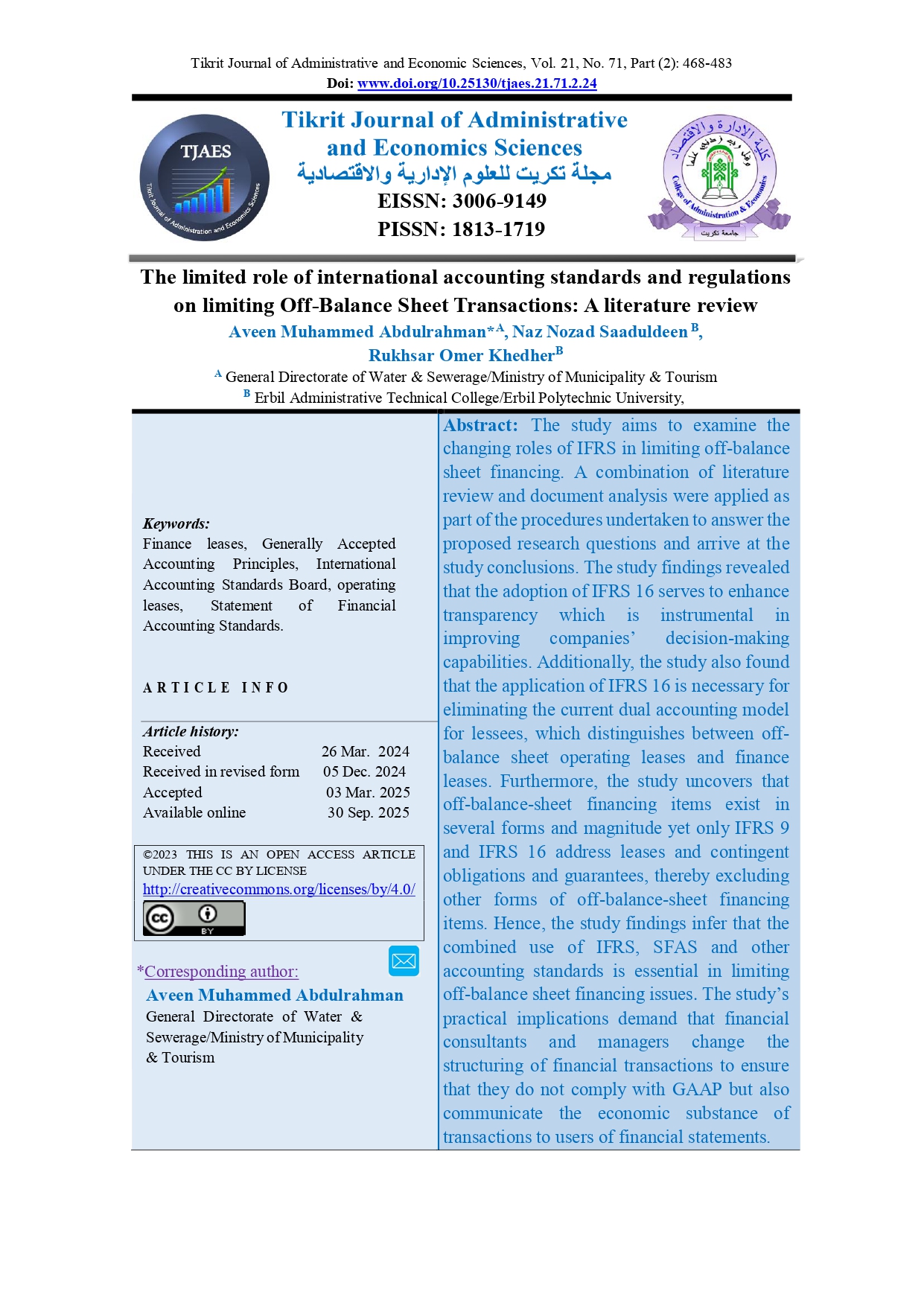
The limited role of international accounting standards and regulations on limiting Off-Balance Sheet Transactions: A literature review
Article Sidebar
THIS IS AN OPEN ACCESS ARTICLE UNDER THE CC BY LICENSE
Main Article Content

Abstract
The study aims to examine the changing roles of IFRS in limiting off-balance sheet financing. A combination of literature review and document analysis were applied as part of the procedures undertaken to answer the proposed research questions and arrive at the study conclusions. The study findings revealed that the adoption of IFRS 16 serves to enhance transparency which is instrumental in improving companies’ decision-making capabilities. Additionally, the study also found that the application of IFRS 16 is necessary for eliminating the current dual accounting model for lessees, which distinguishes between off-balance sheet operating leases and finance leases. Furthermore, the study uncovers that off-balance-sheet financing items exist in several forms and magnitude yet only IFRS 9 and IFRS 16 address leases and contingent obligations and guarantees, thereby excluding other forms of off-balance-sheet financing items. Hence, the study findings infer that the combined use of IFRS, SFAS and other accounting standards is essential in limiting off-balance sheet financing issues. The study’s practical implications demand that financial consultants and managers change the structuring of financial transactions to ensure that they do not comply with GAAP but also communicate the economic substance of transactions to users of financial statements.
Downloads
Article Details
References
Abor, J. Y., Gyeke-Dako, A., Fiador, V. O., Agbloyor, E. K., Amidu, M., & Mensah, L. (2019). Off-Balance Sheet Activities. In Money and Banking in Africa (pp. 149-157). Springer, Cham.
Basheer, M. F., Hidthiir, M. H., & Waemustafa, W. (2019). Impact of bank regulatory change and bank specific factors upon off-balance-sheet activities across commercial banks in south Asia. Asian Economic and Financial Review, 9(4), 419-431.
Bielmann, P. (2016). IFRS 16 Leases – Impact on financial institutions. Retrieved from http://blog.kpmg.ch/ifrs-16-leases-impact-on-financialinstitutions/ on 17 July 2022.
Bučková, V. (2010). SPECIAL PURPOSE ENTITIES AS A FORM OF OFFBALANCE SHEET FINANCING. In New Economic Challenges: 2nd International PhD Students Conference. 20. 1. –21. 1. 2010 (pp. 8-15). Masarykova univerzita nakladatelství.
Gorshunov, M. A., Armenakis, A. A., Feild, H. S., & Vansant, B. (2020). The Sarbanes-Oxley Act of 2002: Relationship to magnitude of financial corruption and corrupt organizational cultures. Journal of Management, 21(2), 73.
Gurjar, H., Tripathi, A., & Joshi, M. C. (2021). The bank efficiency through off-balance sheet items’ window: a Malmquist approach. Vision, 25(4), 448-459.
Haq, M., Tripe, D., & Seth, R. (2022). Do Traditional Off-Balance Sheet Exposures Increase Bank Risk?. Journal of International Financial Markets, Institutions and Money, 101627.
James, H. L., & Lirely, R. (2022). The propensity to save: The effect of Sarbanes–Oxley act. Review of Financial Economics, 40(1), 77-96.
Jensen, T., Popowich, W., Hurley, S., Koumarelas, R. S., & Meacher, R. (2007). Fundamental accounting principles. Twelfth. Vol. Twelfth Ca. Toronto: McGraw Hill.
Kangarluei, S. J., Motavasel, M., & Sharifi, R. M. (2012). The Effect of Off-‐balance Sheet Financing on Profitability and Leverage Ratios. Editorial Note Words from the Board of Editor 2 Profile of Authors Included in this Number 3 Information for Contributors 5, 5(1), 1-200.
Ketz, J. E. (2003). Hidden financial risk: Understanding off-balance sheet accounting. John Wiley & Sons.
Kim, T. N., & Xie, Y. (2022). Off-Balance Sheet Disclosure and Leverage Adjustment Speed. Available at SSRN 4166348.
Lander, G. H., & Auger, K. A. (2008). The need for transparency in financial reporting: Implications of off‐balance‐sheet financing and inferences for the future. Journal of Accounting & Organizational Change. 4 (1), 27-46.
Li, Y. (2010). The case analysis of the scandal of Enron. International Journal of business and management, 5(10), 37-41.
Lin, L. (2017). Managing the risks of equity crowdfunding: lessons from China. Journal of Corporate Law Studies, 17(2), 327-366.
Linzy, J. (2022). The Implications of the Sarbanes-Oxley Act of 2002 Twenty Years Later. Southern University College of Business E-Journal, 17(2), 3.
Mills, L. F., & Newberry, K. J. (2005). Firms' off‐balance sheet and hybrid debt financing: Evidence from their book‐tax reporting differences. Journal of Accounting Research, 43(2), 251-282.
Needles, B. E., Powers, M., & Crosson, S. V. (2013). Principles of accounting. Cengage Learning.
Parnes, D. (2022). Banks’ Off-Balance Sheet Manipulations. The Quarterly Review of Economics and Finance.
Paterson, R. (2016). Off balance sheet finance. Springer.
Puuska, T. (2009). STRUCTURING AND OFF-BALANCE SHEET FINANCING OF MORTGAGE CREDIT DERIVATIVES (Master's thesis).
Segura, A., & Zeng, J. (2020). Off-balance sheet funding, voluntary support and investment efficiency. Journal of Financial Economics, 137(1), 90-107.
Van Peursem, K. A., Zhou, M., Flood, T., & Buttimore, J. (2007). Three cases of corporate fraud: an audit perspective.
Weygandt, J. J., Kieso, D. E., Kimmel, P. D., Trenholm, B., Warren, V., & Novak, L. (2019). Accounting Principles, Volume 2. John Wiley & Sons.
Yücel, G., & Adiloglu, B. (2016). Where are these hidden liabilities? IFRS 16–a case of operating lease. Editör: Prof. Dr. Göksel Yücel, 117.
Zhang, J., & Malikov, E. (2022). Off-balance sheet activities and scope economies in US banking. Journal of Banking & Finance, 141, 106534.
Zhao, F., Barua, A., & Kim, J. H. (2021). Consolidation of off-balance sheet entities and investment efficiency. Accounting Research Journal.