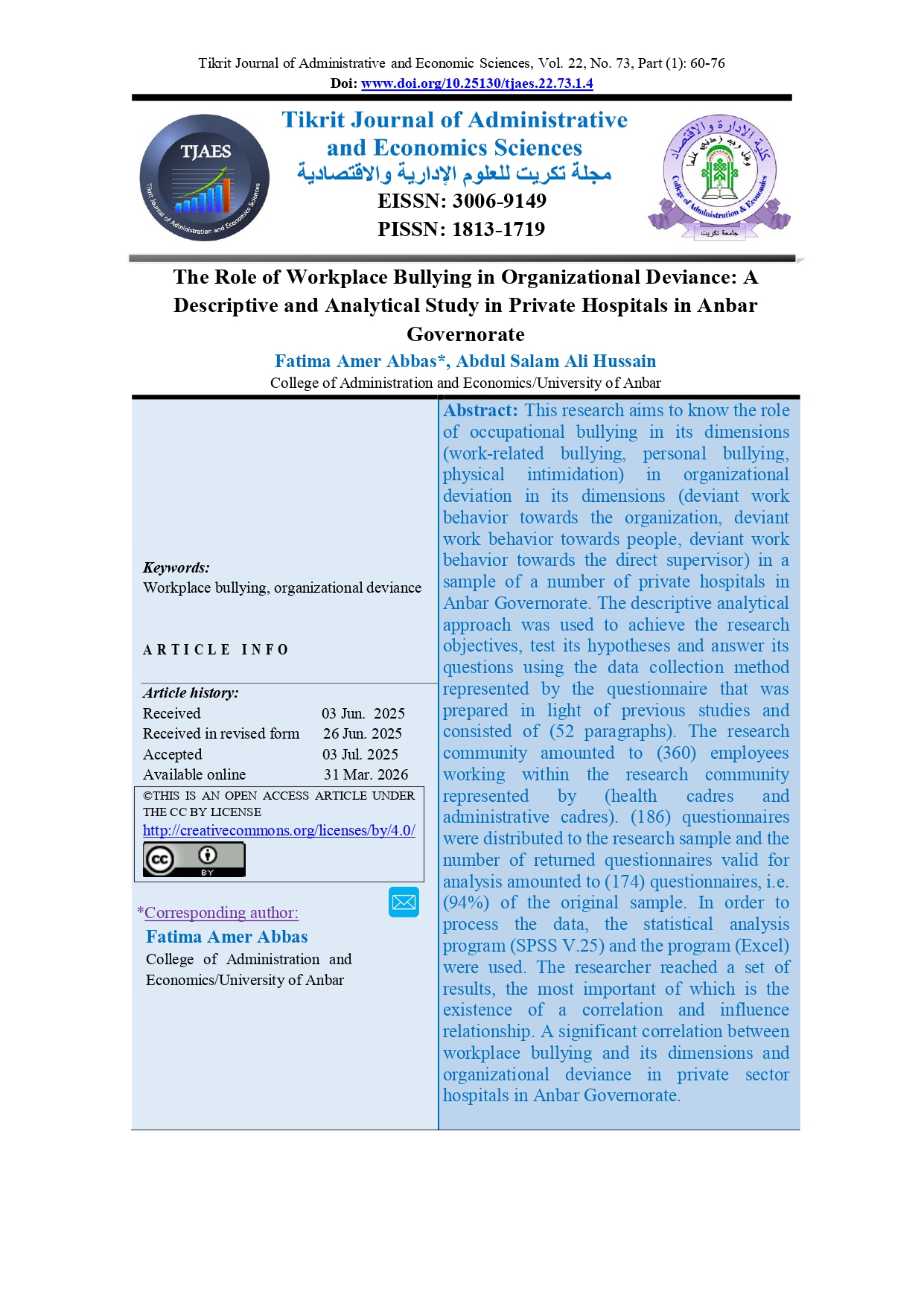
The Role of Workplace Bullying in Organizational Deviance: A Descriptive and Analytical Study in Private Hospitals in Anbar Governorate
Article Sidebar
THIS IS AN OPEN ACCESS ARTICLE UNDER THE CC BY LICENSE
Main Article Content

Abstract
This research aims to know the role of occupational bullying in its dimensions (work-related bullying, personal bullying, physical intimidation) in organizational deviation in its dimensions (deviant work behavior towards the organization, deviant work behavior towards people, deviant work behavior towards the direct supervisor) in a sample of a number of private hospitals in Anbar Governorate. The descriptive analytical approach was used to achieve the research objectives, test its hypotheses and answer its questions using the data collection method represented by the questionnaire that was prepared in light of previous studies and consisted of (52 paragraphs). The research community amounted to (360) employees working within the research community represented by (health cadres and administrative cadres). (186) questionnaires were distributed to the research sample and the number of returned questionnaires valid for analysis amounted to (174) questionnaires, i.e. (94%) of the original sample. In order to process the data, the statistical analysis program (SPSS V.25) and the program (Excel) were used. The researcher reached a set of results, the most important of which is the existence of a correlation and influence relationship. A significant correlation between workplace bullying and its dimensions and organizational deviance in private sector hospitals in Anbar Governorate.
Downloads
Article Details
References
اولاً. المصادر العربية:
ايمان فاضل إسماعيل، (2019)، تأثير الضغط الوظيفي والعدالة في تقليل العمل المنحرف من خلال دور الوسيط للرضا الوظيفي دراسة تطبيقية في الإدارة العامة لإنتاج الطاقة الكهربائية في البصرة. العلوم الاقتصادية، 12 (53).
أحمد قتيبة عبد الله والجرجري، أحمد حسين حسن، (2022)، دور القيادة الرؤيوية في الحد من الانحراف الوظيفي: دراسة الاستطلاعية لآراء عينة من القيادات الإدارية في جامعة الموصل. مجلة تكريت للعلوم الإدارية والاقتصادية، مج. 18، ع. 60، ج. 2، ص. 824-836.
رنا ناصر صبر، (2018)، انعكاس التهكم التنظيمي على السلوك المنحرف للعاملين: بحث استطلاعي لآراء عينة من العاملين في الشركة العامة للصناعات الصوفية. مجلة تكريت للعلوم الإدارية والاقتصادية، مج. 4، ع. 44، ص. 78-98.
سعيد، عبد الرزاق عبد الله، (2022)، التنمر الالكتروني أسبابة وأثاره: دراسة تحليلية لأراء عينه من الموظفين في مديرية تربية كركوك. مجلة تكريت للعلوم الإدارية والاقتصادية، مج.29، ع. 10، ص 272-295
علي أحسان عبد الكريم وعبد الله، أنيس أحمد، (2023)، دور ممارسات إدارة الاحتواء العالي في الحد من التنمر في مكان العمل: دراسة تحليلية لآراء عينة من العاملين في مديرية صحة صلاح الدين. مجلة تكريت للعلوم الإدارية والاقتصادية، مج.19، ع.64، 1، ص. 453- 471.
ثانياً. المصادر الأجنبية:
Ali, Aksu. 2016. “Organizational Deviance and Multi-Factor Leadership.” Educational Research and Reviews 11(8): 589–97. doi:10.5897/err2016.2671.
Alias, Mazni, Roziah Mohd Rasdi, Maimunah Ismail, and Bahaman Abu Samah. 2013. “Predictors of Workplace Deviant Behaviour: HRD Agenda for Malaysian Support Personnel.” European Journal of Training and Development 37(2): 161–82. doi:10.1108/03090591311301671.
Anwar, Muhammad Nadeem. 2011. “Gender Differences in Workplace Deviant Behavior of University.” 4(1): 193–97.
Arshad, Mamoona. 2023. “When Abusive Supervision Increases Workplace Deviance: The Moderating Role of Psychological Safety and Organizational Identification.” LahoreJournal of Business 11(1): 1–26. doi:10.35536/ljb.2023.v11.i1.a1.
Beswick, J., Gore, J., & Palferman, D. (2006). Bullying at work: A review of the literature. Health and Safety Laboratory. Science Group: Human Factors, Buxton, Derbyshire, 14, 1-59.
Dujo López, Víctor, David González Trijueque, José L. Graña Gómez, and José M. Andreu Rodríguez. 2020. “A Psychometric Study of a Spanish Version of the Negative Acts Questionnaire-Revised: Confirmatory Factor Analysis.” Frontiers in Psychology 11(August): 1–13. doi:10.3389/fpsyg.2020.01856.
Elliott, P. P. (1997). Violence in health care. Nursing management, 28(12), 38-42.
Erturk, Abbas, and Lukman Ziblim. 2020. “Is the Perception of Organizational Deviation Affected by the Organizational Climate? Research in Schools.” Eurasian Journal of Educational Research 2020(85): 1–22. doi:10.14689/ejer.2020.85.1.
Einarsen, Staale, Helge Hoel, and Guy Notelaers. 2009. “Measuring Exposure to Bullying and Harassment at Work: Validity, Factor Structure and Psychometric Properties of the Negative Acts Questionnaire-Revised.” Work and Stress 23(1): 24–44. doi:10.1080/02678370902815673.
Erwandi, Dadan, Abdul Kadir, and Fatma Lestari. 2021. “Identification of Workplace Bullying: Reliability and Validity of Indonesian Version of the Negative Acts Questionnaire-Revised (NAQ-R).” International Journal of Environmental Research and Public Health 18(8). doi:10.3390/ijerph18083985.
Fagbohungbe, Bamikole. O., Gabriel A. Akinbode, and Folusho Ayodeji. 2012. “Organizational Determinants of Workplace Deviant Behaviours: An Empirical Analysis in Nigeria.” International Journal of Business and Management 7(5): 207–21. doi:10.5539/ijbm.v7n5p207.
Ferris, D. Lance, Douglas J. Brown, and Daniel Heller. 2009. “Organizational Supports and Organizational Deviance: The Mediating Role of Organization-Based Self-Esteem.” Organizational Behavior and Human Decision Processes 108(2): 279–86. doi:10.1016/j.obhdp.2008.09.001.
Gruys, Melissa L., and Paul R. Sackett. 2003. “Investigating the Dimensionality of Counterproductive Work Behavior.” International Journal of Selection and Assessment 11(1): 30–42. doi:10.1111/1468-2389.00224.
Jan, A., & Husain, S. (2015). Bullying in elementary schools: Its causes and effects on students. Journal of Education and Practice, 6(19), 43-56.
Hershcovis, M. Sandy. 2011. “‘Incivility, Social Undermining, Bullying...Oh My!’: A Call to Reconcile Constructs within Workplace Aggression Research.” Journal of Organizational Behavior 32(3): 499–519. doi:10.1002/job.689.
Hutchinson, M., M. Vickers, D. Jackson, and L. Wilkes. 2006. “Erratum: Workplace Bullying in Nursing: Towards a More Critical Organisational Perspective (Nursing Inquiry (2006) 13,2, (118-126)).” Nursing Inquiry 13(3): 239. doi:10.1002/hpm.848.
Jacob Sunday, Akikibofori. 2014. “The Causes and Impart of Deviant Behaviour in the Work Place.” American Journal of Social Sciences, Arts and Literature 1(2): 1–11. http://ajssal.com/.
Klotz, Anthony C., and M. Ronald Buckley. 2013. “A Historical Perspective of Counterproductive Work Behavior Targeting the Organization.” Journal of Management History 19(1): 114–32. doi:10.1108/17511341311286222.
Kumari, Neeraj, and Devi Singh. 2018. “Impact of Organizational Culture on Employee Performance.” Prabandhan: Indian Journal of Management 11(6): 53–63. doi:10.17010/pijom/2018/v11i6/128442.
Laila, Um e., Salman Iqbal, and Mamoona Rasheed. 2019. “Abusive Supervision and Workplace Deviance: The Moderating Role of Power Distance.” Pakistan Journal of Commerce and Social Sciences 13(2): 311–33.
Lian, Huiwen, D. Lance Ferris, and Douglas J. Brown. 2012. “Does Taking the Good with the Bad Make Things Worse? How Abusive Supervision and Leader-Member Exchange Interact to Impact Need Satisfaction and Organizational Deviance.” Organizational Behavior and Human Decision Processes 117(1): 41–52.
Leymann, H. 1990. “Mobbing and Psychological Terror at Workplaces.” Violence and Victims 5(2): 119–26. doi:10.1891/0886-6708.5.2.119.
Lin, Weipeng, Lei Wang, and Shuting Chen. 2013. “Abusive Supervision and Employee Well-Being: The Moderating Effect of Power Distance Orientation.” Applied Psychology 62(2): 308–29. doi:10.1111/j.1464-0597.2012.00520.x.
Liu, Jun, Ho Kwong Kwan, Long Zeng Wu, and Weiku Wu. 2010. “Abusive Supervision and Subordinate Supervisor-Directed Deviance: The Moderating Role of Traditional Values and the Mediating Role of Revenge Cognitions.” Journal of Occupational and Organizational Psychology 83(4): 835–56. doi:10.1348/096317909X485216.
Madhukar, Vikas, and Sulabh Sharma. 2017. “Organisational Climate: A Conceptual Perspective.” International Journal of Management, IT and Engineering 7(8): 276–93.
Malisetty, Sainath, and K. Vasanthi Kumari. 2016. “An Investigation on Relationship of Deviance Workplace Behavior with Organisational Justice, Abusive Supervision and Work-Family Conflict.” Indian Journal of Science and Technology 9(39): 349–60. doi:10.17485/ijst/2016/v9i39/100449.
Mitchell, Marie S., and Maureen L. Ambrose. 2007. “Abusive Supervision and Workplace Deviance and the Moderating Effects of Negative Reciprocity Beliefs.” Journal of Applied Psychology 92(4): 1159–68. doi:10.1037/0021-9010.92.4.1159.
Nielsen, Karina, Raymond Randall, Ann Louise Holten, and Eusebio Rial González. 2010. “Conducting Organizational-Level Occupational Health Interventions: What Works?” Work and Stress 24(3): 234–59. doi:10.1080/02678373.2010.515393.
Nielsen, Morten Birkeland, Michael Rosander, and Ståle Valvatne Einarsen. 2023. “Witnessing Workplace Bullying — Protocol for a Systematic Review and Meta-Analysis of Individual Health and Well-Being Outcomes.” Systematic Reviews 12(1): 1–8. doi:10.1186/s13643-023-02288-0
Porath, Christine, and Christine Pearson. 2013. “Https://Hbr.Org/2013/01/the-Price-of-Incivility.” Harvard Business Review 01: 1–17. https://hbr.org/2013/01/the-price-of-incivility.
ROBINSON, S. L., and R. J. BENNETT. 1995. “A Typology of Deviant Workplace Behaviors: A Multidimensional Scaling Study.” Academy of Management Journal 38(2): 555–72. doi:10.2307/256693.
Sharma, Naman, and Pratibha Garg. 2017. “Psychological Contract and Psychological Empowerment as Employee Engagement Drivers in Indian It Sector.” International Journal of Applied Business and Economic Research 15(1): 279–87.
Sulaiman, Mohamed, and Omar Khalid Bhatti. 2013. “Workplace Deviance and Spirituality in Muslim Organizations.” Asian Social Science 9(10): 237–46. doi:10.5539/ass.v9n10p237.
Salin, D., & Notelaers, G. (2020). Friend or foe? The impact of high‐performance work practices on workplace bullying. Human Resource Management Journal, 30(2), 312-326.
Smith, Peter K. 2016. “Bullying: Definition, Types, Causes, Consequences and Intervention.” Social and Personality Psychology Compass 10(9): 519–32. doi:10.1111/spc3.12266.
Tepper, Bennett J. 2000. “Consequences of Abusive Supervision.” Academy of Management Journal 43(2): 178–90. doi:10.5465/1556375.
Tambur, Merle, and Maaja Vadi. 2012. “Workplace Bullying and Organizational Culture in a Post-Transitional Country.” International Journal of Manpower 33(7): 754–68. doi:10.1108/01437721211268302.
Tepper, Bennett J., Christine A. Henle, Lisa Schurer Lambert, Robert A. Giacalone, and Michelle K. Duffy. 2008. “Abusive Supervision and Subordinates’ Organization Deviance.” Journal of Applied Psychology 93(4): 721–32. doi:10.1037/0021-9010.93.4.721.
Yıldız, Bora, and Lütfihak Alpkan. 2015. “A Theoretical Model on the Proposed Predictors of Destructive Deviant Workplace Behaviors and the Mediator Role of Alienation.” Procedia - Social and Behavioral Sciences 210: 330–38. doi:10.1016/j.sbspro.2015.11.373.
Yahaya, A., Ing, T. C., Lee, G. M., Yahaya, N., Boon, Y., Hashim, S., ... & Jesus, S. K. C. I. (2012). The impact of workplace bullying on work performance. Archives Des Sciences, 65(4), 18-28.
Zeka, L. (2018). Organizational culture and individuals' experience of workplace bullying.