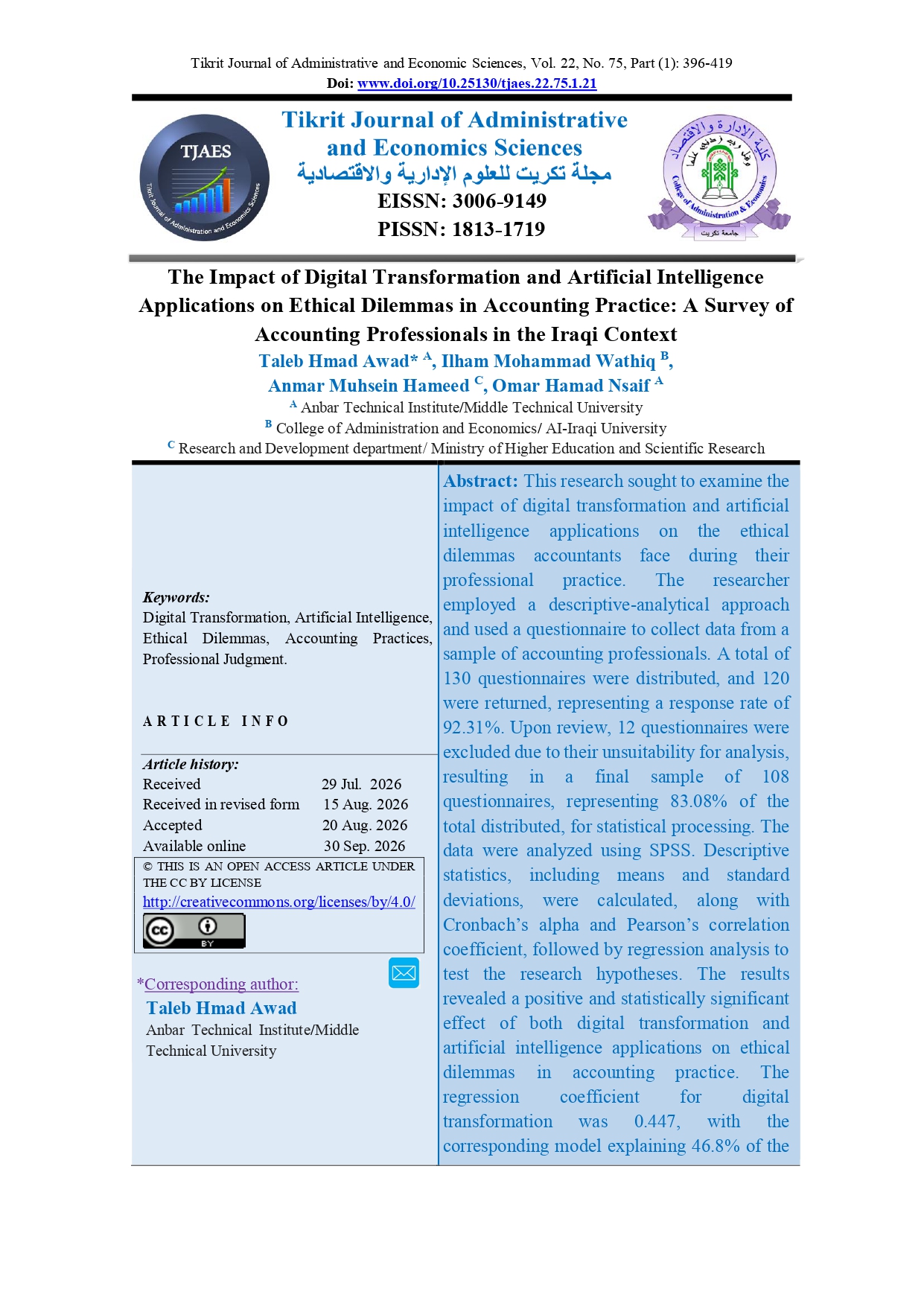
The Impact of Digital Transformation and Artificial Intelligence Applications on Ethical Dilemmas in Accounting Practice: A Survey of Accounting Professionals in the Iraqi Context
Article Sidebar
THIS IS AN OPEN ACCESS ARTICLE UNDER THE CC BY LICENSE
Main Article Content

Abstract
This research sought to examine the impact of digital transformation and artificial intelligence applications on the ethical dilemmas accountants face during their professional practice. The researcher employed a descriptive-analytical approach and used a questionnaire to collect data from a sample of accounting professionals. A total of 130 questionnaires were distributed, and 120 were returned, representing a response rate of 92.31%. Upon review, 12 questionnaires were excluded due to their unsuitability for analysis, resulting in a final sample of 108 questionnaires, representing 83.08% of the total distributed, for statistical processing. The data were analyzed using SPSS. Descriptive statistics, including means and standard deviations, were calculated, along with Cronbach’s alpha and Pearson’s correlation coefficient, followed by regression analysis to test the research hypotheses. The results revealed a positive and statistically significant effect of both digital transformation and artificial intelligence applications on ethical dilemmas in accounting practice. The regression coefficient for digital transformation was 0.447, with the corresponding model explaining 46.8% of the variance in these dilemmas, while the regression coefficient for artificial intelligence applications was 0.480, with the corresponding model explaining 47.4% of the variance. These findings indicate that increasing reliance on digital tools and intelligent systems is associated with a rise in the level of ethical dilemmas perceived by the study sample, particularly those related to confidentiality and data protection, transparency and explainability, bias and fairness, decision accountability, and the preservation of professional judgment. The study concludes by recommending the development of a local professional code of ethics to regulate the use of these technologies in accounting practice, establish controls for data protection, transparency, and accountability, and preserve professional judgment, thereby mitigating the severity of the ethical dilemmas associated with their expanded use.
Downloads
Article Details
References
Abdo-Salloum, A. M., & Chehade, S. (2026). The role of artificial intelligence in transforming accounting and auditing practices: A systematic review. SAGE Open, 16(1).
ACCA. (2024). AI Monitor: Keeping humans in the loop. Association of Chartered Certified Accountants.
Alruwaili, T. F., & Mgammal, M. H. (2025). The impact of artificial intelligence on accounting practices: An academic perspective. Humanities and Social Sciences Communications, 12, 1197.
Appelbaum, D., Kogan, A., & Vasarhelyi, M. A. (2017). Big data and analytics in the modern audit engagement: Research needs. Auditing: A Journal of Practice & Theory, 36(4), 1–27.
Ben Ahmed, D. (2026). The impact of artificial intelligence on accounting information and earnings management: Bibliometric analysis. Journal of Risk and Financial Management, 19(1), 90.
Davenport, T. H., & Ronanki, R. (2018). Artificial intelligence for the real world. Harvard Business Review, 96(1), 108–116.
Djaddang, S., Darmansyah, Suratno, & Sartono. (2026). Digital ethics and moral consequences use of AI in fraud prevention and social accountability impact on the transparency financial reports. JAT: Journal of Accounting and Tax, 4(2), 106–120.
Duska, R. F., Duska, B. S., & Kury, K. W. (2018). Accounting ethics (3rd ed.). John Wiley & Sons.
Floridi, L., Cowls, J., Beltrametti, M., Chatila, R., Chazerand, P., Dignum, V., Luetge, C., Madelin, R., Pagallo, U., Rossi, F., Schafer, B., Valcke, P., & Vayena, E. (2018). AI4People—An ethical framework for a good AI society: Opportunities, risks, principles, and recommendations. Minds and Machines, 28(4), 689–707.
T., Ionescu, C. A., Măgdaș, N., Ștefan, M. C., & Topor, D. I. (2025). Digital transformation of the accounting profession at the intersection of artificial intelligence and ethics. Economics, 19(1), 1–22.
Han, H., Shiwakoti, R. K., Jarvis, R., Mordi, C., & Botchie, D. (2023). Accounting and auditing with blockchain technology and artificial intelligence: A literature review. International Journal of Accounting Information Systems, 48, 100598.
International Ethics Standards Board for Accountants. (2023). 2023 handbook of the International Code of Ethics for Professional Accountants (including International Independence Standards). IFAC.
International Federation of Accountants. (2022). Digital transformation and the role of accounting and finance professionals in this new era. IFAC.
Kokina, J., Blanchette, S., Davenport, T. H., & Pachamanova, D. (2025). Challenges and opportunities for artificial intelligence in auditing: Evidence from the field. International Journal of Accounting Information Systems, 56, 100734.
Maryoush, S. A., Al-Obaidi, I. M. W., & Hamad, M. K. (2025). The relationship between adopting cloud computing technologies to enhance the cybersecurity of accounting information systems and its impact on corporate sustainability. Tikrit Journal of Administrative and Economic Sciences, 21(Special Issue, Part 2), 1134–1172.
Organisation for Economic Co-operation and Development. (2023). OECD AI Principles Overview. OECD.
Raji, I. D., Smart, A., White, R. N., Mitchell, M., Gebru, T., Hutchinson, B., Smith-Loud, J., Theron, D., & Barnes, P. (2020). Closing the AI accountability gap: Defining an end-to-end framework for internal algorithmic auditing. arXiv.
https://doi.org/10.48550/arXiv.2001.00973
Sampaio, C., & Silva, R. (2025). Digital transformation in accounting: An assessment of automation and AI integration. International Journal of Financial Studies, 13(4), 206. https://doi.org/10.3390/ijfs13040206
Schweitzer, B. (2024). Artificial intelligence (AI) ethics in accounting. Journal of Accounting, Ethics & Public Policy, 25(1), 67–103.
https://jaepp.org/index.php/jaepp/article/view/349
Vial, G. (2019). Understanding digital transformation: A review and a research agenda. The Journal of Strategic Information Systems, 28(2), 118–144.
https://doi.org/10.1016/j.jsis.2019.01.003
World Economic Forum. (2024). Governance in the age of generative AI: A 360° approach for resilient policy and regulation. World Economic Forum.
https://www.weforum.org/publications/governance-in-the-age-of-generative-ai/