أثر التمويل الأخضر في تعزيز التنافسية المصرفية: دراسة تطبيقية على القطاع المصرفي العراقي
الشريط الجانبي للمقالة
THIS IS AN OPEN ACCESS ARTICLE UNDER THE CC BY LICENSE
محتوى المقالة الرئيسي

الملخص
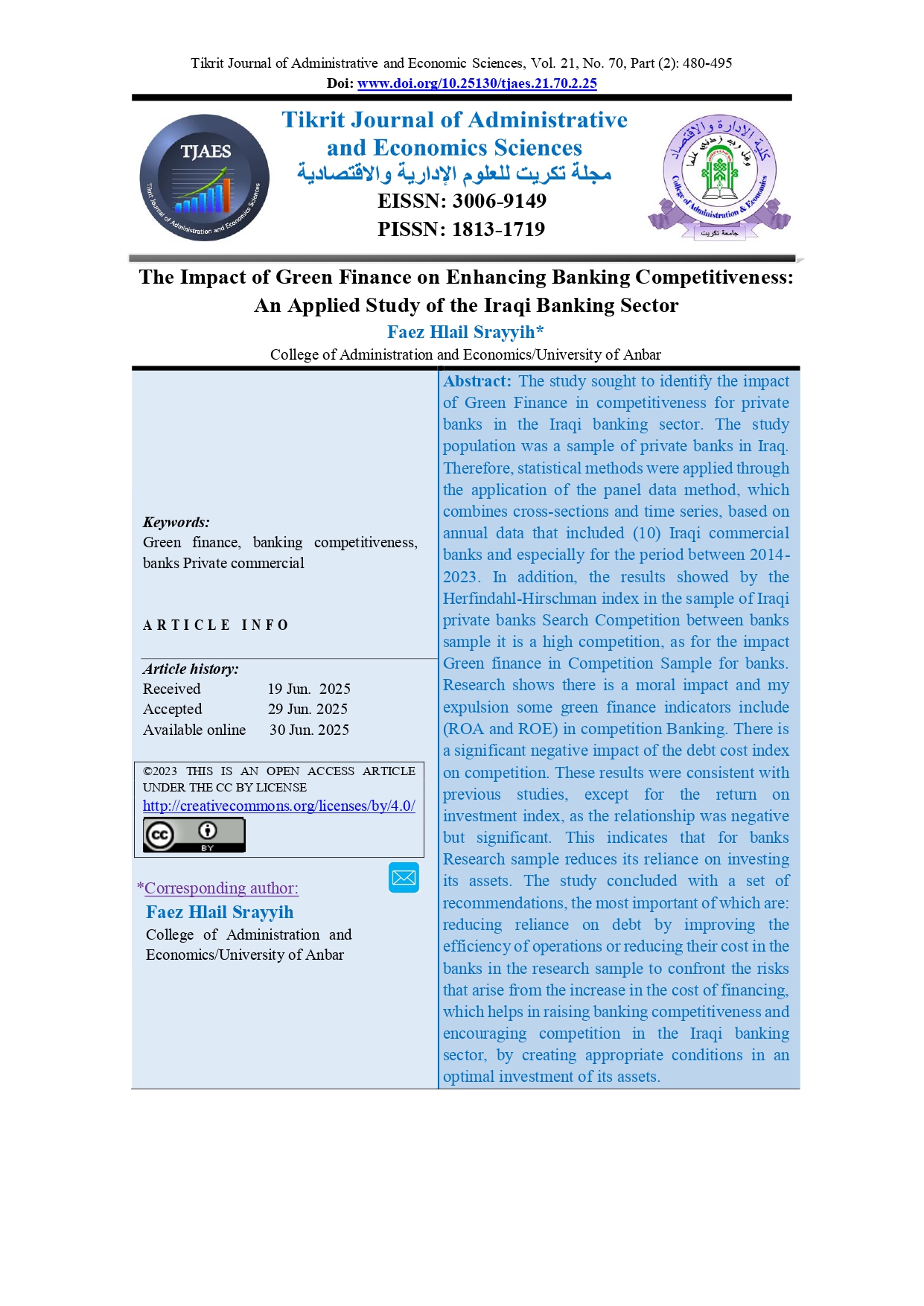
سعت الدراسة إلى تحديد أثر التمويل الأخضر في تعزيز التنافسية لدى المصارف الخاصة ضمن القطاع المصرفي العراقي. وقد تمثلت عينة الدراسة بمجموعة من المصارف التجارية الخاصة العاملة في العراق، حيث تم تطبيق أساليب إحصائية باستخدام منهج (Panel Data) الذي يجمع بين بيانات المقاطع العرضية والسلاسل الزمنية، وذلك بالاعتماد على بيانات سنوية شملت (10) مصارف تجارية عراقية خلال الفترة من 2014 إلى 2023.
أظهرت النتائج، من خلال مؤشر هيرفندال-هيرشمان (Herfindahl-Hirschman Index)، أن مستوى التنافس بين عينة المصارف الخاصة العراقية هو تنافس مرتفع. أما فيما يتعلق بتأثير التمويل الأخضر في التنافسية المصرفية لعينة المصارف، فقد بينت النتائج وجود تأثير معنوي لبعض مؤشرات التمويل الأخضر مثل العائد على الأصول (ROA) والعائد على حقوق الملكية (ROE) في التنافس المصرفي. كما أظهرت النتائج وجود تأثير سالب معنوي لمؤشر تكلفة الدين على التنافسية، وهو ما يتوافق مع نتائج دراسات سابقة، باستثناء مؤشر العائد على الاستثمار، إذ كانت العلاقة سالبة ولكنها ذات دلالة إحصائية، مما يشير إلى أن المصارف ضمن عينة الدراسة تقلل من اعتمادها على استثمار أصولها.
وقد خلصت الدراسة إلى مجموعة من التوصيات، كان من أبرزها ضرورة تقليل الاعتماد على التمويل بالديْن من خلال رفع كفاءة العمليات أو خفض كلفتها لدى المصارف المشمولة بالدراسة، وذلك لمواجهة المخاطر الناجمة عن ارتفاع تكلفة التمويل، بما يُسهم في تعزيز التنافسية المصرفية وتشجيع المنافسة في القطاع المصرفي العراقي، من خلال تهيئة الظروف المناسبة للاستثمار الأمثل.
التنزيلات
تفاصيل المقالة
المراجع
Aithal, A. (2023). Enhancing banking competitiveness through artificial intelligence: A strategic approach. Journal of Financial Innovation, 10(2), 55–68.
Al-Qaisi, K. M., & Al-Rfou, AN (2015). The impact of banking sector competitiveness on economic growth: Empirical evidence. International Journal of Economics and Finance, 7(12), 45–54.
Baharudin, B. S., & Arifin, Z. (2023). The Effect of Green Finance on Bank Value: A Case from Indonesia. Journal of Social Research, 2(8), 2817–2825. https://doi.org/10.55324/josr.v2i8.1354
Baharudin, B. S., & Arifin, Z. (2023). The Effect of Green Finance on Bank Value: A Case from Indonesia. Journal of Social Research, 2(8), 2817–2825. https://doi.org/10.55324/josr.v2i8.1354
Baharudin, N. H., & Arifin, A. Z. (2023). Green finance and environmental sustainability: A bibliometric analysis. Journal of Cleaner Production, 399, 136-148
Bikker, J. A., & Haaf, K. (2002). Competition, concentration and their relationship: An empirical analysis of the banking industry. Journal of Banking & Finance, 26(11), 2191–2214.https://doi.org/10.1016/S0378-4266(02)00205-4
Claessens, S., & Laeven, L. (2004). What drives bank competition? Some international evidence. Journal of Money, Credit and Banking, 36(3), 563–583.https://doi.org/10.1353/mcb.2004.0044
Gafoor, C. P., Perumbalath, S., Daimari, P., & Naheem, K. T. (2024). Trends and patterns in green finance research: A bibliometric study. Innovation and Green Development, 3, 100119.https://doi.org/10.1016/j.igd.2023.100119Zhang, Y., Gao, K.,
He, L., Zhang, Y., & Li, W. (2019). The effect of green finance on sustainable energy development: A case study in China. Sustainability, 11(20), 5595.https://doi.org/10.3390/su11205595
Koball, T., Wagner, R., & Schmidt, L. (2024). Cybersecurity threats in AI-driven banking systems: Governance and defense mechanisms. Journal of Digital Finance Security, 12(1), 99–115.
Kovačević, L., Janković, M., & Radosavljević, M. (2023). Role of AI in banking transformation: From chatbot to intelligent systems. Banking Technology Review, 18(1), 32–45.
OECD. (2011). Bank competition and financial stability. OECD Publishing.https://www.oecd.org/finance/financial-markets/48501035.pdf
Porter, M.E. (1985). Competitive Advantage: Creating and Sustaining Superior Performance. Free Press.
Radenković, B., Nikolić, N., & Marković, I. (2023). Machine learning in banking: A new era of financial intelligence. International Journal of Data Science, 7(4), 210–225.
Schaeck, K., & Cihak, M. (2012). Banking competition and capital ratios. European Financial Management, 18(5), 836–866. https://doi.org/10.1111/j.1468-036X.2011.00652.x
Urban, M. A., & Wójcik, D. (2019). Dirty banking: Probing the gap in sustainable finance. Sustainability, 11(6), 1745.https://doi.org/10.3390/su11061745
Urban, M. A., & Wójcik, D. (2019). Dirty banking: Probing the gap in sustainable finance. Sustainability, 11(6), 1745.https://doi.org/10.3390/su11061745
Wang, T., Chi, S., Cui, K., & Wen, C. (2025). The development, regional differences, and dynamic evolution of China’s Green Finance in the context of “Carbon Peaking and Carbon Neutrality”. International Review of Economics and Finance, 100, 104100.https://doi.org/10.1016/j.iref.2025.104100
Zhang, C., Zhou, B., & Wang, Y. (2021). When green finance meets banking competition: Evidence from hard-to-abate enterprises of China. Pacific-Basin Finance Journal, 68, 101954.https://doi.org/10.1016/j.pacfin.2023.101954
Zhang, C., Zhou, B., & Wang, Y. (2021). When green finance meets banking competition: Evidence from hard-to-abate enterprises of China. Pacific-Basin Finance Journal, 68, 101954.https://doi.org/10.1016/j.pacfin.2023.101954
Zhou, B., & Zhang, C. (2023). When green finance meets banking competition: Evidence from hard-to-abate enterprises of China. Pacific-Basin Finance Journal, 78, 101954.https://doi.org/10.1016/j.pacfin.2023.101954