دور القيادة الريادية مدخلا لتحقيق البراعة التنظيمية في المنظمات الدولية في مدينة أربيل
الشريط الجانبي للمقالة
THIS IS AN OPEN ACCESS ARTICLE UNDER THE CC BY LICENSE
محتوى المقالة الرئيسي

الملخص
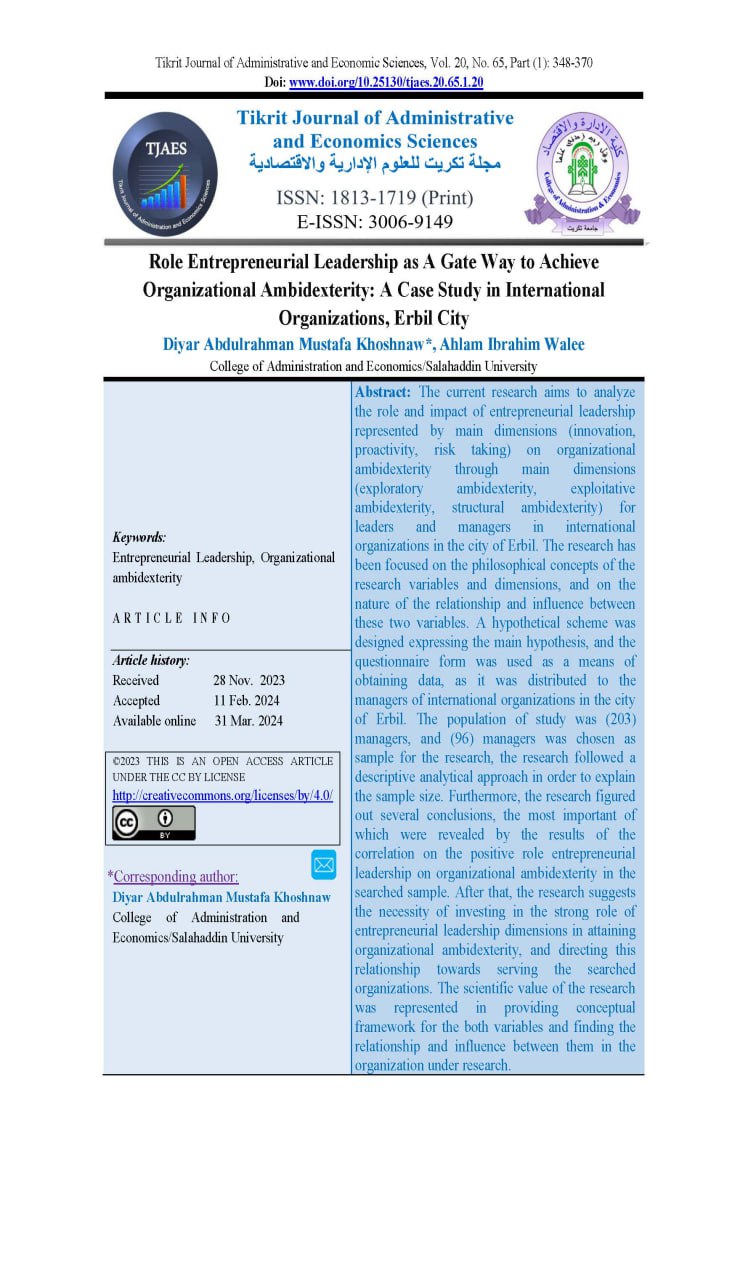
يهدف البحث الحالي إلى تحليل دور وأثر القيادة الريادية ممثلة بالأبعاد الرئيسية (الابتكار، الاستباقية، تحمل المخاطر) على البراعة التنظيمية من خلال الأبعاد الرئيسية (البراعة الاستكشافية، البراعة الاستغلالية، البراعة الهيكلية) للقادة والمديرين في المنظمات الدولية في العالم مدينة أربيل، لقد تم التركيز على المفاهيم الفلسفية لمتغيرات البحث وأبعادها وعلى طبيعة العلاقة والتأثير بين هذين المتغيرين تم تصميم مخطط افتراضي معبر عن الفرضية الرئيسة، وتم استخدام استمارة الاستبيان كوسيلة للحصول على البيانات، حيث تم توزيعها على مدراء المنظمات الدولية في مدينة أربيل بلغت مجتمع البحث بـ (203) مديرًا فيما تم اختيار (96) منهم كعينة البحث.
اتبع البحث المنهج الوصفي التحليلي لتوضيح حجم العينة، وتوصل إلى عدة استنتاجات من أهمها ما كشفت عنه نتائج العلاقة الارتباطية بين الدور الإيجابي للقيادة الريادية في البراعة التنظيمية لدى عينة البحث، وبعد ذلك يشير البحث إلى ضرورة الاستثمار في الدور القوي لأبعاد القيادة الريادية في تحقيق البراعة التنظيمية، وتوجيه هذه العلاقة نحو خدمة المنظمات المبحوثة.
التنزيلات
تفاصيل المقالة
المراجع
Cogliser, C. C., & Brigham, K. H. (2004). The intersection of leadership and entrepreneurship: Mutual lessons to be learned. The Leadership Quarterly, 15(6), 771-799.
Urbano, D., Alvarez, C., & Turró, A. (2013). Organizational resources and intrapreneurial activities: an international study. Management Decision, 51(4), 854-870. http://dx.doi.org/10.1108/00251741311326617
Weissbrod, I. (2019). Leadership and Goal Setting for Sustainable Innovation Projects in Large Businesses. In Innovation for Sustainability (pp. 135-155). Palgrave Macmillan, Cham. https://doi.org/10.1007/978-3-319-97385-2_8.
Renko, M., El Tarabishy, A., Carsrud, A. L., & Brännback, M. (2013). Understanding and measuring entrepreneurial leadership style. Journal of small business Management, 53(1), 54-74. https://doi.org/10.1111/jsbm.12086
Venaik, S., & Brewer, P. (2010). Avoiding uncertainty in Hofstede and GLOBE. Journal of international business studies, 41(8), 1294-1315.
Roebuck, C. (2011). Critical Need for Entrepreneurial Leaders during Turbulent Times. Retrieved from transforming organisational & individual performance via entrepreneurial leadership website: http://chrisroebuck.co/blog/critical-need-for-entrepreneurial-leadersduring-turbulent-times
Autio, E., Pathak, S., & Wennberg, K. (2013). Consequences of cultural practices for entrepreneurial behaviors. Journal of International Business Studies, 44(4), 334-362
Zahra, S. A., & Wright, M. (2016). Understanding the social role of entrepreneurship. Journal of management studies, 53(4), 610-629. http://doi: 10.1111/joms.12149.
Zaech, S., & Baldegger, U. (2017). Leadership in start-ups. International Small Business Journal, 35(2), 157-177. https://doi.org/10.1177/0266242616676883
Paudel, S. (2019). Entrepreneurial leadership and business performance. South Asian Journal of Business Studies, 8(3), 348–369. https://doi.org/10.1108/SAJBS-11- 2018-0136.
Widyani, A. A. D., Landra N., Nengah S., Mateus X. & Wayan G. S. (2020). The role of ethical behaviour and entrepreneurial Leadership to improve organizational performance. Cogent business & management, 7:1, 1747827. http://DOI:10.1080/23311975.2020.1747827
IBM (2010). Capitalizing on complexity: Insights from the global chief executive officer study. (Report) Somers, NY: IBM Global Business Services. (Report)
Jones, O., & Crompton, H. (2009). Enterprise logic and small firms: A model of authentic entrepreneurial leadership. Journal of Strategy and Management, 2(4), 329-351.
Giovanni D., & Lovallo D., (2019). Rational entrepreneurs or optimistic martyrs? Some considerations on technological regimes, corporate entries, and the evolutionary role of decision biase.
Esmer, Y., & F, Dayi, (2018). Entrepreneurial leadership: A theoretical framework. Mehmet Akif Ersoy Üniversitesi İktisadi ve İdari Bilimler Fakültesi Dergisi, 4(2), 112-124, http://DOI:0,30798/makuiibf,332570.
Schaltegger, S. & Wagner, M. (2011). Sustainable entrepreneurship and sustainability innovation: categories and interactions. Business Strategy and the Environment, 20(4), 222-237. (September) http://DOI:10.1002/bse.682.
Han, M., & Celly, N. (2008). Strategic ambidexterity and performance in international new ventures. Canadian Journal of Administrative Sciences/Revue Canadienne des Sciences de l'Administration, 25(4), 335-349.
Brem, A. (2017). Creativity and routine: Conceptual considerations on managing organisational ambidexterity in entrepreneurial ventures. International Journal of Entrepreneurship and Innovation Management, 21(3), 261-273.
Nielsen, J. A., Mathiassen, L., & Hansen, A. M. (2018). Exploration and exploitation in organizational learning: A critical application of the 4I model. British Journal of Management, 29(4), 835-850. http://DOI:10.1111/1467-8551.12324.
Kodama, M., (2019). Business Innovation through Holistic Leadership-Developing Organizational Adaptability. Systems Research and Behavioral Science (36), 365–394
March, J. G. (1991). Exploration and exploitation in organizational learning. Organization science, 2(1), 71-87.
Lawrence, T. B., Mauws, M. K., Dyck, B., & Kleysen, R. F. (2005). The politics of organizational learning: Integrating power into the 4I framework. Academy of management review, 30(1), 180-191
Burgelman, R. A. (1991). Intraorganizational ecology of strategy making and organizational adaptation: Theory and field research. Organization science, 2(3), 239-262.