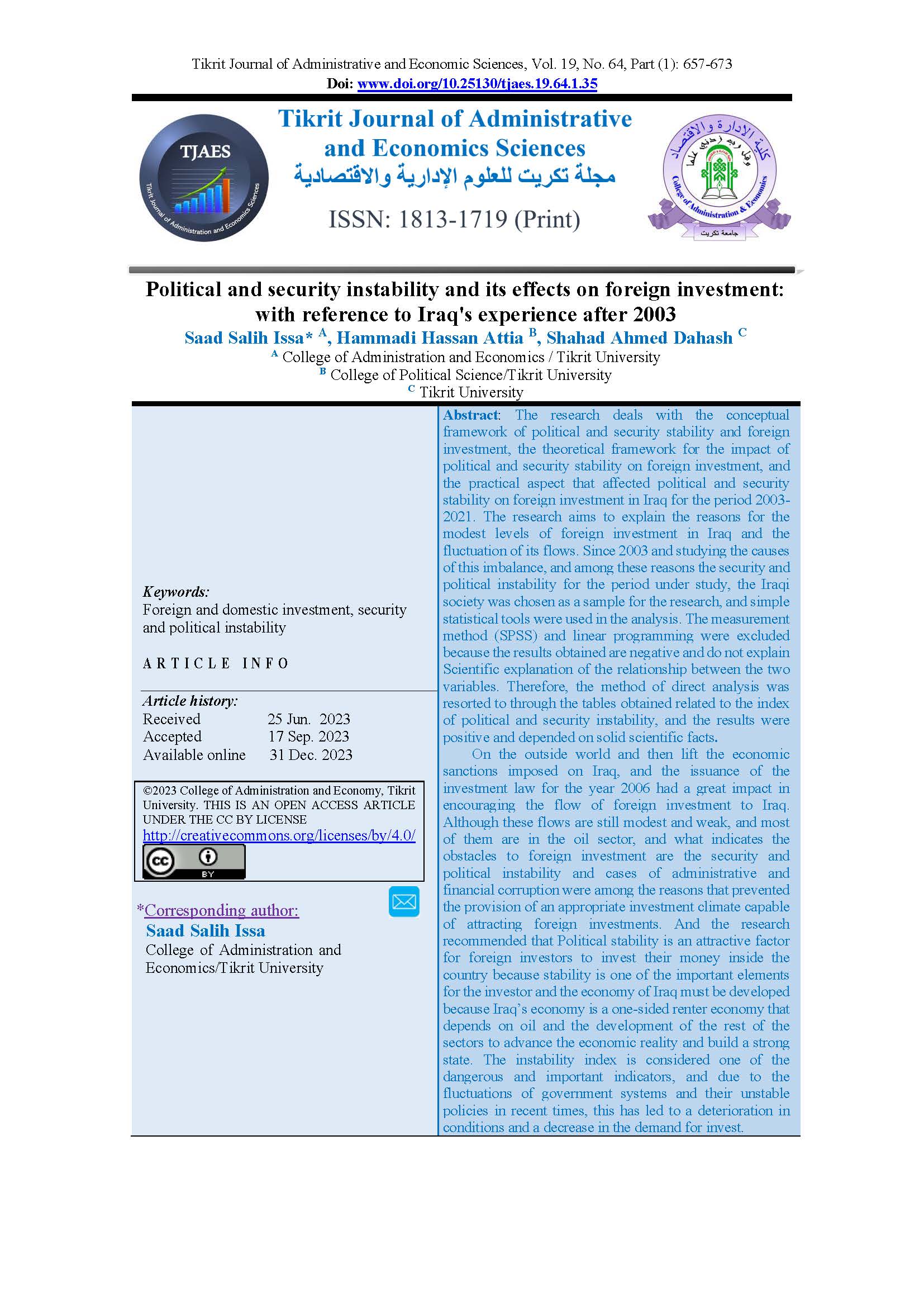
Political and security instability and its effects on foreign investment: with reference to Iraq's experience after 2003
Article Sidebar
THIS IS AN OPEN ACCESS ARTICLE UNDER THE CC BY LICENSE
Main Article Content

Abstract
The research deals with the conceptual framework of political and security stability and foreign investment, the theoretical framework for the impact of political and security stability on foreign investment, and the practical aspect that affected political and security stability on foreign investment in Iraq for the period 2003-2021. The research aims to explain the reasons for the modest levels of foreign investment in Iraq and the fluctuation of its flows. Since 2003 and studying the causes of this imbalance, and among these reasons the security and political instability for the period under study, the Iraqi society was chosen as a sample for the research, and simple statistical tools were used in the analysis. The measurement method (SPSS) and linear programming were excluded because the results obtained are negative and do not explain Scientific explanation of the relationship between the two variables. Therefore, the method of direct analysis was resorted to through the tables obtained related to the index of political and security instability, and the results were positive and depended on solid scientific facts.
On the outside world and then lift the economic sanctions imposed on Iraq, and the issuance of the investment law for the year 2006 had a great impact in encouraging the flow of foreign investment to Iraq. Although these flows are still modest and weak, and most of them are in the oil sector, and what indicates the obstacles to foreign investment are the security and political instability and cases of administrative and financial corruption were among the reasons that prevented the provision of an appropriate investment climate capable of attracting foreign investments. And the research recommended that Political stability is an attractive factor for foreign investors to invest their money inside the country because stability is one of the important elements for the investor and the economy of Iraq must be developed because Iraq’s economy is a one-sided renter economy that depends on oil and the development of the rest of the sectors to advance the economic reality and build a strong state. The instability index is considered one of the dangerous and important indicators, and due to the fluctuations of government systems and their unstable policies in recent times, this has led to a deterioration in conditions and a decrease in the demand for invest.
Downloads
Article Details
References
Aziz, Fawzia Khada Karam, The Impact of Political Instability on Economic Development in Iraq, Al-Ustad Magazine, Volume Two, No. 207, (University of Baghdad: 2013).
Al-Zamili, Majid Ahmed, Security and Political Stability and its Impact on Development, 2022, https://2u.pw/UJPyXx, accessed 2/15/2023
Al-Rafi’i, Iftikhar, The Investment Climate in Iraq, Reality and Ambition, Cihan University Scientific Journal, Volume 1, Issue 3
Al-Shammari, Abdul Rahman, The Effects of Economic and Political Obstacles on the Flow of Foreign Direct Investment in Iraq (An Analytical Study 2003-2014), Suez Canal University, Faculty of Commerce, Volume 8, Number 5 2017.Sheikha, Muhammad Ghiyath, Investment, first edition, (Dar Raslan, 2021).
Saif Abdul-Jabbar and Mustafa Muhammad Riyad, foreign investments in Iraq and their role in economic development, Journal of the University College of Economic Sciences, Baghdad (Iraq: 2013).
Saleh Nasser, Political Instability Concept and Indicators, Egyptian Institutefor Studies, Political Studies, (Turkey: 2019).
Ibrahim, Saadi, Political instability in Iraq after 2003, 2018.
Saber, Ali Sabah, The American Occupation of Iraq and the Problem of State Building, (2003-2014), Master Thesis, College of Arts and Sciences, Department of Political Sciences, Middle East University, 2015.
Zain Al-Abidin Muhammad Abdul-Hussein and Sadeq Ali Hussein, The Iraqi Economy after 2003, A Study in Reality and Future Strategies, Al-Rafidain Center for Dialogue, 2020.
Al-Zaini, Muhammad, The Iraqi economy, the current reality and future challenges, Emirates Center for Strategic Studies and Research.
Qasim, Sahar, the mechanisms that must be provided for the transition of Iraq from a planned economy to a market economy, Central Bank of Iraq, 2011.
Suhair Ibrahim and Sobhi Abdel Ghafour, Improving the investment climate in developing countries, with reference to Iraq, Anbar University Journal of Economic and Administrative Sciences, Volume 6, Number 11, (Iraq: 2014).
Data.albankaddawli.org/indicator/BX
Ministry of planning, central statistical organization CSO, annual ST.